
For working-class families across Michigan, the question of who speaks for them at the ballot box is no longer a simple one. The United Auto Workers union — long a pillar of Democratic support in one of America’s most competitive political battlegrounds — is fighting to win back the trust of its own members ahead of the Nov. 3 midterms.
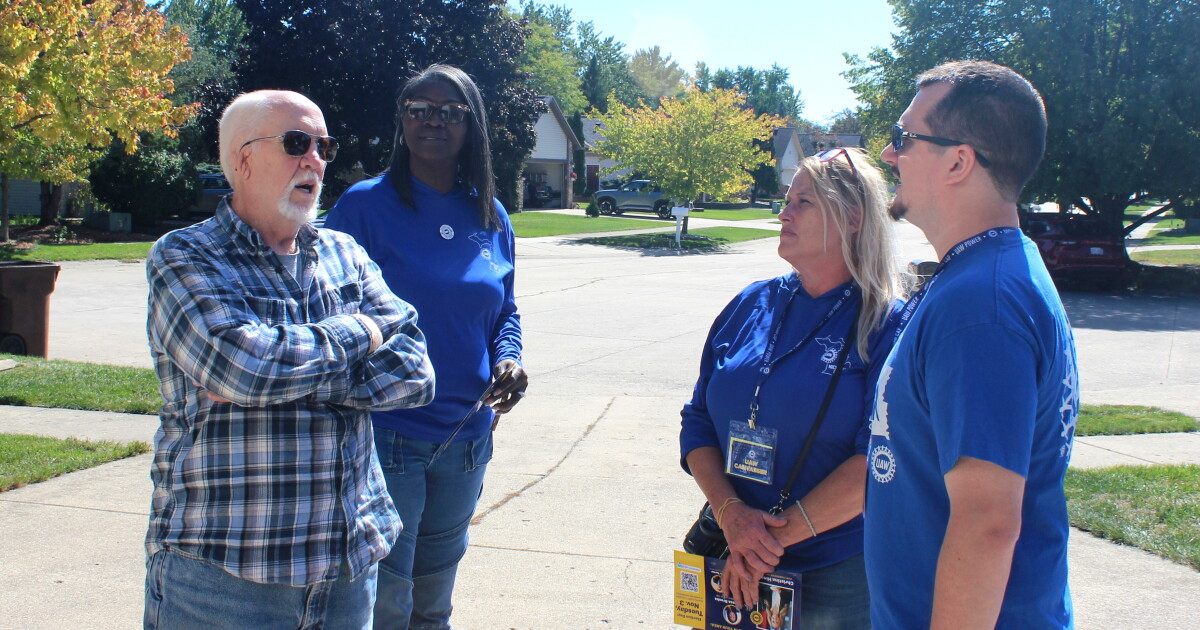
On a recent Saturday morning in Macomb County, UAW canvassers knocked on doors in a quiet suburban neighborhood north of Detroit. They were met with a familiar mix of support, skepticism, and outright refusal — a snapshot of just how divided union households have become over cost of living concerns and which political party can actually deliver for everyday workers.
Walter Usakowski, a retired worker from Ford Motor Co.’s Sterling Axle Plant, didn’t need much convincing. He was already on board with the union’s slate of Democratic candidates when canvassers found him mowing his lawn. But he was candid about the challenge ahead: after more than 45 years on the shop floor, he knows plenty of fellow members who cast their ballots for Republican President Donald Trump.
“I think the UAW members now are starting to fall a little more in line,” Usakowski said.
Still, he wasn’t certain how many of his former coworkers would follow.
A Union Divided Over Pocketbook Issues
The broader political rifts running through the country are cutting right through union halls. In Macomb County — where Trump won by nearly 14 percentage points in 2024 — canvassers encountered retirees and working members who largely agreed that affordability was their top concern, but couldn’t agree on which party would better address it. One resident blamed billionaires for the country’s economic struggles and planned to vote Democratic. A couple on the next block said they both supported Trump and turned down a flyer listing UAW-endorsed candidates.
That split reflects a national trend. In 2024, voters who were union members — or lived in households with one — split between Trump and Democratic nominee Kamala Harris, with just over half backing Harris and 44% voting for Trump. Trump’s anti-establishment message and promises to shake up international trade deals — which many factory workers blamed for gutting American manufacturing jobs — resonated with a significant chunk of union households.
Betty Anderson, a UAW member, believes the union is heading in the right direction. But she’s frustrated by the divide and skeptical it can be healed.
“I don’t think those people are ever going to be on our side,” Anderson said. “They think they have an opportunity to be in an elite class.”
Corruption Scandals Left Deep Scars
The UAW’s ability to unite its members politically is complicated by a troubled recent past. Since 2017, more than 10 UAW officials have pleaded guilty in a federal corruption investigation that found millions of dollars in union dues had been stolen. Members also grew disillusioned with closed-door contract negotiations they felt shut them out entirely.
Shawn Fain was elected UAW president in 2023 on a platform of transparency, and his leadership helped secure victories in labor disputes with Detroit’s three major automakers — wins that union leaders hope have rebuilt enough goodwill to turn out voters this November. Fain announced on Friday that he had won reelection to lead the union for another four years, though the results have not yet been certified.
JJ Jewell, a member of the UAW’s Community Action Program executive committee and one of the canvassers working Macomb County, offered a measured take on what lies ahead.
“It’s not going to be an overnight thing,” Jewell said. “Even if this election goes fantastically, that’s not mission accomplished. That means we’re 1% of the way done.”
The Senate Race and What’s at Stake for Auto Workers
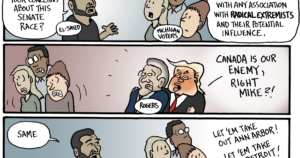
The UAW threw its support behind progressive Democrat Abdul El-Sayed in the U.S. Senate primary, a choice that surprised many political observers. The union passed over rival Haley Stevens, a four-term congresswoman who had served as chief of staff on an auto bailout task force during the Great Recession — a credential she leaned on heavily during her campaign. Instead, the UAW cited El-Sayed’s support for universal healthcare and his criticism of corporate money in politics.
Mark DePaoli, director of one of the UAW’s southeast Michigan regions, said the process was open to all members.
“I don’t think anybody expected us to endorse him,” DePaoli said.
El-Sayed wore a UAW pin during his first Senate debate against Republican opponent and former U.S. Rep. Mike Rogers. His campaign credited the union’s backing with helping him win a competitive primary.
“The UAW’s backing of Abdul was critical in winning a historic primary despite being outspent by tens of millions of dollars, and will be just as critical in winning” next month, said Cole Wozniak, a spokesperson for El-Sayed.
Rogers, meanwhile, is focusing on his opposition to federal regulations that would have required automakers to ramp up production of electric vehicles — a mandate some in the auto industry warned could lead to factory closures and job losses.
“Mike knows the challenges our autoworkers face, and he’ll be their champion in the U.S. Senate,” said Rogers spokesperson Alyssa Brouillet. “The same can’t be said for Abdul and UAW national leadership.”
Shrinking Membership, Growing Stakes
The UAW’s political clout depends heavily on its ability to get members to the polls — and that task has become harder as its ranks have thinned. In the 1980s, the union counted more than 600,000 active and retired members in Michigan. Today, that number sits around 350,000. Despite the decline, the UAW remains the largest union in the state.
Robert Bruno, a professor in the School of Labor and Employment Relations at the University of Illinois Urbana-Champaign, put it plainly:
“You don’t win campaigns off of your endorsements,” Bruno said. “You win campaigns at the door, or at the bar, or at the union hall.”
Union leaders say they’re putting that philosophy into action. About 113,000 members voted early during Michigan’s August primary, according to the UAW, and hundreds of volunteers are canvassing neighborhoods and calling voters ahead of Election Day. In September, the union held a conference of its Michigan political arm for the first time since 2018, with Fain telling reporters the organization wants its members driving the agenda — especially on issues like affordability and the cost of everyday life.
“We are as active as we can be right now,” Fain said.
For union voters in Michigan, the coming weeks will test whether shared economic anxiety is enough to bridge deep political divides — and whether the UAW can deliver not just endorsements, but actual votes, when it matters most. More on Michigan’s politics and government coverage, including the politics behind presidential visits with the UAW and what a new era for the UAW means, offers important context for understanding the stakes this election cycle. Reporting from Report for America contributed to this story.
Comments are closed.