
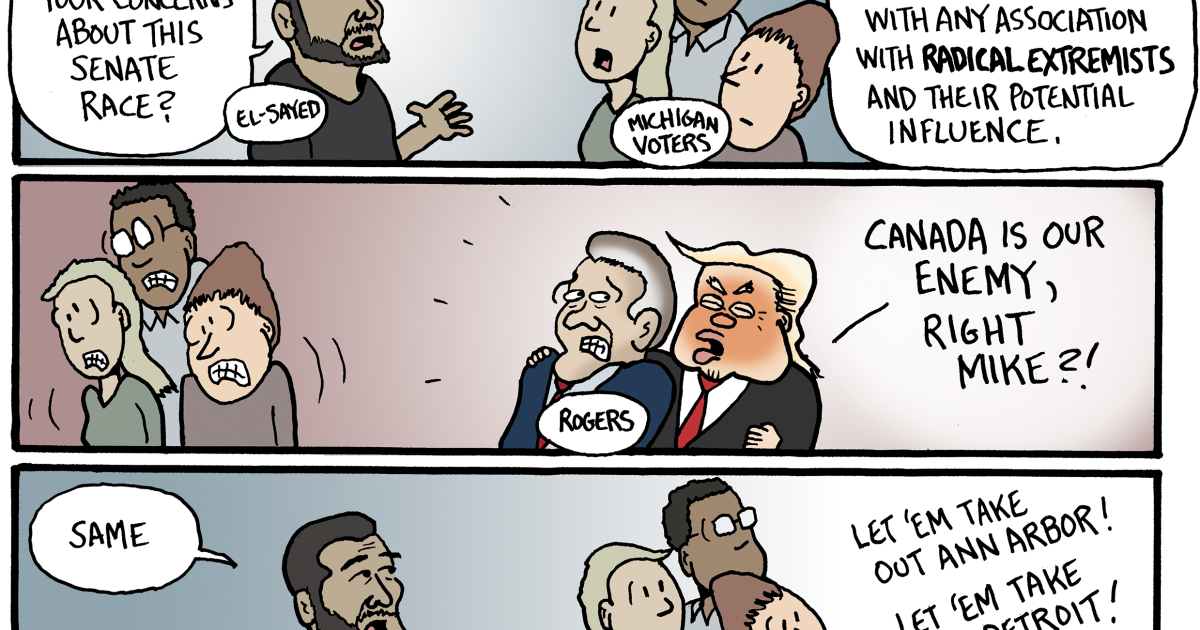
Michigan’s U.S. Senate race is heating up — and so are the political headaches for both major candidates. With the contest between Abdul El-Sayed and Mike Rogers drawing intense scrutiny, each candidate is navigating uncomfortable associations that could shape how Michigan voters make up their minds.
The recent debate between the two candidates has only amplified the pressure, with both campaigns working to define — and distance — themselves from figures who have become liabilities on the campaign trail.
El-Sayed and the Hasan Piker Connection
For El-Sayed, the controversy centers on a past connection to online streamer Hasan Piker, whose widely criticized anti-Israel rhetoric has drawn sharp attention. Piker is not a political heavyweight, but his inflammatory commentary has been enough to put El-Sayed on the defensive with Michigan voters who find those views deeply troubling.
El-Sayed has moved to draw a clear line between himself and Piker, publicly condemning any rhetoric that endangers the Jewish community and clarifying his own positions on antisemitism. Whether that response satisfies voters depends largely on the individual — for some, the distancing is sufficient; for others, the original association raises questions that won’t easily go away.
Rogers and the Trump Problem
Mike Rogers faces a challenge of an entirely different scale. Rather than a fringe internet personality, the figure Rogers is now trying to separate himself from is President Donald Trump himself.
According to political cartoonist John Auchter, writing in his ongoing Auchter’s Art series for Michigan Public, Trump has long operated by his own rules — and that style is now creating friction for Republicans down the ballot. As Auchter put it,
“the horrible things he says and terrible decisions he makes aren’t working well for his Republican underlings.”
Rogers, like many in his party, is now attempting to create separation from the president — a move that carries real political risk. Voters who strongly supported Trump may view the distancing as disloyalty, while those who have grown frustrated with the administration may find the pivot too little, too late. Auchter noted that for
“maybe a few voters, that will work. For most, it will not.”
The dynamics playing out in the Michigan Senate race reflect a broader challenge facing candidates on both sides: associations and alliances that once seemed manageable are now under a microscope. Voters are weighing not just where each candidate stands on policy, but how they handle the baggage that comes with their political networks — and whether the steps taken to address those associations are genuine or merely tactical. Related coverage from Michigan Public includes an examination of Secretary of State candidates clashing over election integrity, a look at Michigan Supreme Court candidate Jody White, and a report on how Michigan traffic stops are contributing to deportations. Earlier Auchter commentary has also explored challenges facing GOP candidates tied to Trump’s economic decisions, concerns about the administration’s trade strategy, and the flood of political attack ads hitting Michigan voters.










Comments are closed.