
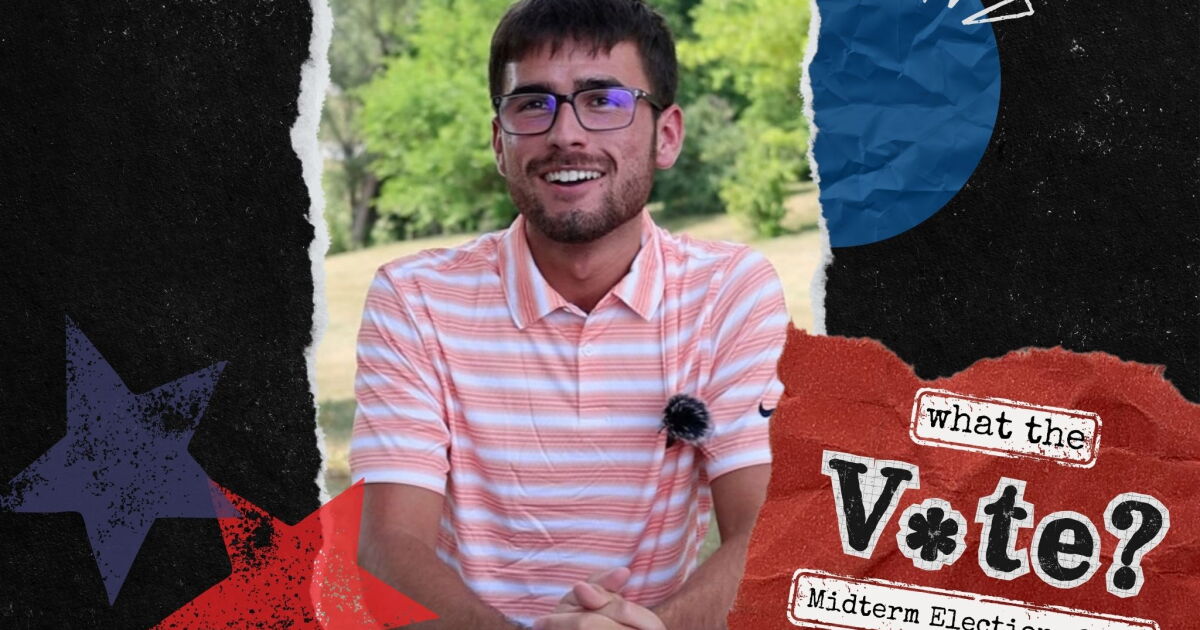
For millions of young Americans, the path to the ballot box runs straight through financial hardship — and for one Michigan college student, that reality is impossible to ignore. The rising cost of living isn’t just squeezing his budget; it’s shaping his entire view of what democracy owes young people, and what young people owe democracy.
Cody Bannick grew up in Bad Axe, a small town in Michigan’s Thumb region where conservative politics dominate the landscape. Now a junior at Wayne State University in Detroit, he has spent his young life navigating two very different political worlds. That cross-cultural experience pushed him toward civic engagement — he’s an active member of Warriors Vote, a Wayne State campus organization focused on mobilizing student voters and building political awareness among young people.
Bannick’s story is part of Michigan Public’s ongoing Stateside series, What the Vote?, which is speaking with some of Michigan’s youngest voters to understand the issues driving them to the polls ahead of the 2026 midterm elections. What Bannick’s experience reveals goes beyond personal politics — it exposes the structural barriers that make it harder for young, low-income, and first-generation voters to fully participate in the democratic process.
When Home and Campus Pull in Opposite Directions
For college students like Bannick, voting isn’t always simple. Students who attend school far from their hometown face a genuine logistical challenge: they may be registered to vote in one county while living in another, forcing a choice between absentee voting and in-person participation — and sometimes navigating confusing registration processes to update their information. Bannick was candid about how politically isolated he feels when he returns to Bad Axe, a community that went overwhelmingly for the Republican ticket in 2024.
“If you look at the map, in 2024, when Trump got elected, it’s very red. I think there’s only a couple people that voted for the candidate Kamala Harris. And, it was very disheartening, you know, because I feel that — where I’m from — everyone is persuaded by their parents.”
That sense of being politically out of step with one’s hometown is common among young voters who leave rural communities for college. Michigan does allow voters to register at their college address, and the state has made strides in same-day voter registration — but awareness of those options is uneven, and organizations like Warriors Vote exist precisely to fill that gap. Campus-based voter mobilization efforts have become a critical part of ensuring that new voters understand their rights and their options.
Bannick sees himself as something of a political outlier in his own family, describing the experience with a mix of humor and resolve.
“It’s kind of like I’m the black sheep of the family, but that’s what makes me different.”
Economic Hardship as a Barrier to Civic Participation
Research consistently shows that economic hardship is one of the strongest predictors of low voter turnout. When people are working multiple jobs, struggling to afford housing, or carrying the financial weight of their households, finding time to register, research candidates, and get to the polls becomes another burden on an already overloaded life. Bannick lives that reality every day.
Coming from a single-parent household, he said there’s no financial safety net waiting for him. When he looked into renting an apartment near campus, the numbers were daunting.
“I was gonna go find an apartment myself and rent was $900. I know my friends are doing it, but their parents are helping them a little bit.”
Without that parental support, Bannick has taken on a level of financial responsibility unusual for someone his age.
“We don’t have that second income that’s coming in. That’s why my mom has to work those 12 hours, and that’s why I’m working 80 hours to help support my mom.”
Working 80 hours a week while attending college full-time leaves little room for civic engagement — yet Bannick is doing it anyway. His situation illustrates why affordability is not just a kitchen-table issue but a democratic one. When economic pressures force young people to prioritize survival over participation, elections lose voices that deserve to be heard.
Young Voters Want to Be Taken Seriously
Beyond the financial pressure, Bannick described a frustration that resonates with many young Americans: the feeling that older generations don’t treat them as credible political participants. This perception — that young voters don’t matter or that their concerns won’t be acted on — is a documented driver of youth voter disengagement. Bannick put it plainly.
“It’s like adults don’t see us younger adults as adults. And I think that we’re all very smart. We’re all very educated. We all believe in different things. And I think that’s why some students don’t feel like they want to vote, because their vote doesn’t matter.”
This kind of civic discouragement is exactly what voter outreach programs aim to counter. When young people believe their vote is meaningless, turnout drops — and election outcomes fail to reflect the full range of public opinion. Ensuring that eligible voters trust the system and feel empowered to participate is a foundational goal of healthy election administration. Michigan Public’s What the Vote? series has also spotlighted other Gen Z voters wrestling with similar questions of political identity and participation, including a Grand Rapids resident who feels her values aren’t reflected in today’s political climate and a young conservative at Michigan State University who sees the American dream slipping away for his generation.
Despite the obstacles, Bannick says his faith and his experiences — straddling rural conservatism and urban progressivism — have reinforced his belief that an open mind is essential. And he is showing up to vote, motivated by something specific: a desire to see the cost of living return to something manageable for working families.
“The reason I’m voting this term, and that I voted last term, is to see change. I really want to see change in the world, because I want our world to go back to how it was three years ago. You know, where things are affordable, families are enjoying life.”
His voice — informed by financial strain, family sacrifice, and a genuine belief in democratic participation — is exactly the kind that election systems must work to include. Whether Michigan’s voter registration infrastructure, campus outreach programs, and polling access are doing enough to reach voters like him is a question worth asking as the 2026 midterms approach. Elsewhere in Michigan’s political landscape, voters and candidates alike are navigating high-stakes races: healthcare costs are driving voters toward Medicare for All, the gubernatorial race is heating up, and election officials are working to reassure voters about election security — all issues that affect whether citizens like Bannick believe casting a ballot is worth their time.
Reporting for Michigan Public’s Stateside series was done by Jaden Jefferson. Related coverage in the What the Vote? series includes reporting by Yeaniva Seisay on a Kalamazoo artist advocating for more opportunities for young people.


![Michigan Leaders Unite to Halve Cancer Deaths with Early Detection Plan[embed]https://www.youtube.com/watch?v=c1CGP0-PD_Y[/embed]](https://realnewsfast.com/wp-content/uploads/2026/10/Michigan-Leaders-Unite-to-Halve-Cancer-Deaths-with-Early-Detection-300x200.jpg "Michigan Leaders Unite to Halve Cancer Deaths with Early Detection Plan[embed]https://www.youtube.com/watch?v=c1CGP0-PD_Y[/embed]")

Comments are closed.