
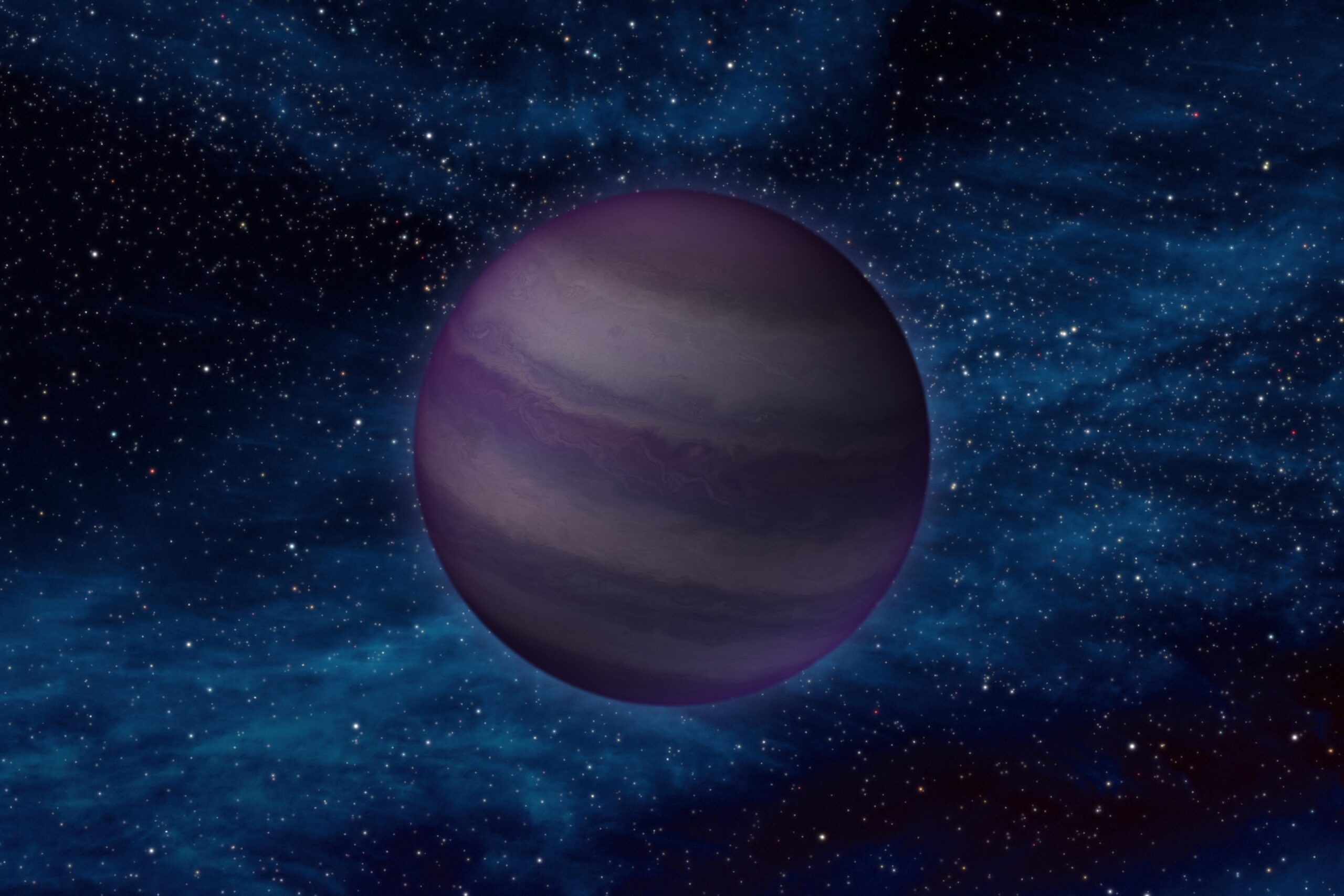
Astronomers Uncover Earth-Like Weather on Nearby Brown Dwarf
In a breakthrough discovery, scientists have observed an intriguing world just 7.5 light-years away, revealing weather patterns that bear a striking resemblance to those on Earth. This discovery was made possible by the advanced capabilities of the James Webb Space Telescope (JWST), which captured detailed observations of the coldest known brown dwarf, WISE 0855.
Led by Brittany Miles, an assistant astronomer at the University of Arizona’s Steward Observatory, the scientific team dedicated 11 hours to observing WISE 0855. They meticulously collected a spectrum of its light every 15 minutes, offering the most comprehensive time-series portrait of this frigid world to date. This study marks the first direct confirmation that water clouds on another celestial body change thickness over time, akin to terrestrial weather.
The research, published in The Astrophysical Journal, unveils that WISE 0855’s atmosphere is influenced by two concurrent processes: fluctuating water clouds at high altitudes and deep chemical gases rising through convection. These findings, impossible to discern with older telescopes, underscore the power of JWST data.
“This is the first time we’ve been able to confirm that water clouds are becoming thinner and thicker on a nearby world,” said Brittany Miles, a postdoctoral researcher at Steward Observatory. “Before JWST, we only had photometry, which mixed up the effects of clouds, chemistry, and temperature all together. Now we can actually distinguish them.”
Brown dwarfs occupy a niche between planets and stars, being too large to be planets and too small to sustain nuclear fusion like stars. WISE 0855, at a temperature of approximately 265 Kelvin, is colder than Earth’s surface and closely resembles a free-floating giant planet with a mass twice that of Jupiter.
Understanding the atmospheric dynamics of WISE 0855 requires viewing it through a metaphorical “screen door,” as described by co-author Mark Marley, director of the Lunar and Planetary Laboratory at the University of Arizona. “The photons go through the atmosphere and escape to space,” Marley explained. “It’s like looking at the world through a screen door, where the screen is filtering out some of the light. We’re learning about the world on either side of the screen – but we also have to understand the screen itself.”
As WISE 0855 rotates, different patches of its surface come into view, each exhibiting varying cloud cover and temperature. JWST’s medium-resolution spectrograph was adept at tracking these changes across individual molecular features, a feat previously unattainable for an object this cold. The instrument also detected a rhythmic, wave-like chemical signal tied to carbon monoxide and phosphine, revealing constant convective mixing within the brown dwarf.
This process, known to planetary scientists as disequilibrium chemistry, is familiar from Jupiter, where gases rise from deep layers into the visible atmosphere. Observing these changes in real-time, molecule by molecule, is a novel achievement.
“We’re seeing water clouds getting thicker and thinner, and deep gases rising and falling, and we can actually watch them change in real-time,” Miles stated.
Miles emphasizes that this discovery’s true value lies in its broader implications for understanding planetary atmospheres. The fundamental physics of convection, clouds, and chemistry observed on WISE 0855 likely extends to gas giant exoplanets, which astronomers are now studying with JWST.
“Even though brown dwarfs are not true planets, they exhibit planet-like behavior,” Miles noted. “There is a spectrum of behaviors – not a hard line between brown dwarfs and planets. Jupiter and this object look distinctly different, but they have similar weather patterns. There are basic physics and chemistry that can be applied across all of these worlds.”
For Miles, whose models were built upon foundational work by theorists like Marley, the publication represents both a scientific milestone and a testament to collaborative effort. “A lot of my physical intuition on what is missing from the models is because of Mark’s mentorship and hard work,” she acknowledged. “This is a multi-year project. A lot of people contributed to make sure this could be done right.”
Looking ahead, Miles plans to conduct more baseline observations with JWST to further explore WISE 0855’s rotation and its atmospheric dynamics. For now, the findings suggest that weather phenomena are universal, and even our nearest cosmic neighbors have skies that warrant attention.
Read More Here









Comments are closed.