
NASA’s OSIRIS-REx Mission: A Triumph in Asteroid Exploration
On September 30, NASA’s OSIRIS-REx mission officially concluded, marking the end of the United States’ first mission to collect and return a sample from an asteroid. Spearheaded by the University of Arizona, this mission achieved numerous milestones despite facing multiple challenges over its more than two-decade lifespan.
The mission’s principal investigator, Dante Lauretta, a Regents Professor and director of the Arizona Astrobiology Center, commended his team for their adaptability and perseverance. He referred to a statement from a report to NASA, emphasizing that successful missions are those designed to handle surprises: “That certainly describes OSIRIS-REx,” Lauretta said. He expressed pride in the team’s accomplishments and the bittersweet end of the mission.
Origins of a Vision
The mission’s roots trace back to 2004 when Michael Drake, then director of the Lunar and Planetary Laboratory, first proposed it. Despite initial setbacks with NASA denying the proposal twice, persistence paid off in 2011 when the mission was approved under the New Frontiers Program, evolving into a billion-dollar project.
Following Drake’s untimely death, Dante Lauretta, initially the deputy principal investigator, assumed leadership. Together, they aimed to unravel mysteries about the solar system’s formation and life’s origins. The target asteroid, Bennu, was chosen for its accessibility, potential Earth impact threat, and its rich organic composition.
OSIRIS-REx was equipped with advanced tools, such as U of A’s OCAMS, spectrometers, and the Touch-And-Go Sample Acquisition Mechanism (TAGSAM). The spacecraft, resembling a 15-passenger van, embarked on its journey to Bennu on September 8, 2016.
Surprises from Bennu
Upon arriving at Bennu on December 3, 2018, scientists learned their predictions about the asteroid’s sandy surface were incorrect. Instead, Bennu’s terrain was rocky, posing challenges for the dust-focused TAGSAM. Additionally, the asteroid was unexpectedly ejecting material into space, though this was found to pose minimal threat to the spacecraft.
Guinness World Records recognized the mission for two record-breaking accomplishments: The spacecraft made the closest orbit of a planetary body and made the asteroid the smallest planetary object ever orbited by a spacecraft.
Ultimately, the team selected “Nightingale” within Hokioi Crater as the sampling site, due to its finer-grained material. Pre-sample analysis revealed Bennu’s surface teeming with organic material, promising pristine samples.
Sample Collection Amidst a Pandemic
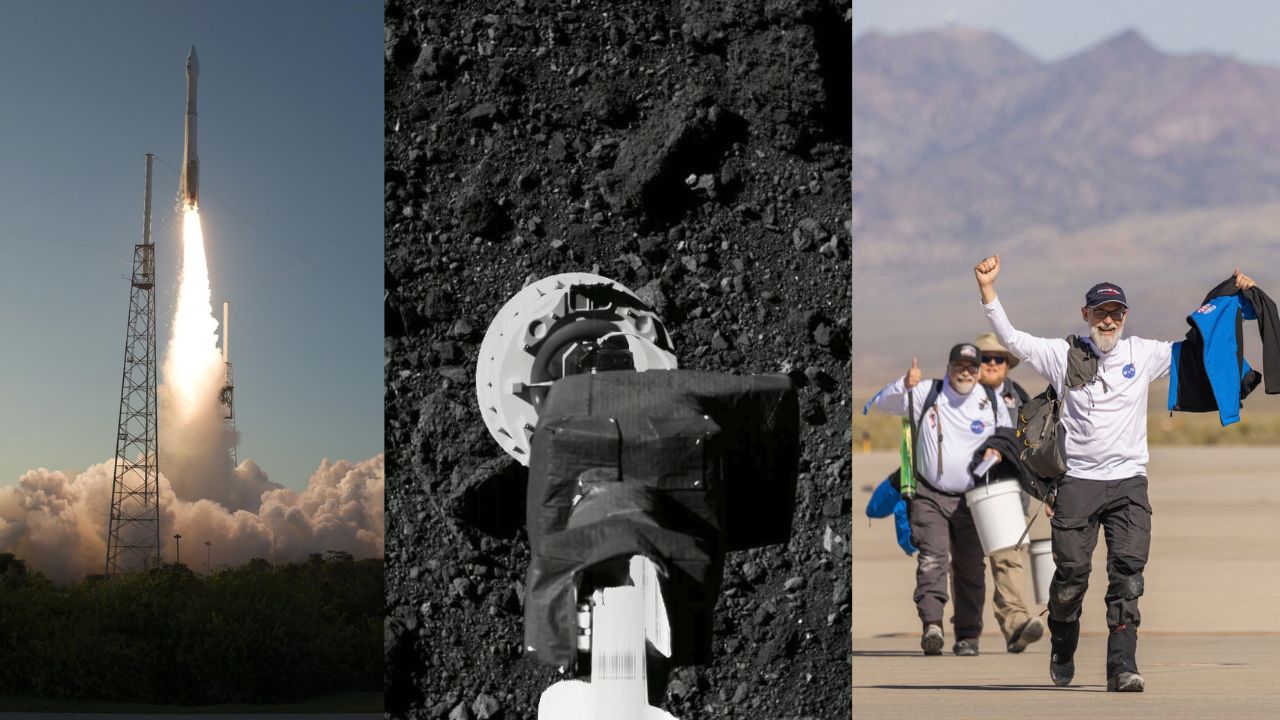
Despite the global COVID-19 pandemic, OSIRIS-REx successfully collected a sample on October 20, 2020. TAGSAM briefly touched Bennu’s surface, capturing material as the spacecraft momentarily sank into the asteroid.
Following collection, a malfunction caused the spacecraft to lose some material. Quick action led to the successful stowage of the sample, which began its journey back to Earth on May 10, 2021.
During the return journey, the team discovered Bennu’s slightly higher impact risk with Earth, further refining asteroid orbit predictions.
Return to Earth and Beyond
On September 24, 2023, OSIRIS-REx deployed its Sample Return Capsule, which safely landed in the Utah desert despite a parachute issue. Lauretta described the reunion with the capsule as reuniting with an “old friend.”
After safely securing the sample, the spacecraft set course for its next mission to the asteroid Apophis under the new moniker, OSIRIS-APEX.
Unlocking Bennu’s Secrets
Initial analysis of the OSIRIS-REx sample revealed carbon-based compounds and hydrated minerals, supporting theories on asteroids’ role in delivering life’s essentials to Earth.
Research also indicated Bennu’s origins from a larger, water-rich parent asteroid. Findings suggest that asteroids like Bennu played a crucial role in distributing life’s building blocks across the solar system.
As the mission concludes, over 200 research papers have been published, with much of Bennu’s material preserved for future study. The spacecraft’s journey continues, promising further discoveries in the years to come.
Read More Here










Comments are closed.