
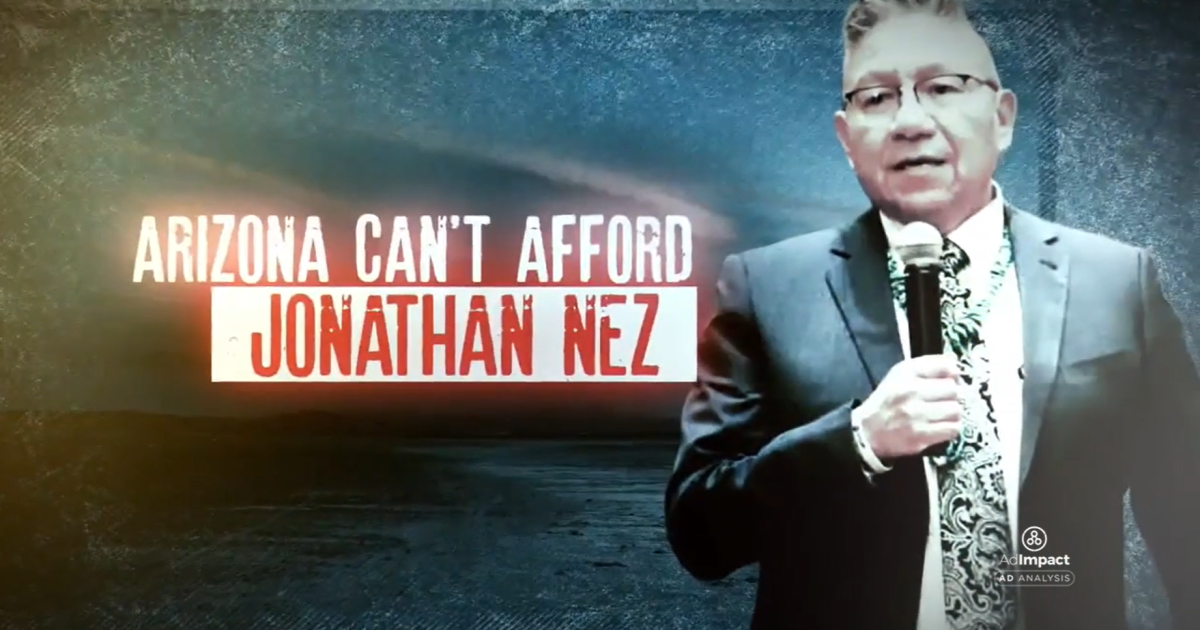
When political ads flood the airwaves in a competitive congressional race, voters depend on those ads being accurate. But a recently released attack ad targeting Arizona Democratic candidate Jonathan Nez raised a pointed question: What happens to informed voter choice when outside money moves fast and gets the facts badly wrong?
A Trump-aligned super PAC backing Republican Congressman Eli Crane launched a 29-second attack ad against his Democratic challenger, former Navajo Nation President Jonathan Nez — but the ad used the wrong man’s photo. Twice. The image shown while the ad referenced Nez actually depicted Myron Lizer, Nez’s former vice presidential running mate on the Navajo Nation. The ad accused Nez of misspending tribal funds on a Disney World family trip, but the face on screen belonged to someone else entirely. The mistake was later corrected, but not before the original version circulated publicly.
The irony cuts deep: Lizer is not a Democrat. He is an outspoken conservative and staunch Trump supporter who delivered a pre-recorded speech in defense of Trump’s policies at the 2020 Republican National Convention from Shiprock, New Mexico. The PAC’s ad, meant to damage a Democratic candidate, accidentally featured a prominent Navajo Republican.
A PAC in a Hurry — and Voters Left with Misinformation
The No Going Back PAC, registered with the Massachusetts address and the Federal Election Commission only in September, wasted no time flooding Arizona’s 2nd Congressional District. According to the Virginia-based ad tracking firm AdImpact, the super PAC is expected to spend more than $650,000 in the district. That’s a significant sum directed at shaping what voters believe about a candidate — and in this case, it began with a factual error that misidentified the very person being attacked.
Nez, who noticed the ad dropped just days before the federally recognized Columbus Day holiday — a day many Indigenous communities observe as Indigenous Peoples Day — believes the rush to publish is what caused the blunder.
“And they didn’t do their research obviously, because they mixed up me with my former vice president. Monday is Indigenous Peoples Day and diversity is our strength in this country.”
— Jonathan Nez, speaking to KJZZ
For voters in Arizona’s 2nd Congressional District, the episode illustrates a real concern about how outside money can distort the information environment during an election. When a super PAC injects hundreds of thousands of dollars into a race with incorrect content, ordinary voters may make judgments based on false impressions — not verified facts. The credibility of election-season advertising matters to democratic participation, and errors like this one erode public trust in the political process.
Lizer, despite being a Republican, was not pleased to find his image used without permission. He later told KJZZ he has asked PACs to not use his name, image, or likeness “for political gain.” And in a rare moment of cross-partisan agreement, Lizer characterized the PAC’s conduct plainly, writing that it was “obviously overzealous and careless in its release.”
KJZZ reached out to Lizer, Rep. Crane’s campaign, and the No Going Back PAC for comment. Neither the Crane campaign nor the PAC responded to requests for reaction to the error.
A Race That’s Tightening — and Outside Money Is Paying Attention
The ad blunder comes as this Arizona rematch heats up considerably. In 2024, Nez lost to Crane by 9 percentage points — a significant margin in a district that Donald Trump carried by 15 points over Vice President Kamala Harris that same year. The district, which covers northeastern Arizona, leans conservative.
But recent polling suggests this cycle looks different. At least one survey showed Nez and Crane statistically tied — a dramatic shift from two years ago. That kind of momentum explains why outside groups are pouring money into the race, and why voters in the district should pay close attention to who is funding the ads they see and whether those ads hold up to scrutiny.
The contest pits a retired U.S. Navy SEAL who appeared on Shark Tank against an Indigenous sheepherder with deep roots in Navajo Nation governance. Nez says internal polling fears among Crane’s supporters explain the aggressive ad push.
“That just shows you that there is fear amongst my opponent and his supporters in this election. And I’m sure they did their own internal poll and saw the same numbers that they’re in trouble.”
— Jonathan Nez
Whether or not that assessment proves accurate, the episode underscores a broader tension in modern political campaigns: super PACs operating with large budgets and little accountability can shape — or in this case, distort — the information available to voters in competitive districts. Readers following this race can consult the Arizona Voter Guide from KJZZ for verified, up-to-date coverage of the candidates and issues on the ballot. Separately, Arizona’s 1st Congressional District also saw candidates face off in a debate this week, while another Arizona congressional candidate has been speaking out about her personal experience with violent crime on the campaign trail. Reporting on these and other Arizona election contests has been covered by KJZZ reporters including Camryn Sanchez and Gabriel Pietrorazio. Full candidate profiles for races such as the 2026 Arizona Senate 9th Legislative District are also available, alongside coverage of controversies surrounding other candidates on the ballot this fall.




Comments are closed.