
University of Iowa Students Contribute to Groundbreaking Neutrino Research
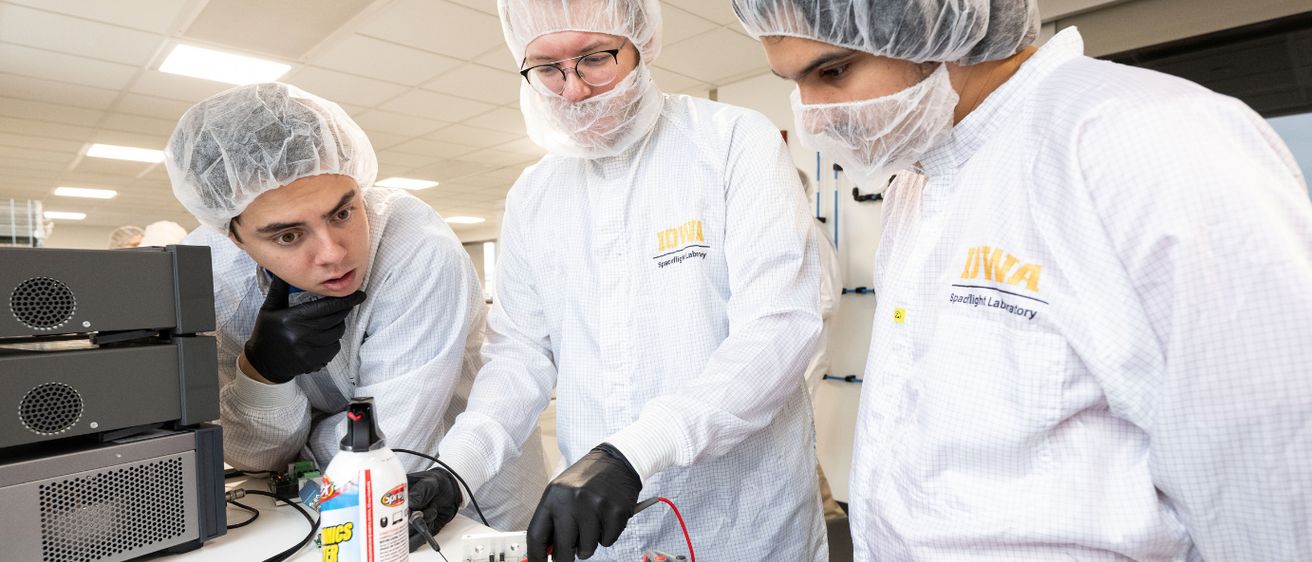
In a remarkable blend of education and cutting-edge science, a group of University of Iowa undergraduates and graduate students are at the forefront of a pivotal particle physics experiment. These students are meticulously assembling and testing electronic circuits and protective enclosures crucial for the Deep Underground Neutrino Experiment (DUNE), a global effort aimed at unlocking the mysteries of neutrinos.
Neutrinos are nearly massless particles that constantly stream through the universe, interacting so infrequently with matter that trillions pass through our bodies and the Earth unnoticed each second. Understanding these elusive particles is key for scientists seeking insights into the universe’s origins and its subsequent evolution.
The project has transformed the Iowa Spaceflight Lab, located on the top floor of Van Allen Hall, into an assembly hub. Since the previous summer, students have been assembling electronics and protective boxes designed to power photon detectors. These detectors, each equivalent in size to a jumbo jet, are set to be housed underground at the Sanford Underground Research Facility in Lead, South Dakota. This subterranean location, a former gold mine, was chosen to optimize neutrino detection and minimize interference from cosmic rays and other external sources.
The initiative is spearheaded by Jane Nacthman and Yasar Onel, esteemed professors in the Department of Physics and Astronomy at Iowa, who secured the necessary funding to involve UI students in this transformative work.
“A lot of students have gained a lot of knowledge about engineering and electrical circuits and how these large projects work, as well as being inspired by the physics,” Nacthman notes, highlighting the educational benefits of the project.
Sydney Tune, a senior from Strafford, Missouri, majoring in physics and astronomy with minors in geoscience and mathematics, is one of the many students inspired by this endeavor. Tune expresses excitement about future contributions, stating, “I think it’s really cool that one day I’ll be able to say, ‘Hey, DUNE found this, and I helped them with that discovery.’”
Read More Here



Comments are closed.