
New Insights from Ancient Footprints at White Sands Illuminate Early Human Life in North America
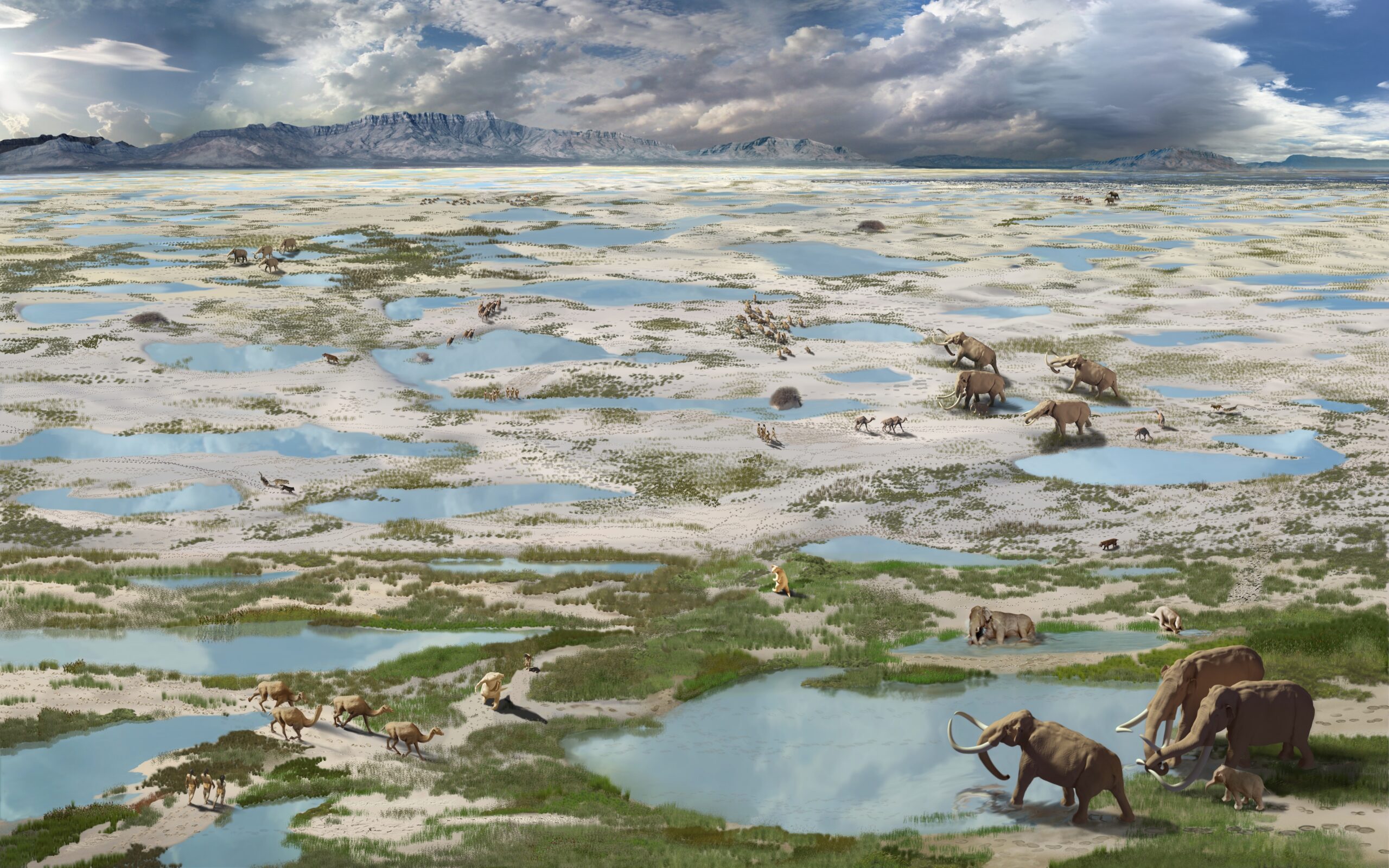
Recent excavations at White Sands National Park, New Mexico, have provided a breakthrough in understanding the oldest human footprints in North America. Researchers have not only refined the age of these footprints but also gained valuable insights into the environmental conditions faced by early humans.
A study published in Science Advances, involving the University of Arizona and the United States Geological Survey among others, highlights that ancient humans at White Sands experienced rapid changes in climate and water resources during their lifetimes. The footprints, left along an ancient lakeshore, are believed to be the oldest evidence of human presence on the continent, dating back thousands of years earlier than previously thought.
Using innovative techniques, researchers isolated large quantities of pollen grains and employed refined dating methods at the USGS Radiocarbon Laboratory. This enabled them to date the footprints to between 23.5 and 21.7 thousand years ago, during the Last Glacial Maximum. The detailed chronology offers a glimpse into the abrupt environmental changes that early North American humans navigated.
For the first time, scientists were able to examine climate and environmental changes over approximately 50-year spans, akin to a human generation. “The White Sands sediments are unique,” explained co-author Jessica Tierney from the University of Arizona’s Department of Geosciences. “We can see fluctuations that were relevant for the humans present at that time.”
Tierney’s work involved analyzing geochemical markers in sediments and fossil pollen to reconstruct past climates, revealing a dynamic environment. The landscape transitioned from conifer forest to sagebrush and oak steppe, with Lake Otero receding significantly. This transformation was recorded through isotopic analysis of preserved plant material, showing drastic changes in water availability, corroborated by ice core samples from Greenland.
Tierney noted, “This tells us that local changes in aridity at White Sands were quite large and followed global climate shifts.” During the Last Glacial Maximum, temperatures were cooler than today, and vegetation shifted rapidly in response to warming events.
Ruppia pollen, an indicator of desert streams and springs, suggested fluctuating water levels in Lake Otero over 1,500 years, eventually leading to a dry playa where humans, mammoths, and dire wolves left their tracks. The site offers a unique intersection of archeology and paleoclimate studies, preserving both environmental records and ancient footprints.
Future research aims to unravel how a warming event in Greenland triggered drying in the American Southwest. “This study fulfilled a long-term research goal at White Sands,” said Kathleen Springer, USGS research geologist and co-lead author. “It’s remarkable that early humans were real-time witnesses to a rapidly changing environment discernible within a human lifetime.”
Ed Jolie, an anthropology professor and study co-author, emphasized the significance of these findings in connecting contemporary Indigenous peoples to their ancestors. “This research continues to remind scientists and the wider public that these resilient ancient human populations are the ancestors of contemporary Indigenous peoples,” Jolie stated, underscoring the enduring connection to the land since time immemorial.
Read More Here






![Environmental Opera “Auksalaq” Opens UVA’s Arts on the Hill Series[embed]https://www.youtube.com/watch?v=PjYuP9wh3Hw[/embed]](https://realnewsfast.com/wp-content/uploads/2026/10/Environmental-Opera-Auksalaq-Opens-UVAs-Arts-on-the-Hill-SeriesembedhttpswwwyoutubecomwatchvPjYuP9wh3Hwembed-300x200.jpg "Environmental Opera “Auksalaq” Opens UVA’s Arts on the Hill Series[embed]https://www.youtube.com/watch?v=PjYuP9wh3Hw[/embed]")


Comments are closed.