
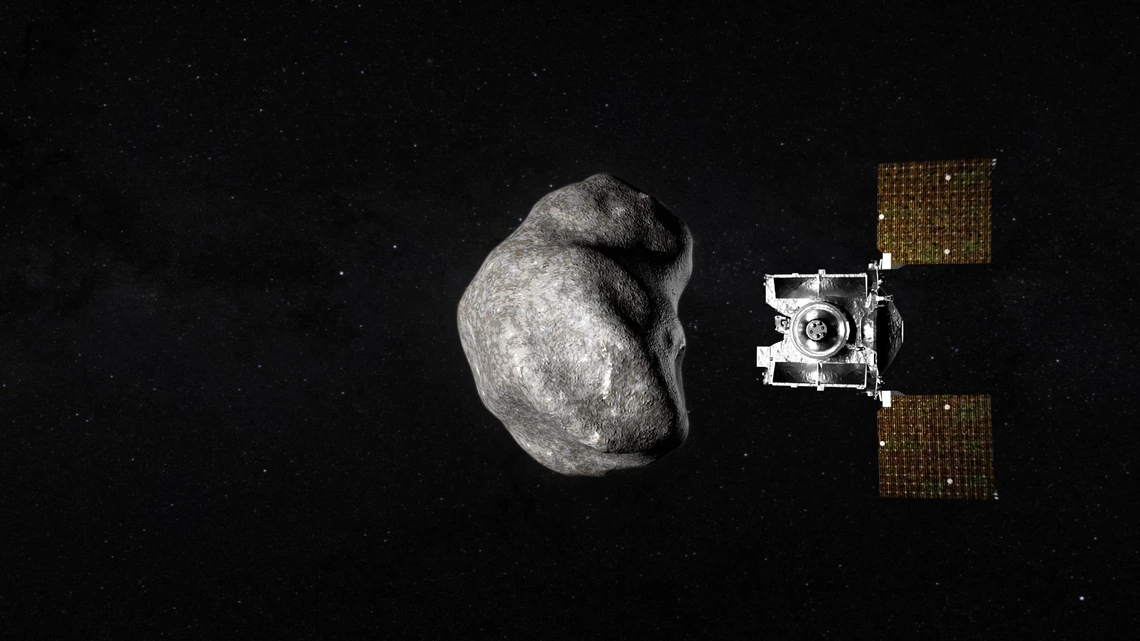
In a cosmic event that promises to captivate the world, the asteroid Apophis is set to pass alarmingly close to Earth on the evening of April 13, 2029. At a distance of just 20,000 miles from our planet’s surface, this flyby will be closer than many satellites orbiting Earth. As night descends over Europe and northern Africa, millions will have the chance to witness this rare astronomical occurrence.
Apophis’s proximity marks a once-in-7,500-years event, making this celestial encounter an extraordinary spectacle. A NASA spacecraft, currently en route to meet the asteroid, will document this moment from deep space, capturing the asteroid’s journey past Earth.
“I think that’s just going to be a really powerful sequence of images to help people understand how vulnerable we are,” remarked Dani Mendoza DellaGiustina, an associate professor at the Lunar and Planetary Laboratory and the principal investigator of OSIRIS-APEX.
The Spacecraft’s Journey
The spacecraft involved in this mission was initially known as OSIRIS-REx, which successfully delivered a sample from the asteroid Bennu back to Earth in September 2023. Now rebranded as OSIRIS-APEX, it is expected to reach Apophis by late spring 2029. The team behind the mission is currently preparing the spacecraft for its next significant maneuver: a flyby of Earth in March 2027, which will help align its trajectory with Apophis.
This flyby is part of a series of gravity assists designed to refine the spacecraft’s orbit. The last such maneuver in September 2025 allowed the team to observe Earth as if it were a distant astronomical body, offering insights into how telescopes might view exoplanets.
“Studying Earth as a habitable world from the perspective of a distant spacecraft that is seeing our own planet as it though it’s an astronomical object is a really rare opportunity,” said DellaGiustina.
Engineering Challenges and Innovations
Navigating to Apophis requires the spacecraft to endure conditions it wasn’t initially designed for, including being closer to the sun. Engineers have adapted it to withstand this harsh environment by tilting its solar panels to protect sensitive components. This maneuver, dubbed “the fig leaf,” has proven effective through three solar passes, with three more to come.
“I’m pretty confident after going through three passes already,” DellaGiustina noted, highlighting the team’s innovative approach to this challenge.
Observing Apophis’s Reaction
Upon arrival at Apophis, a critical question will be how Earth’s gravitational pull affects the asteroid. Researchers anticipate changes in Apophis’s rotation and surface condition due to this gravitational interaction. The spacecraft is equipped to detect even subtle shifts on the asteroid’s surface.
These observations will provide valuable insights, as DellaGiustina explained: “OSIRIS-APEX will be in a unique geometry to observe that shaking, which is very cool.”
Preparing the Next Generation
The mission also plays a pivotal role in training the next generation of scientists, having already involved over 150 students, many of whom now work with NASA and its partners. DellaGiustina emphasized, “It’s a really important and personal part of our story – the number of students that we’ve trained.”
Read More Here






![Environmental Opera “Auksalaq” Opens UVA’s Arts on the Hill Series[embed]https://www.youtube.com/watch?v=PjYuP9wh3Hw[/embed]](https://realnewsfast.com/wp-content/uploads/2026/10/Environmental-Opera-Auksalaq-Opens-UVAs-Arts-on-the-Hill-SeriesembedhttpswwwyoutubecomwatchvPjYuP9wh3Hwembed-300x200.jpg "Environmental Opera “Auksalaq” Opens UVA’s Arts on the Hill Series[embed]https://www.youtube.com/watch?v=PjYuP9wh3Hw[/embed]")


![New documentary explores Elizabeth Holmes’ final days before prison[embed]https://www.youtube.com/watch?v=GGJSRFWALTI[/embed]](https://realnewsfast.com/wp-content/uploads/2026/10/New-documentary-explores-Elizabeth-Holmes-final-days-before-prisonembedhttpswwwyoutubecomwatchvGGJSRFWALTIembed-300x200.jpg "New documentary explores Elizabeth Holmes’ final days before prison[embed]https://www.youtube.com/watch?v=GGJSRFWALTI[/embed]")

Comments are closed.