
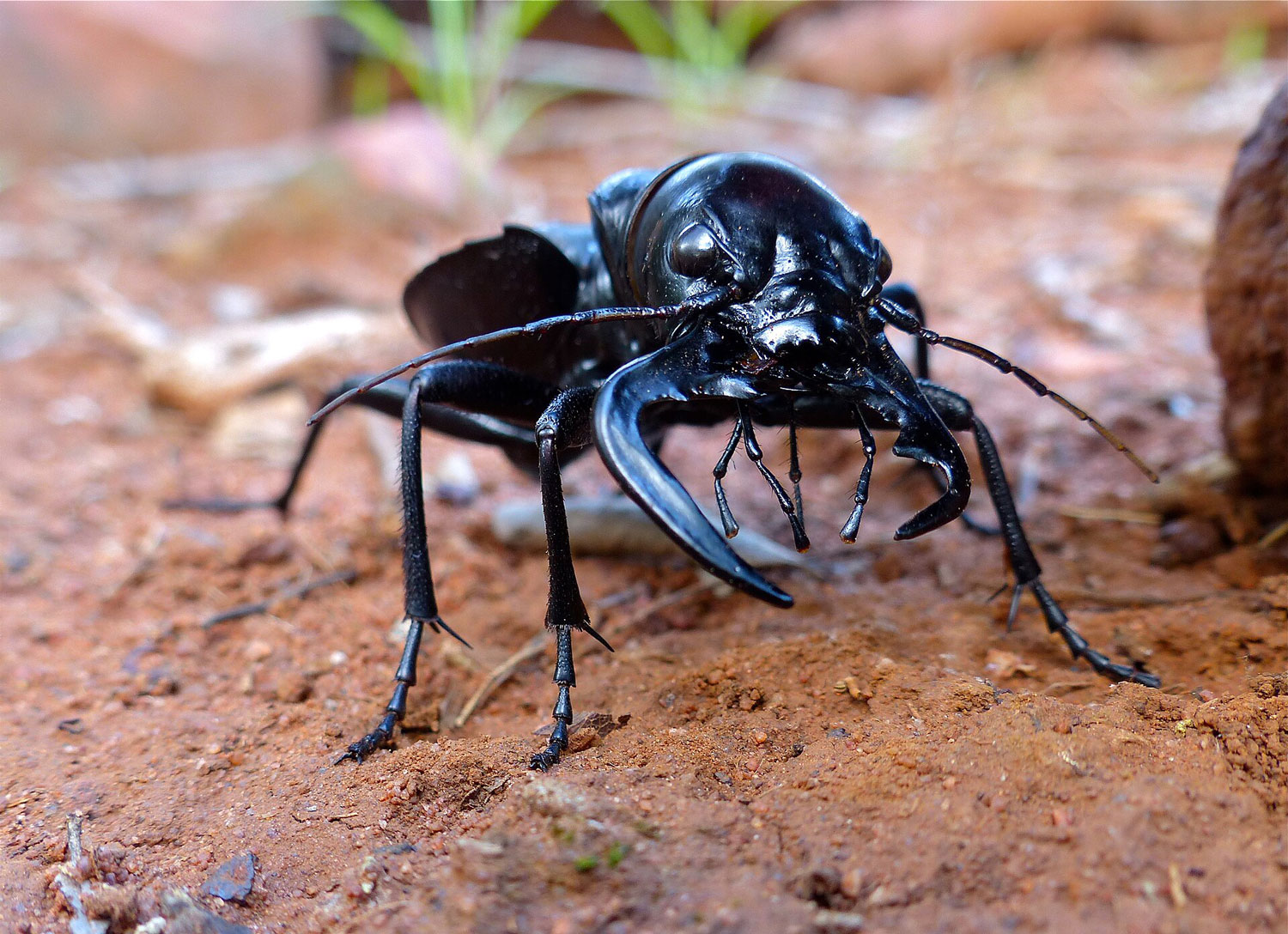
Have you ever wondered how certain species end up on different continents despite their inability to fly or swim? Recent research has shed light on a fascinating journey through time that explains this phenomenon in tiger beetles.
The Groundbreaking Discovery
Associate Professor Grey Gustafson, from the Department of Biological Sciences, unraveled a mystery involving tiger beetles through DNA sequencing. His research, published in the Proceedings of the Royal Society B, suggests that the ancestors of today’s tiger beetles roamed South America and Africa long before these continents drifted apart. Intriguingly, North America’s largest tiger beetles share lineage with these South American giants.
Gustafson’s investigation started with two groups of tiger beetles found in the western U.S.: the giant tiger beetles of the genus Amblycheila and the night stalking tiger beetles of the genus Omus. The prevailing hypothesis was that they belonged to the Manticorini tribe—a group that includes large-bodied, flightless beetles in the Southern Hemisphere. The question arose: How did these beetles make their way to North America, when most of their relatives are found in Sub-Saharan Africa and South America?
Exploring the Evolutionary Path
Gustafson remarked, “We wanted to know how a large-bodied, flightless beetle could get across the ocean to South America and then better yet, how our North American beetles fit into this tribe.” Supported by a four-year National Science Foundation grant, Gustafson spent three years gathering and analyzing genomic data to trace the evolutionary history of manticorine tiger beetles in North America.
Utilizing genomic sequences from freshly collected samples, ethanol-preserved materials, and specimens held in U.S. and European natural history collections, the research team mapped a family tree. This genealogical chart allowed them to pinpoint the most recent common ancestors and the timeline of species divergence.
The Findings: A Prehistoric Connection
The research unveiled that these beetles predate the continental separation, originating on a supercontinent called Gondwana. “The exciting thing we found was that the group is actually older than when the continents were separated, so they didn’t actually get across the oceans,” Gustafson explained.
DNA sequencing confirmed that North America’s giant tiger beetles are closely related to their South American counterparts and, collectively, to those in southern Africa. This ties back to the time when South America and Africa were part of Gondwana.
Gustafson expanded, “Because of the size of the supercontinent, many biologists hypothesized that lineages with lots of closely related modern diversity in Africa and South America likely originated when the continents were still part of Gondwana.”
The phenomenon of vicariance explains this distribution, where a physical barrier divides species populations. While not exclusive to tiger beetles, this concept enriches the broader ecological narrative about evolution. Similar to the flightless birds like rheas and ostriches, these tiger beetles illustrate the Gondwanan vicariance.
Gustafson concluded, “The answer to our question of how these giant beetles got across the ocean was that they actually didn’t. As the continents separated, they took their giant tiger beetles with them.”
Read More Here




![Environmental Opera “Auksalaq” Opens UVA’s Arts on the Hill Series[embed]https://www.youtube.com/watch?v=PjYuP9wh3Hw[/embed]](https://realnewsfast.com/wp-content/uploads/2026/10/Environmental-Opera-Auksalaq-Opens-UVAs-Arts-on-the-Hill-SeriesembedhttpswwwyoutubecomwatchvPjYuP9wh3Hwembed-300x200.jpg "Environmental Opera “Auksalaq” Opens UVA’s Arts on the Hill Series[embed]https://www.youtube.com/watch?v=PjYuP9wh3Hw[/embed]")


Comments are closed.