
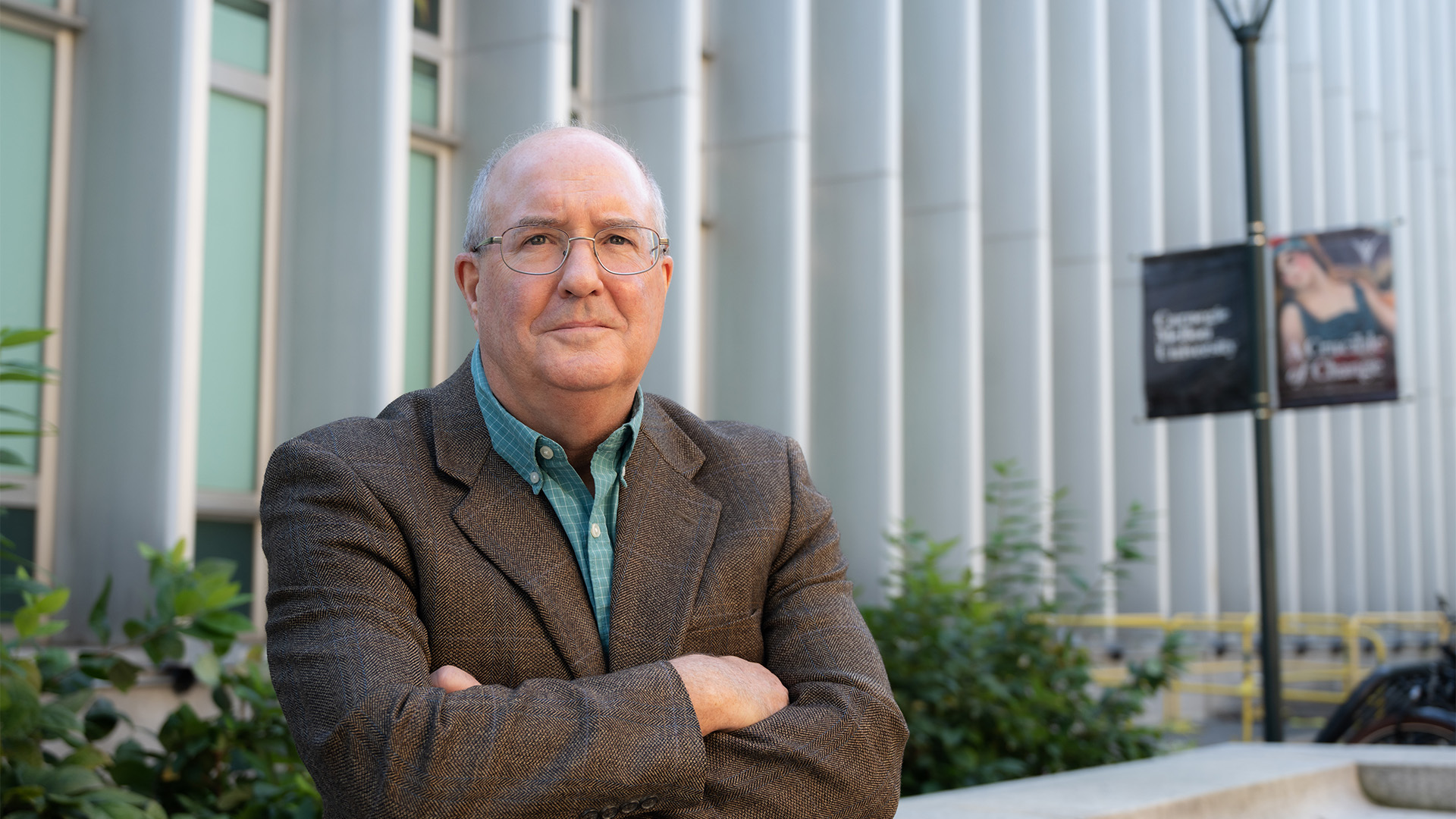
Carnegie Mellon Physicist Embarks on AI-Driven Research to Decode Universe Mysteries
In a groundbreaking initiative, Carnegie Mellon University’s Professor Colin Morningstar joins a national team poised to revolutionize particle and nuclear physics through artificial intelligence. Backed by a Phase II grant from the U.S. Department of Energy’s Genesis Mission, this endeavor aims to leverage AI and some of the globe’s most formidable supercomputers to fast-track scientific breakthroughs.
The award underscores the Carnegie Mellon Department of Physics’ emerging prominence in AI-fueled scientific exploration. Faculty participation in three Genesis for AI Science projects—spanning cosmology, particle physics, and nuclear physics—demonstrates the department’s alignment with national scientific goals.
“These projects span nearly the full spectrum of modern physics, from understanding the large-scale structure of the universe to understanding the fundamental particles that make it up,” stated Rachel Mandelbaum, Head of the Department of Physics. “AI is creating new opportunities across all of those areas, and Carnegie Mellon’s collaborative culture allows us to bring together physicists and computational experts to move the field forward.”
Central to the research is Morningstar’s use of large-scale computer simulations to examine the strong force binding quarks and gluons into protons and neutrons. This technique, known as lattice quantum chromodynamics (QCD), models space and time on a grid to facilitate particle interaction calculations.
The project, titled “Lattice QCD at the Intelligence Frontier,” is spearheaded by William Detmold from the Massachusetts Institute of Technology and includes members from the USQCD Collaboration. With researchers from approximately 15 universities and six national laboratories, Morningstar contributes as a co-principal investigator.
“Our overarching goal is to understand what makes up the universe, what the fundamental particles are and how they interact,” Morningstar remarked. “To fully interpret the results of next-generation experiments, we need increasingly precise theoretical calculations, and this award will help us explore how AI can advance those calculations.”
Such calculations are vital for analyzing data from major DOE experiments like the Deep Underground Neutrino Experiment and the forthcoming Electron-Ion Collider. The DOE’s supercomputing infrastructure and the American Science Cloud will be instrumental in developing AI tools to enhance data analysis, simulation efficiency, and software optimization.
“The point of this award is to use new techniques to help us get around some of the stumbling blocks in our calculations,” Morningstar explained. “People have begun exploring how AI can assist with this work, but this project gives us the opportunity to take a much more focused approach and determine where these tools can truly make a difference.”
This initiative is part of a DOE grand challenge to deepen understanding of the fundamental forces governing matter and the universe. By refining models of quarks and gluons, the team aims to lay the theoretical groundwork for uncovering new physics in upcoming experiments.
Morningstar was also awarded two National Science Foundation grants for complementary research. A 2025 NSF award supports exploration into the structure and interactions of particles, including calculations for significant neutrino experiments. Another NSF grant, received in September 2026, focuses on optimizing software for advanced supercomputers.
“The OAC award complements the physics that’s being attacked in the Genesis award,” Morningstar noted on the latest NSF grant. “It’s attacking in a different way using a different computational approach to solve the same sort of problems.”
These accolades place Morningstar and his team at the convergence of physics, AI, and advanced computing, laying the foundation for potential discoveries that might redefine our understanding of the universe and pave the way for future technological innovations.
Read More Here





Comments are closed.