
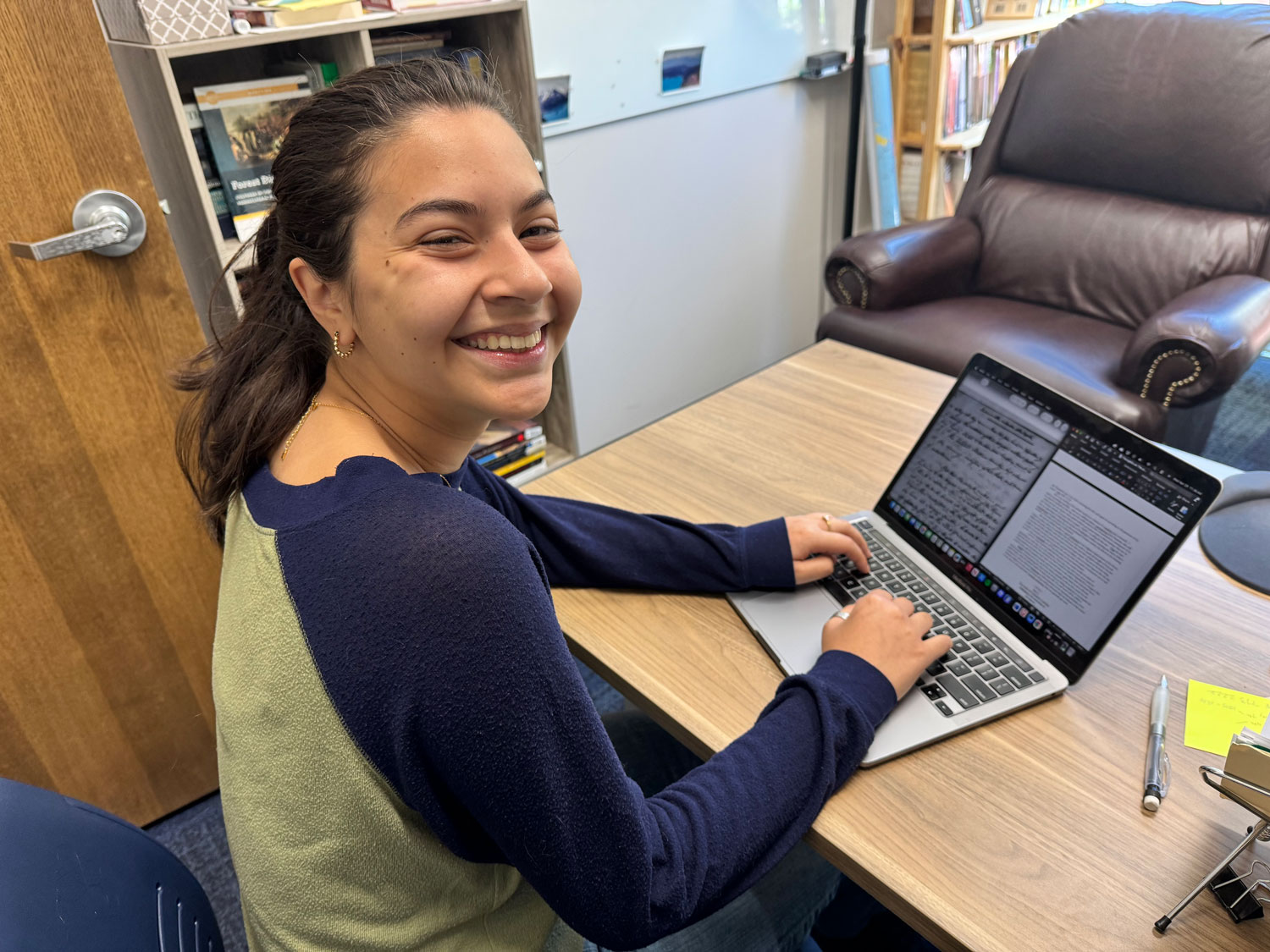
Daniella Ferrero is physically in Flagstaff, Arizona, in 2026, but her thoughts have been immersed in Trelawny, Jamaica, during the 1820s for the past year.
As a history major at the Honors College, Ferrero has recently completed the transcription of over 100 pages from the writings of John Shipman, an English Methodist missionary who was sent to Jamaica to convert enslaved workers on sugar plantations. This project was part of her participation in the Honors Undergraduate Fellowship program, which offers students paid research opportunities. She worked alongside Kyle Welty, an assistant teaching professor who began transcribing Shipman’s writings nearly two decades ago at Southern Methodist University.
“My grad school research sat and languished for a long time, but thanks to the Honors Undergraduate Fellowship program, it’s slowly coming back to life,” Welty remarked.
Ferrero’s experience with the transcription project has not only prepared her for a future in archival work, with a focus on Latin American colonial history and independence movements but has also provided fresh insights into a complex historical era.
“This has opened my eyes a lot to the importance of archives and all the work that goes into creating one,” Ferrero stated. “Archives need to survive and stay accessible to communities, otherwise the details and nuance of history can get lost.”
Setting the scene
Welty explains that in early 19th-century Jamaica, slavery was the central institution, with enslaved individuals making up nearly 90% of the population. Those who were not enslaved were usually involved with slavery, whether as plantation owners, overseers, or merchants.
“The missionaries were in a weird third category,” Welty noted. “They weren’t technically there to support slavery; they were there to spread the gospel and convert people to the Methodist faith. As evangelists, they were pro-education. That put planters in an uneasy mood. They thought, ‘If they’re taught about the liberation of the Israelites from Egypt, will that put ideas into their heads?’”
Ferrero highlighted the delicate balance missionaries had to maintain in the Caribbean, being acceptable to white plantation owners while adhering to their faith, which was taking an anti-slavery stance.
“There was a big abolitionist movement starting in the Methodist Church in England,” Ferrero said. “But John Shipman was living in a society built on slavery, so he couldn’t be seen threatening the institution of slavery. He knew the planters could ask him to leave at any time.”
Ferrero uncovered a letter written by Shipman to reassure planters that he was not there to challenge slavery, even making controversial statements about the differences between enslaved people and the ruling class.
“It ended up getting him recalled” from Jamaica, Welty explained. Shipman later highlighted the irony in a letter: ‘You want us to work in a slave-dominant culture, but you’re abolitionists? You can’t have it both ways.’”
It’s complicated
Shipman’s letters might suggest a pro-slavery stance, but he was a complex figure full of contradictions. Ferrero discovered a crossed-out passage in Shipman’s draft that hinted at an emerging abolitionist view.
“He said something like, ‘If enslaved people on a plantation are being called to do immoral things that go against the teachings of the Bible, they should leave,’” Ferrero mentioned. “He crossed that out, because he knew that if he ever wanted to get this book published, a thought like that could never have seen the light of day.”
Throughout the document, Ferrero noticed many inconsistencies in Shipman’s language.
“He’ll say something like, ‘The enslaved people have the capacity to be and do more; things might be different for them if they weren’t deprived of opportunities,’” Ferrero said. “But even as he writes this, he repeats racial stereotypes from that time.”
The research conducted by Welty and Ferrero highlights a timeless insight: history is rarely clear-cut because individuals are complex.
“The common perspective today is that these missionaries were an arm of the colonial agenda,” Welty said. “That’s true, but it’s more complicated than that. They were there with a variety of intentions and motives, sometimes in outright opposition of the planter class. It shows a more complicated status on the ground. I think if we can appreciate that—if we can see nuance in historical figures—we can extend that to our contemporaries.”

Jill Kimball | NAU Communications
(928) 523-2282 | jill.kimball@nau.edu
Read More Here








Comments are closed.