
With Election Day just days away, the question of who watches the watchers has taken on new urgency in Pennsylvania. Federal election monitors are heading to four counties across the state — and state officials are making clear that those monitors are not above the law.
The U.S. Department of Justice sent a letter to Pennsylvania election officials last week announcing it would deploy monitors to Allegheny, Lehigh, Luzerne, and Philadelphia counties on Election Day. According to DOJ civil rights division attorney James Catnia, the monitors will blend into polling place surroundings, wearing business-casual clothing with no identifying pins or uniforms.
In the letter, Catnia emphasized that
“Our monitors only observe and take notes. They do not intrude or interfere in any way in the voting process.”
Federal election monitoring is not a new practice. Three of the four counties named this year — Allegheny, Luzerne, and Philadelphia — were also visited by monitors in 2024 under President Biden. Such monitoring has traditionally served to help document whether local election officials are complying with civil rights protections and ballot-access laws. But this year, the context around that monitoring has become harder to ignore.
Pennsylvania’s Top Election Official Draws a Line
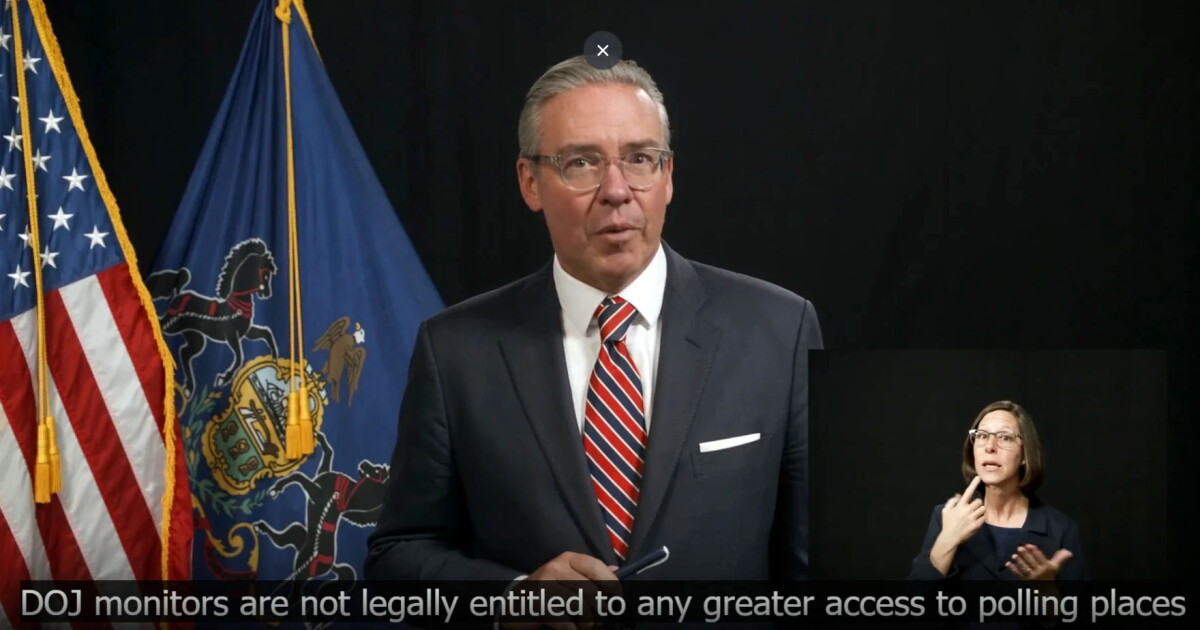
In a pre-election address Tuesday, Pennsylvania Secretary of State Al Schmidt made it plain that anyone observing polls — including federal monitors — must operate within the boundaries of state and federal law.
“DOJ monitors are not legally entitled to any greater access to polling places than any member of the public,”
Schmidt said.
“We encourage them to coordinate with county election offices to ensure that their activities on Election Day do not disrupt the voting process in any way.”
Schmidt also reminded officials and observers alike that
“state and federal laws strictly limit military and law enforcement presence at polling places.”
Before issuing those warnings, Schmidt spent several minutes urging voters to be
“patient”
with poll workers, describing them as
“our neighbors who have offered their time so others in their community can exercise their right to vote.”
His direct remarks about the limits of federal monitor authority were notably firm — a signal that Pennsylvania is watching how this process unfolds.
The broader political backdrop matters here. President Donald Trump has repeatedly claimed, without verified evidence, that elections are fraudulent — a pattern that began after his 2020 loss. His supporters attempted to disrupt the certification of that election on January 6, 2021. More recently, the Trump administration filed legal action seeking court intervention if a Republican Senate candidate loses in Alaska, and brought a court fight in California over voter roll removal demands. Trump has also stated publicly that losses by candidates he supports this fall would be the result of fraud.
State officials and election-integrity advocates have largely been careful about how loudly they voice these concerns. Part of that caution stems from a real worry: raising fears about election interference could discourage voters from going to the polls in the first place — turning warnings into the very problem they’re trying to prevent.
Luzerne County: ‘Nothing to Hide’
Luzerne County has been through this before. The Justice Department monitored its elections in the 2022 and 2024 general elections and the 2024 primary. County Manager Romilda Crocamo pointed to that track record as evidence of a process that works when everyone follows the rules.
“Each time, the county worked cooperatively with federal personnel, and each time the election went forward as it should,”
Crocamo said.
Crocamo explained that the county’s standing position keeps DOJ monitors outside polling places — not inside them.
“The ground rules are clear and well understood. DOJ monitors will not be stationed inside polling places. That has been the county’s consistent position: it keeps polling places orderly and prevents any appearance of intimidation of voters. Monitors are free to observe from outside polling places, and county election officials will stay in contact with the DOJ throughout Election Day,”
she said.
She also spoke directly to voters who may be uncertain about what they’ll encounter at the polls.
“Voters should cast their ballots with confidence. Any problem at a polling place should be reported right away to the poll workers on site or to the Luzerne County Bureau of Elections,”
Crocamo said.
“Luzerne County has nothing to hide. Our Bureau of Elections, our Board of Elections, and hundreds of poll workers are prepared to run a fair, accurate, and lawful election. County administration has complete confidence in the work of our Bureau of Elections staff. Monitoring confirms that work,”
she added.
Civil Rights Groups Flag Concerns About Expanded Monitoring
While federal election monitoring has a long and largely uneventful history, civil rights organizations are raising alarms about how this year’s program is different in scale and composition. One week before Election Day, the ACLU, its Pennsylvania chapter, and the Public Interest Law Center sent a joint letter to election officials in all 67 Pennsylvania counties urging vigilance.
The groups acknowledged the program’s normal function:
“DOJ’s election monitoring program has existed for many years, and monitors have long been deployed without incident. Under normal circumstances, monitors wear plainclothes, do not interfere with or disrupt voting or counting, and abide by all local, state, and federal rules and regulations.”
But they flagged a significant shift:
“This year, DOJ has announced that it is massively expanding its monitoring program. Monitors under this new, expanded program could be poorly trained, lack a legal background (or potentially be from outside DOJ entirely), or even be conspiracy theorists who may have been disqualified from federal employment in the past.”
The letter made clear that expanded scope does not mean expanded authority.
“Participants in DOJ’s monitoring program … do not derive any additional powers from federal statutory or regulatory authority. Persons acting as federal election monitors … must comply with all state laws regulating other members of the public.”
The letter’s bottom line for county officials was unambiguous:
“No matter what federal actors say on Election Day, you run your elections. And you are responsible for ensuring that no one — including federal officials — interferes with the right to vote in your county.”
Pennsylvania Governor Josh Shapiro echoed those sentiments, saying state leaders have been actively preparing for a wide range of potential federal actions — including the possible deployment of federal troops on Election Day. Speaking to WESA over the weekend, Shapiro said,
“We have been preparing for this for more than a year,”
and while he acknowledged being
“deeply concerned”
about possible federal overreach, he pledged that
“we will protect people’s access to the polling places.”
For voters heading to the polls, the message from Pennsylvania officials is consistent: your right to vote is protected, election workers are prepared, and anyone present at polling locations — federal monitor or otherwise — must follow the same rules as everyone else. Read more from our partners at WESA.





Comments are closed.