
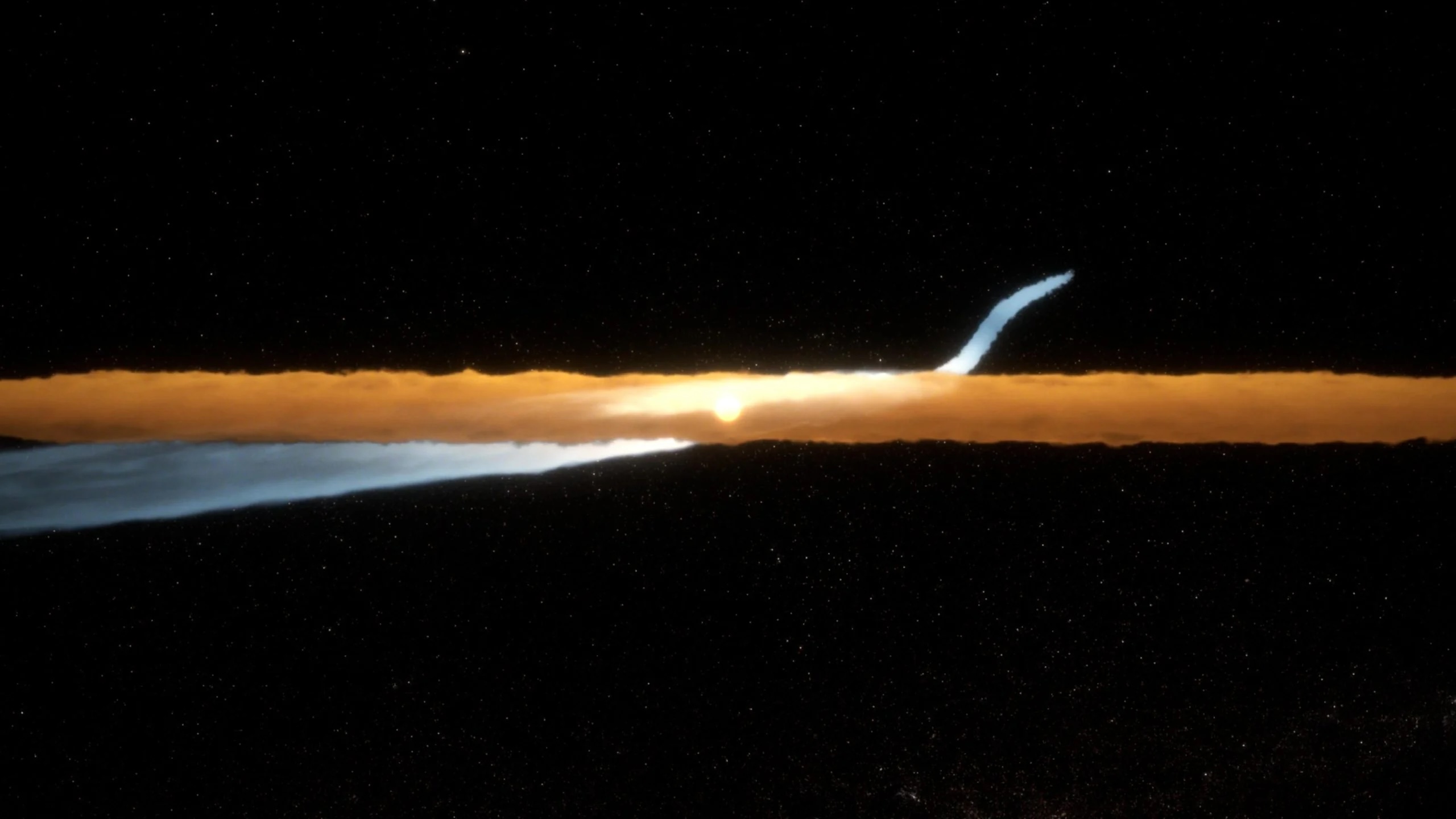
In the expansive realm of space, 63 light-years from Earth, the constellation Pictor harbors a cosmic enigma. Known as the “Cat’s Tail,” this extraordinary structure has intrigued astronomers since its discovery. Stretching a vast distance, this dark feature spans roughly a thousand times the average space between our planet and the sun.
The Cat’s Tail resides within the debris disk surrounding Beta Pictoris, a star system in its youth, only a few million years old. Recently, astronomers achieved a breakthrough by capturing the Cat’s Tail in visible light using the Hubble Space Telescope, offering fresh insights into its mysterious nature.
Under the leadership of Arin Avsar, a planetary scientist from the University of Arizona, the research team documented their findings in a paper published in The Astrophysical Journal Letters. By analyzing images spanning 14 years, the research sheds light on the Cat’s Tail’s location and possible origins.
This study’s observations, made with the Hubble Space Telescope, revealed the “Cat’s Tail” structure for the first time in the visible light spectrum (white arrow). Unlike the original discovery observations made with the James Webb Space Telescope, which detected the dust grain’s heat emissions using infrared radiation, the tail appears shorter in the new images, because the further the trail of dust grains extends from the star, the less light they reflect.
“The Cat’s Tail is thought to be the aftermath of a collision between large bodies – think something like Pluto,” explained Avsar, a doctoral student associated with the University of Arizona’s Lunar and Planetary Laboratory and Steward Observatory. The Cat’s Tail was initially detected by the James Webb Space Telescope through infrared emissions, but visible light observations had remained elusive.
Our solar system, now a picture of order, began as a chaotic assembly of gas and dust, with space rocks colliding violently. To understand our early solar system, astronomers study young star systems like Beta Pictoris, believed to be in the final stages of forming planets.
Avsar suggested that the Cat’s Tail’s elusive nature in visible light is due to its composition. “It consists almost entirely of what we call organic refractory material, which is heavily carbon-based. These long chains of carbon atoms absorb visible light, so they’re quite black,” he said.
The recent observations indicate that the Cat’s Tail is composed of micron-sized dust grains, which are remarkably porous. This structure stretches around 1,000 astronomical units, a vast length if visualized as 200 trillion house cats lined up consecutively.
“How you can get dust grains that small that are as porous as we see here, no one really understands, and that’s part of why we study this feature,” Avsar remarked. The team speculates that high-velocity collisions may have transformed carbon grains into gas, which then recondensed into their porous form.
Combining data from Hubble and the James Webb Space Telescope allowed scientists to explore the Cat’s Tail’s three-dimensional structure. Previously thought to extend behind Beta Pictoris, the structure may actually lie within the same plane as the star, stretching sideways.
By employing Hubble in a novel way, Avsar’s team also discovered a new aspect of the Beta Pictoris debris disk: a warp possibly caused by the gravitational influence of the massive planet Beta Pic b, which is about 10 times the mass of Jupiter.
“This gives us another line of evidence into how giant planets influence comets through their immense gravitational force,” Avsar explained. Such findings provide insight into the forces that shaped our own solar system, where giant planets likely rearranged or ejected numerous smaller bodies in its formative years.
Read More Here







Comments are closed.