
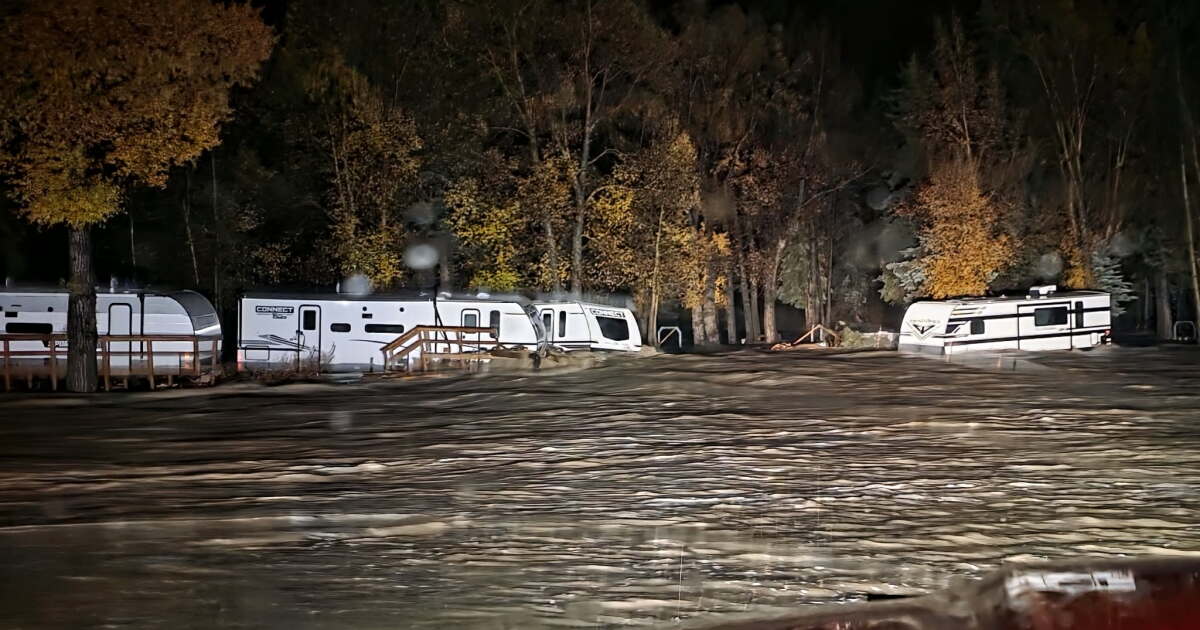
Days of relentless rain across the Four Corners region have left hundreds of homes evacuated, thousands of residents displaced, and rescue crews conducting hundreds of operations across New Mexico and Colorado. Even as some rivers began to recede from record highs, new storms continued rolling through the area Saturday, keeping the crisis far from over.
More than 5 inches of rain in some locations drove floodwaters from the Colorado mountains down into the desert communities of New Mexico and Arizona. Around 2,000 people in and around Farmington, New Mexico — a city of roughly 46,000 near the convergence of Arizona, Colorado, New Mexico, and Utah — were directly affected.
Farmington Police Chief Steve Hebbe delivered a direct message to residents at a news conference Saturday:
“This is not over, and we need you to monitor alerts.”
At least a couple hundred people required rescue since rains intensified Wednesday, with flooding reaching its worst on Thursday and Friday. Some residents were stranded on rooftops waiting for help. San Juan County spokesperson Devin Neeley confirmed that New Mexico National Guard helicopters carried out 11 hoist operations, with each lift capable of transporting up to eight people to safety.
Despite the scale of displacement, emergency shelters were not at capacity, suggesting that most evacuees found refuge with friends or family rather than at official sites.
Evacuations Remain as Hazards Linger
Even where water levels dropped, evacuation orders stayed in place. Officials cited ongoing dangers including downed power lines, leaking gas lines, and the threat of additional storm surges through the weekend. San Juan County Sheriff Shane Ferrari urged patience from frustrated residents.
“There’s a lot of anxiety, and there’s a lot of frustration,”
Ferrari said.
“But please understand we are blocking those areas for your safety.”
Authorities in both Colorado and New Mexico asked residents not to fly drones over flooded areas to check on property or for sightseeing, warning that drone activity can interfere with rescue aircraft. They also requested that people reserve 911 calls for genuine emergencies only.
Downstream from Farmington, floodwaters reached into the Navajo Nation, closing a 2-mile stretch of U.S. Highway 64 west of Shiprock due to water on the roadway.
Rivers Hit Historic Levels
Upstream in Colorado, the San Juan River surged through the hot springs resort town of Pagosa Springs at levels not recorded in over a century — running 2 to 3 feet higher than a flood just over a year ago that officials had already classified as a 100-year event. In Durango, the Animas River tore through the city in a muddy torrent, though it stayed just below its own historic records.
Flooding reached as far east as the Conejos River in south-central Colorado, prompting Governor Jared Polis to add Conejos County to the list of areas eligible for state disaster assistance. Several roads remained closed, including U.S. 160 northeast of Pagosa Springs, though the Four Corners region’s famed Million Dollar Highway — U.S. 550 — reopened between Durango and Ouray after crews repaired water damage along the route.
Severe thunderstorms also triggered widespread flooding in Hopi communities in northern Arizona earlier this week, where tribal leaders declared a state of emergency on Thursday.
This latest round of flooding is part of a two-month pattern of heavy rainfall driven by tropical moisture moving inland from the Pacific. The region had previously endured months of drought, but recent storms have saturated the soil, making flash flooding increasingly likely with each new rain event. Earlier flooding struck the Grand Canyon and parts of New Mexico, underscoring how vulnerable the rocky desert landscape is when rain arrives in volume.






Comments are closed.