
New Assessment Tool Offers Early Detection of Canine Cognitive Decline
Observing the aging process in dogs can be distressing, especially when they begin to exhibit signs of disorientation or increased anxiety. These symptoms may indicate dementia, but by the time they appear, the cognitive decline might have been progressing unnoticed for years.
In an effort to identify these issues sooner, researchers at the University of Arizona have created a 40-minute test known as CANID, which stands for Cognitive Assessment for Neuropsychological Impairments in Dogs. This innovative test uses a series of three tasks to evaluate memory and behavioral adaptability, potentially detecting subtle cognitive impairments in dogs as young as seven or eight years old. Typically, overt signs of dementia are not evident until dogs reach 12 to 14 years.
Dr. Evan MacLean with his pet dog Sisu.
“We can’t ask them questions; we can’t tell them, ‘OK, this is the test of your memory,'” remarked Dr. Evan MacLean, the study’s senior author and a professor in the College of Veterinary Medicine at the University of Arizona. Instead, the research team uses treat-based games to observe dogs’ memory capabilities and impulse control.
Led by Stephanie Hargrave, a Ph.D. student in the Department of Psychology, the study was recently published in the journal Animal Cognition. Hargrave highlighted that most current methods for detecting dementia in dogs rely on owner surveys, which often only identify severe cognitive issues.
“Unfortunately, by the time these measures identify dogs as having canine cognitive dysfunction syndrome, their cognitive impairment is often quite severe,” Hargrave stated. CANID requires trained personnel and special equipment and is not designed for at-home use. However, it allows researchers to study many dogs, which could lead to preventative and therapeutic strategies for pet owners.
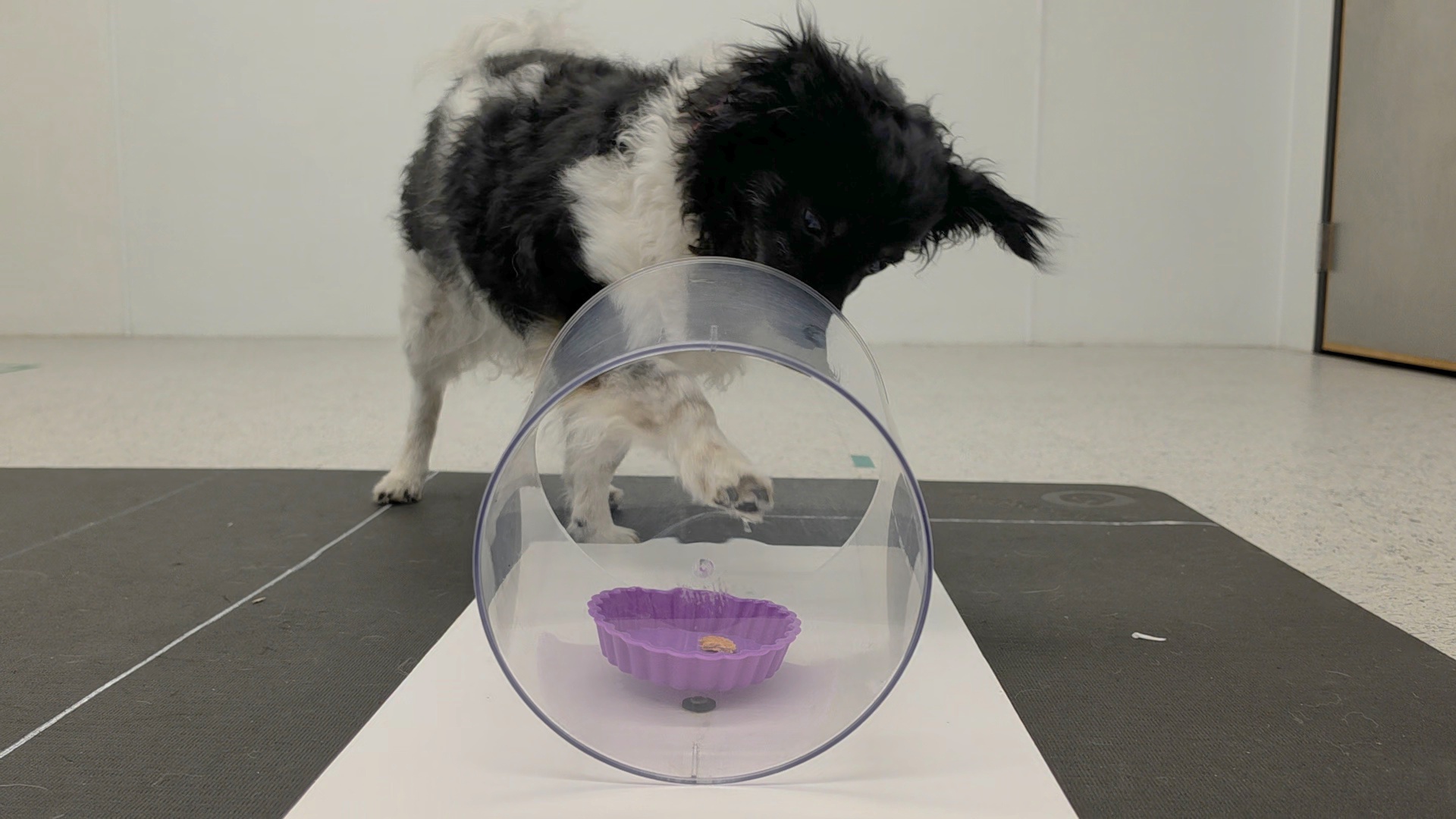
The assessment involves three tasks: In the first, a dog must resist the impulse to directly reach for a treat in a clear tube, instead navigating to the open ends. The second task tests memory by hiding a treat behind one of four barriers, requiring the dog to recall its location after a short delay, sometimes with distractions. The third task, a favorite of MacLean’s, involves the dog finding an alternative route to a treat when its usual path is blocked.
A dog approaching a treat behind a blind.
Emma Kristal/Arizona Canine Cognition Center
Scores from these tasks are combined into a single assessment score, with 239 dogs in Tucson and California tested and retested over six months to a year. The scores remained stable and aligned with human neuropsychological test standards.
An intriguing finding was that cognitive decline in dogs does not correlate with size. “If you’re a big dog, you probably die before you reach a point in that trajectory where you would have experienced major cognitive impairment,” MacLean explained. This suggests that smaller breeds, such as Chihuahuas, are more likely to experience cognitive decline due to their longer lifespans.
The research could also have implications for humans, as dogs with dementia may develop amyloid plaques similar to those seen in Alzheimer’s disease. “Dogs drink the same water we do. They breathe the same air,” noted MacLean, emphasizing the potential for significant discoveries beneficial to both species through studying dogs.
Dog owners in the Tucson area interested in participating in cognitive aging studies can enroll through the Arizona Canine Dog Cognition Center. Those elsewhere in the U.S. can join the Dog Aging Project, which tracks 50,000 dogs nationwide. Participants might also get the chance to try simpler cognitive games designed for home use.
“We see the development of CANID as an exciting milestone – it’s a tool that is going to help us do a lot of important future research,” MacLean said. For Hargrave, this research is personal, as her Chihuahua mix, Roxy, approaches 11 years old. “I’m especially interested in what I can do to prolong her cognitive health and prevent decline,” she said.
Read More Here










Comments are closed.