
With Election Day one week away and five days of early in-person voting still remaining, North Carolina is already rewriting its turnout record — and the numbers are raising serious questions about where the state’s voters stand heading into the final stretch. Understanding what these figures mean can help everyday citizens grasp how voter participation shapes election outcomes and why the composition of the early vote matters so much.
According to WFAE political reporter Steve Harrison, nearly 1.6 million North Carolinians have already cast early ballots — the vast majority in person. That’s a striking leap from the same point during the 2022 midterms, when roughly 1.16 million ballots had been submitted. In other words, about half a million more voters have already participated compared to two years ago.
One notable shift within that overall surge: mail-in voting is down compared to 2022. Analysts point to repeated claims by President Trump that mail voting is fraudulent — rhetoric that appears to have nudged some voters away from the mail option and toward early in-person locations instead. Mail voting has always represented a small share of total ballots cast in North Carolina, so the change in method hasn’t significantly altered the overall picture.
Republican Turnout Lags Behind Historical Norms
The more telling story may be in who is showing up. Registered Republicans currently make up just under 24% of all early ballots cast. In raw numbers, nearly twice as many registered Democrats have voted early so far as registered Republicans.
That gap looks even more dramatic when compared to recent elections. During the 2022 midterms — a strong cycle for Republicans nationally, when Ted Budd won North Carolina’s U.S. Senate seat — registered Republicans accounted for 31% of early voters at this same point. And in 2018, a year widely considered favorable to Democrats, Republican early voters still made up 31% of the pool. This year’s 24% figure represents a significant drop from both of those benchmarks.
Republicans have been closing the gap since early voting began in mid-October, when their share of the pool dipped below 20%. The question now is whether they can reach 27% or higher by the end of early voting — let alone match their historical baseline of around 30% to 31%. Harrison notes the latter scenario looks unlikely given the current trajectory.
Independent Voters Are Surging — and Trending Away from Republicans
Democrats currently account for just under 42% of early voters, a share that closely mirrors their standing at this point in both 2022 and 2018. But unaffiliated voters — often called independents — are turning out at notably elevated rates compared to previous cycles.
Both national and state polling data suggest those independent voters are leaning toward Democrats this cycle. Veteran North Carolina Republican strategist Paul Shumaker offered a candid assessment of why on Tim Boyum’s Tying it Together podcast:
“Here’s what you need to understand with the non-idealogue unaffiliated voter. They do not like Donald Trump right now. A lot of that is not driven by policy. A lot of that is driven by leadership style, OK?”
— Paul Shumaker
What the Numbers Could Mean for Specific Races
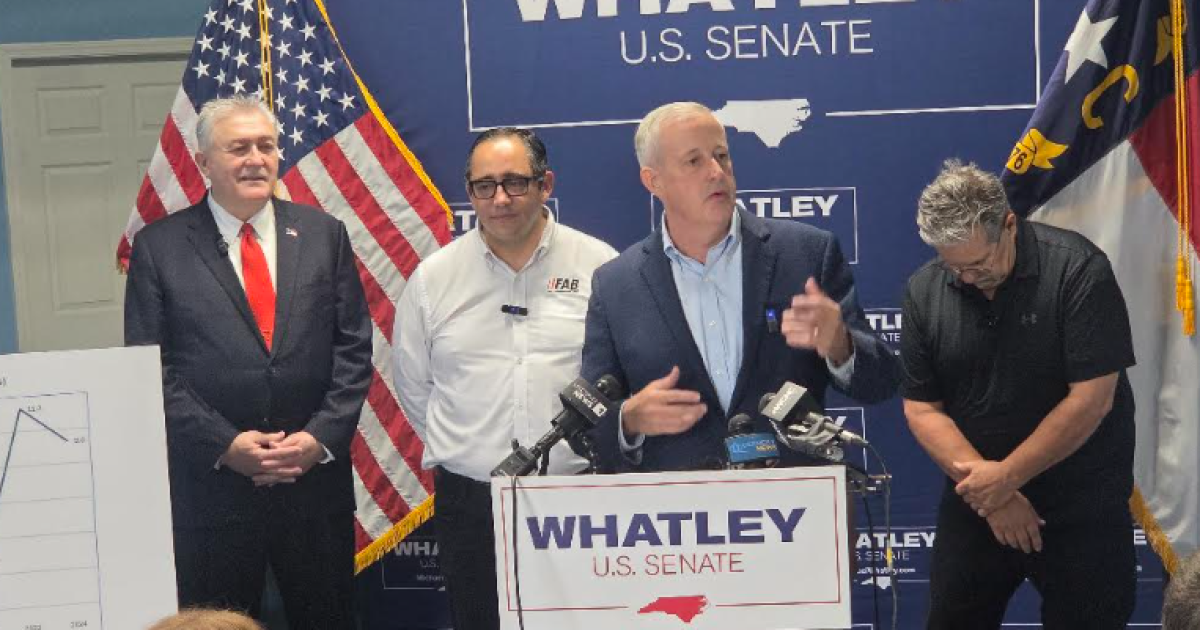
In the U.S. Senate race, Democrat Roy Cooper — the state’s former governor — has held consistent polling leads of 8 to 10 percentage points over Republican Michael Whatley. Harrison said nothing in the early voting data contradicts those polls, making Cooper a heavy favorite heading into Election Day.
Other contests may hinge more directly on whether the current turnout patterns hold. Political observers are watching closely to see if Democrats can flip control of the state House, though few expect the state Senate to change hands. Competitive congressional races in the 11th District in the western mountains and the 1st District along the rural northeast and coast — both areas where Republicans hold registration advantages — are also drawing attention.
Shumaker went further, suggesting that even Republicans in districts considered reliably safe — including incumbents Richard Hudson, David Rouzer, and Tim Moore — could be at risk if the turnout disparity widens. He put it bluntly:
“If Democrats make up 35% and Republicans make up 27% it’s going to be a bad night for a lot of people.”
— Paul Shumaker
To illustrate how dramatically wave elections can upend expectations, Shumaker recalled a striking historical parallel:
“A lot of people don’t remember that in 1994 a guy named Tom Foley lost. He was speaker of the U.S. House of Representatives. His district wasn’t on anything.”
— Paul Shumaker
With five days of early voting still ahead, the final composition of the early electorate remains in flux. Each day’s numbers will offer fresh signals about which party’s voters are motivated — and what that motivation might mean for North Carolina’s elections on Tuesday.









Comments are closed.