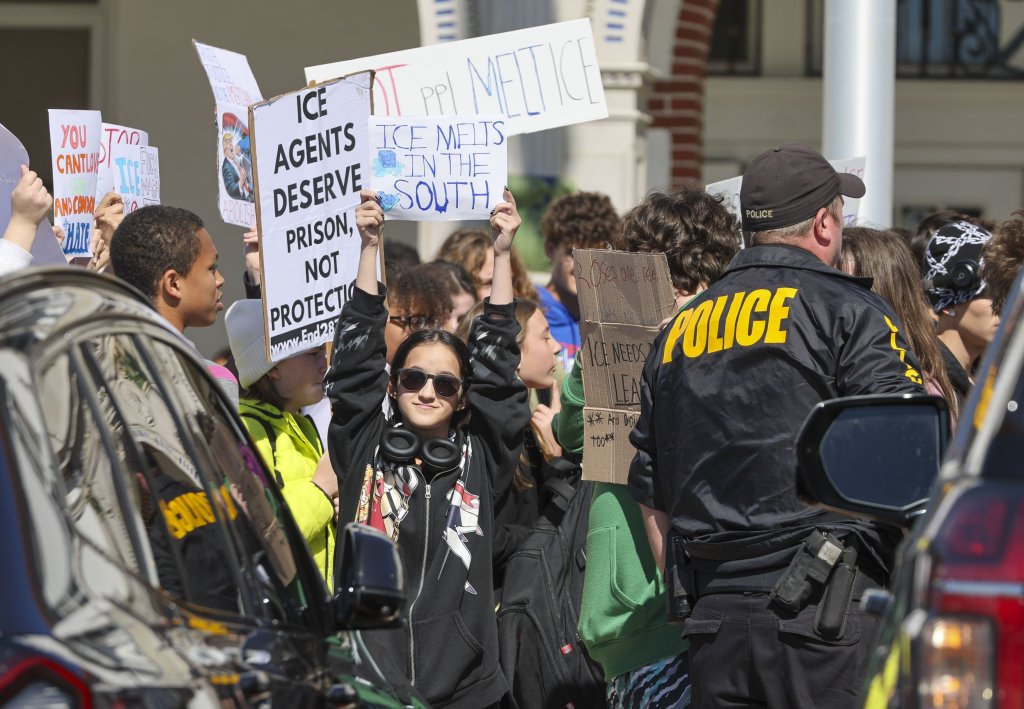
The halls of St. Petersburg High School have recently been tumultuous, echoing the voices of students uniting in protest. Spearheading this movement is senior Liam Fisher, who, along with his peers, has been vocal about their disagreement with federal immigration enforcement activities in Minnesota.
“I don’t particularly like (that) our country is sending untrained people, arming them, giving them money to kidnap people, murder them,” expressed Fisher, aged 17. His dissatisfaction led to organizing a series of walkouts during school hours.
Over several days, the protest saw significant participation, with dozens of students from St. Petersburg High and thousands from other schools joining in, leaving school administrators with the task of deciding on disciplinary actions. Fisher faced a major campus disruption charge, equivalent to making a bomb threat, resulting in a three-day suspension, which his family contested.
State officials have been pressuring schools to suppress protest activities and scrutinize educators who support them. Education commissioner Anastasios Kamoutsas has urged parents to report any school staff encouraging student walkouts, promising swift action.
In one notable incident, two Hillsborough County lawmakers demanded the removal of a principal’s certification for allegedly aiding a student protest. The principal had redirected the protest to the school’s football field instead of punishing the students.
This has left educators in a precarious position, balancing safety and support for students’ rights to express themselves with the risk of state repercussions. Schools have been issuing warnings to families about the potential consequences of participating in protests.
Disciplinary responses have varied across Florida, with some schools issuing reprimands and others opting for suspensions. However, specific data on these actions is not available as each case is handled individually by local school boards.
“In general, you always look at what is the accusation and what is the code (of conduct), then match the discipline to the code,” said Kevin Hendrick, Pinellas County superintendent.
New Pressure on Protesters
The state’s current approach contrasts with previous reactions to student protests. In 2018, after the Parkland shooting, students’ political walkouts were seen as opportunities for learning and discussion. Similarly, in 2022, when students opposed legislation limiting LGBTQ+ discussions in classrooms, they were allowed to express their views without facing punishment.
Pasco County’s former superintendent, Kurt Browning, recalled that during those times, the state remained uninvolved, allowing principals to exercise their discretion. “We never punished anybody. We didn’t have to. We allowed them to do what they wanted to do within reason, and they went back to class,” Browning remarked.
Eliza Lane, who participated in a 2023 protest against the removal of “The Bluest Eye” from the curriculum, noted that the administration seemed more concerned about getting into trouble themselves than about disciplining students. Lane, now at the University of Florida, emphasized the need for school administrators to be courageous amidst growing state pressures.
For Students, No Regrets
Teachers and union leaders have denied allegations of encouraging student protests, focusing instead on ensuring students’ safety while they express their rights. “Neither PCTA nor the (Florida Education Association) has ever encouraged or participated in student walkouts concerning any topic,” stated Lee Bryant, president of the Pinellas Classroom Teachers Association.
Despite the risks, students like Fisher remain resolute. His three-day suspension, initially equated to an offense like inciting a riot, was later reduced to “inciting a disturbance” by Principal Darlene Lebo. This adjustment spared him from state reporting requirements.
Fisher, aspiring to study marine biology at the University of California, San Diego, sees the disciplinary actions as paradoxical. “For three days I got to sleep in, I tried to do schoolwork, and I slept in some more,” he reflected, pointing out the irony in being punished with what felt like a reward.
Fisher remains firm in his decision to protest, stating, “In my situation I felt as though this was not something I was going to regret. I still feel that.”
©2026 Tampa Bay Times. Visit tampabay.com. Distributed by Tribune Content Agency, LLC.
Read More Here