
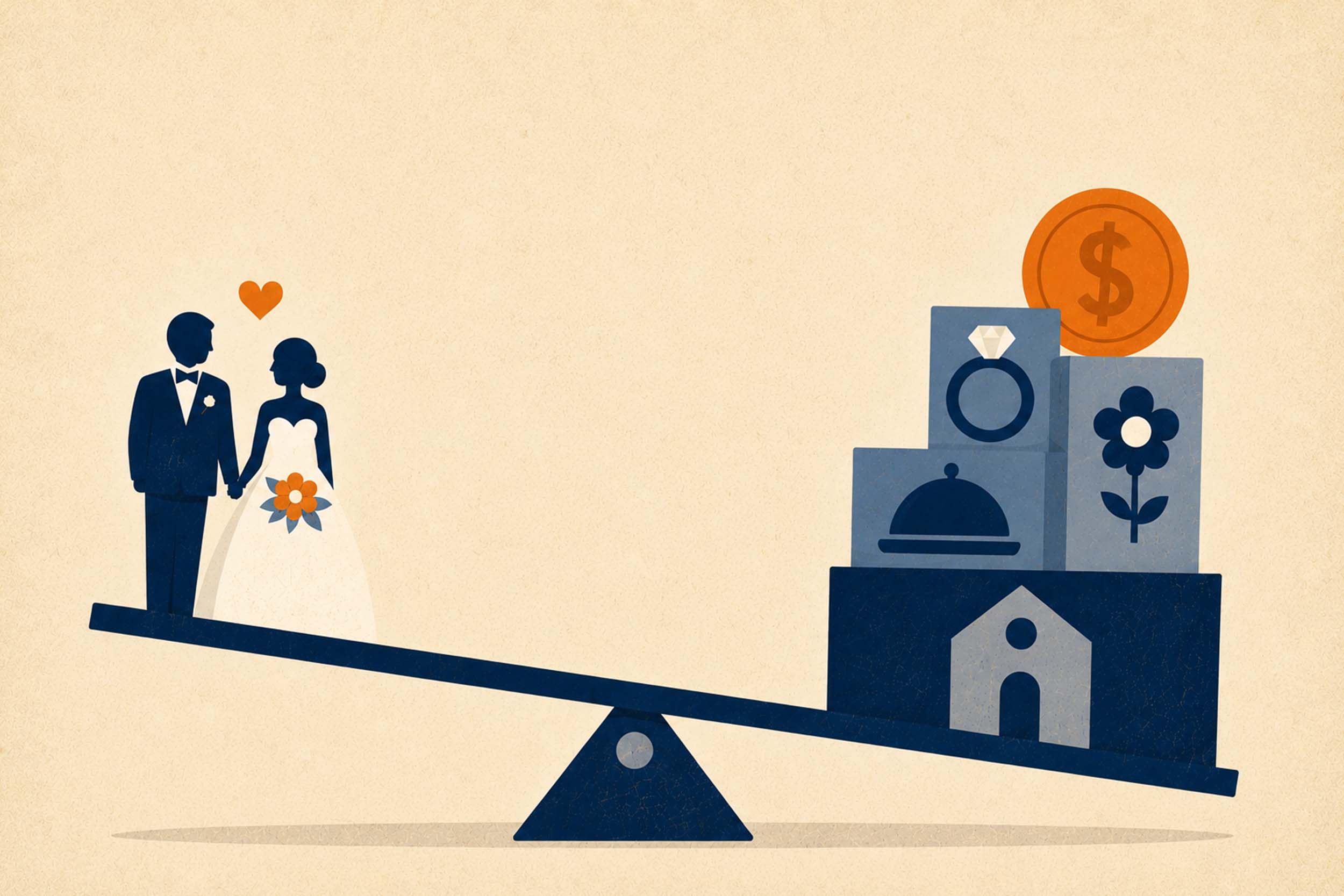
Weddings are cherished events, often viewed as one of life’s most memorable milestones. However, they also come with a hefty price tag which many are willing to pay despite the financial strain.
Zola, an online wedding registry and planner, reports that the average cost of a wedding in the U.S. reached $36,000 in 2025. This figure stands in stark contrast to the median personal income, which hovers around $45,000 annually.
Despite the high costs, an overwhelming 95% of couples believe the expense is justified, even though more than half end up in debt to afford their dream wedding. The question arises: when did weddings become as costly as buying a new car?
To understand this trend, UVA Today consulted Luca Cian, a consumer psychology expert at the University of Virginia’s Darden School of Business, who provided insights into why couples invest so heavily in their nuptials.
Inflation and Beyond
Cian acknowledges inflation as a contributing factor but notes it only partly explains the rising costs. From 2019 to 2024, wedding budgets surged by 30%, a rate surpassing inflation. This increase is partly due to couples prioritizing “guest experience,” investing in elements like ambient lighting, signature cocktails, and social media-friendly installations—expenses that were rare a decade ago. The wedding industry has realized it can charge increasingly higher prices without significant resistance.
The Influence of Advertising
Advertising has played a pivotal role in shaping the contemporary American wedding. Cian cites the example of diamond engagement rings: “In 1940, only about 10% of American first-time brides received a diamond engagement ring. By 1990, after decades of De Beers’ ‘A Diamond is Forever’ campaign and the famous ‘two months’ salary’ rule, that figure was around 80%.” Advertising often reframes aspirations as obligations, making it difficult for couples to opt for less without feeling they are failing.
Social Media’s Role
Social media amplifies the pressures introduced by advertising. Platforms like Pinterest, Instagram, and TikTok expose couples to idealized wedding scenarios, intensifying the “performance economy.” Around 40% of couples now request “social-first” content from their photographers, aiming for materials suited for sharing on social platforms. Weddings have evolved into both private celebrations and public performances.
Why Spend So Much?
Weddings are deeply hedonic and identity-defining events, which are categories where consumers are most inclined to overspend. Research by Cian and Chiara Longoni highlights that people approach hedonic experiences differently from utilitarian ones, where emotion and personal meaning take precedence over price. Weddings are also public identity statements, reflecting a couple’s values and social status.
The extended planning process, averaging 20 months, creates a “sunk-cost trap” where additional costs seem minor compared to the total investment. Vendors capitalize on this by strategically offering upsells throughout the planning phase.
Read More Here





![Robert Harmon Celebrates 99th Birthday at UVA’s Homecomings Weekend[embed]https://www.youtube.com/watch?v=c_VPFnE8x-w[/embed]](https://realnewsfast.com/wp-content/uploads/2026/10/Robert-Harmon-Celebrates-99th-Birthday-at-UVAs-Homecomings-Weekendembedhttpswwwyoutubecomwatchvc_VPFnE8x-wembed-300x200.jpg "Robert Harmon Celebrates 99th Birthday at UVA’s Homecomings Weekend[embed]https://www.youtube.com/watch?v=c_VPFnE8x-w[/embed]")
![Environmental Opera “Auksalaq” Opens UVA’s Arts on the Hill Series[embed]https://www.youtube.com/watch?v=PjYuP9wh3Hw[/embed]](https://realnewsfast.com/wp-content/uploads/2026/10/Environmental-Opera-Auksalaq-Opens-UVAs-Arts-on-the-Hill-SeriesembedhttpswwwyoutubecomwatchvPjYuP9wh3Hwembed-300x200.jpg "Environmental Opera “Auksalaq” Opens UVA’s Arts on the Hill Series[embed]https://www.youtube.com/watch?v=PjYuP9wh3Hw[/embed]")
![New documentary explores Elizabeth Holmes’ final days before prison[embed]https://www.youtube.com/watch?v=GGJSRFWALTI[/embed]](https://realnewsfast.com/wp-content/uploads/2026/10/New-documentary-explores-Elizabeth-Holmes-final-days-before-prisonembedhttpswwwyoutubecomwatchvGGJSRFWALTIembed-300x200.jpg "New documentary explores Elizabeth Holmes’ final days before prison[embed]https://www.youtube.com/watch?v=GGJSRFWALTI[/embed]")