
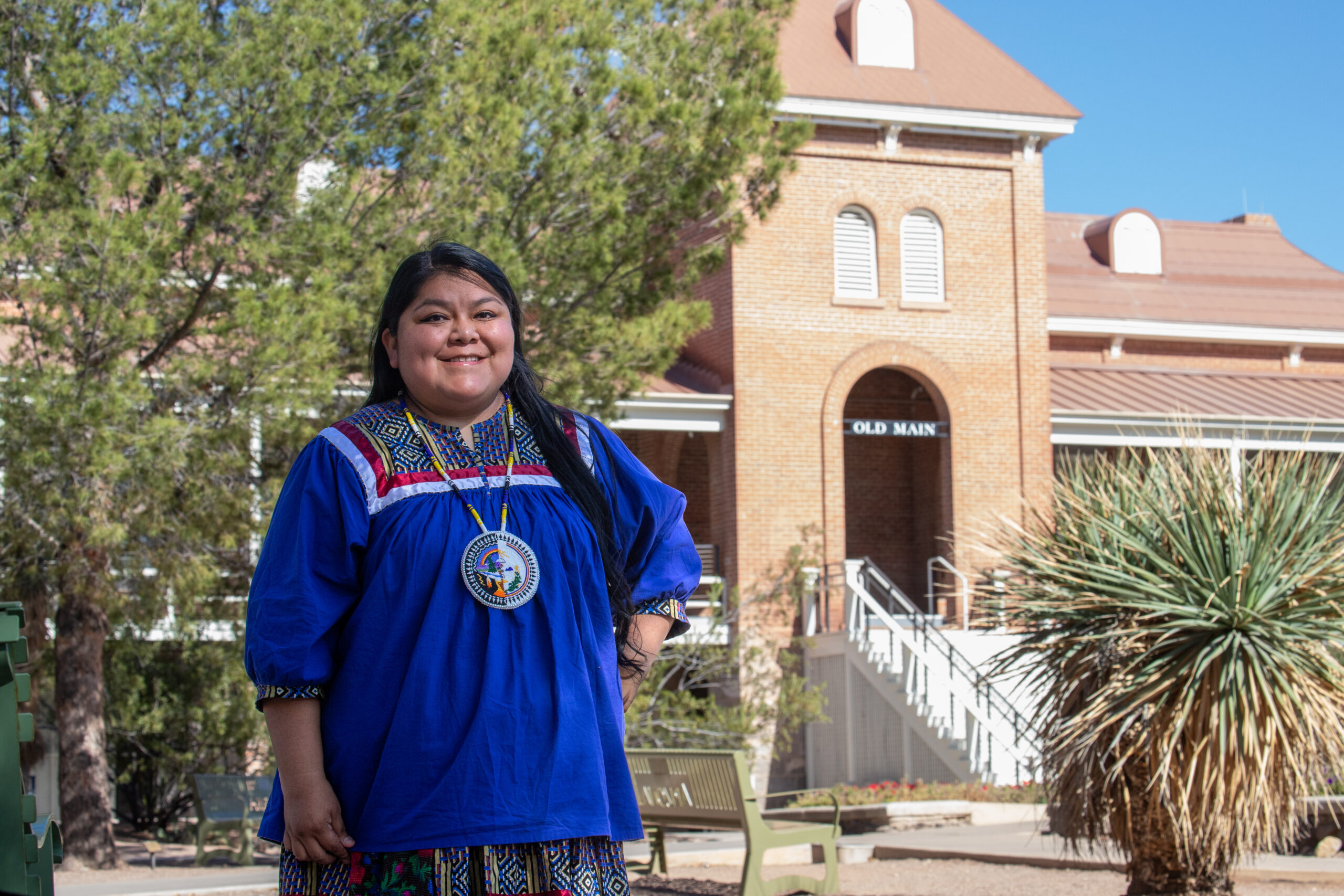
Amid the vast landscapes of Arizona’s White Mountains lies a story of tradition and innovation. Shannon Taylor, a dedicated student from the Fort Apache Indian Reservation, is soon to graduate with a degree that honors her roots while paving the way for future conservation efforts.
Shannon Taylor has spent her life immersed in the cultural richness of the White Mountain Apache and Navajo tribes. Her upbringing involved engaging in traditional ceremonies, fishing, and exploring the natural world with her family. These experiences have shaped her career ambitions.
Taylor is set to earn her Bachelor of Science in geographical information systems technology from the University of Arizona. Her work in cartography, the art and science of map-making, is inspired by the White Mountain Apache’s historical role as stewards of their land.
“My ancestors, they fought for the land. They’re the reasons we’re still here, because they did not give up,” Taylor shared. Completing her degree through Arizona Online, she looks forward to joining their Professional Science Master’s program in resilience practice.
Committed to Ancestral Lands
After completing her education at East Fork Lutheran School and Northland Pioneer College, where she earned an Associate of Arts degree in 2012, Taylor applied her skills in service to the White Mountain Apache Tribe. Her artistic talents were evident early, developed through learning traditional Apache crafts.
Beadwork depicts half of each seal from Taylor’s tribes: White Mountain Apache and Navajo.
Kyle Mittan/University Communications
During the COVID pandemic, Taylor seized the opportunity to further her education at Tohono O’odham Community College, which was offering free tuition to enrolled tribal members. It was a chance to study life sciences and natural resources without leaving her homeland.
“My main goal with obtaining my education is to help my tribe or any other tribal communities, to apply my knowledge of GIS to help with tribal conservation efforts, land management and other tribal environmental issues,” Taylor said. “I grew up here, I’m still here, and I plan to stay here on my ancestral lands.”
Mapping Her Future
At TOCC, Taylor expanded her expertise, acquiring a certificate in geographic information systems. Her inspiration partly stemmed from her aunt, a cartographic technician for the White Mountain Apache Tribe and the Bureau of Indian Affairs.
Taylor recognized the importance of GIS in tribal conservation and land management. “She’s very knowledgeable about the land and resources that the tribe has,” Taylor said, expressing her aspiration to follow her aunt’s path.
As she sought a bachelor’s program, Taylor was drawn to the University of Arizona’s GIS technology program, known for its high rankings. Despite being three-and-a-half hours away from Tucson, she connected with the campus community through various clubs, including the American Indian Science and Engineering Society and the Native FEWS Alliance.
“I asked to join clubs and some of them were really open about opening it to online students,” Taylor explained. Her involvement allowed her to attend conferences and gain support from the Indigenous Resilience Center.
Additionally, Taylor had the chance to study abroad in Italy, enriching her educational experience. “The U of A has helped me grow in so many different ways,” she added. “The personal and professional growth that I experienced is something that I could have never been able to achieve without them.”
Advocating for the Next Generation
For the past two years, Taylor has worked with the U.S. Department of Agriculture’s National Institute for Food and Agriculture, aiding forestry-related programs. She collaborates with the Confederated Salish Kootenai Tribes and the Leech Lake Band of Ojibwe.
Upon graduation, Taylor will transition to a GIS-focused role, applying her map-building skills to support forestry research. She sees GIS as a powerful tool for addressing challenges on tribal lands, such as the lack of physical addresses for homes.
Highlighting the importance of ecological conservation, Taylor noted the recovery of the Apache trout, a species once endangered. “Things like that, tribal issues, they have to be mapped,” Taylor emphasized. “They have to be presented in GIS data in order to obtain funding for protection and rehabilitation efforts.”
As a Native GIS specialist, Taylor aims to integrate traditional ecological knowledge into her work. “So much Indigenous science is finally being acknowledged by Western science, and we’ve known it for centuries,” she said.
“Indigenous knowledge was taught to us by our ancestors, to help protect and preserve the environments around us,” she added. “I hope to be able to do that for the next generation.”
Read More Here





Be First to Comment