
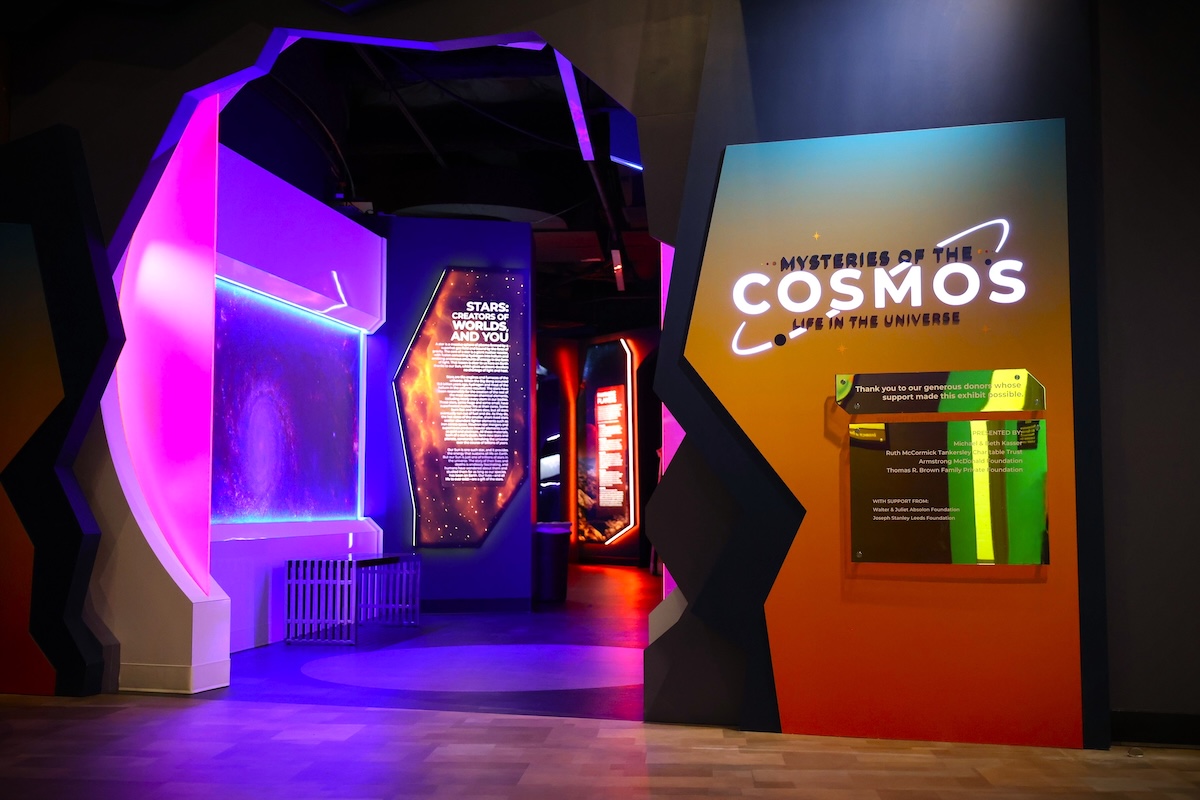
Visitors to the University of Arizona this weekend can embark on a celestial journey at the Flandrau Science Center & Planetarium’s latest exhibit, “Mysteries of the Cosmos: Life in the Universe.” This new attraction delves into the age-old question: Are we alone in the universe?
Starting Saturday, May 2, the exhibit opens its doors to the public, celebrating the exploration of space and highlighting the pivotal research conducted by University of Arizona scientists in the quest for extraterrestrial intelligence.
The Flandrau team found inspiration for the exhibit from a lecture given at the 2025 College of Science Lecture Series. The lecture featured Chris Impey, co-department head and distinguished professor of astronomy, alongside Daniel Apai, professor of astronomy and planetary sciences, both from the Department of Astronomy and Steward Observatory.
The lecture series focused on the science of communication, where Impey and Apai explored how humans might communicate with extraterrestrial life if it exists. They pondered questions like how to initiate contact, whether aliens would understand us, and if such communication should even be attempted.
“Contact with an alien civilization could be the greatest discovery and the most transformational event in human history,” Apai remarked during the event, a sentiment that heavily influenced the exhibit’s creation.
“We were inspired by their lecture because it touched on so many different areas of research that take place every day at the University of Arizona: astronomy and planetary science, chemistry and biology,” said Bill Plant, the exhibits director. “I think we’ve been asking that question around the campfire since we developed the ability to communicate with one another: What else is out there, and if we’re not alone – what could we learn from them? I think it’s one of those things that’s ingrained into the fabric of human nature.”
Incorporating the insights of Apai, Impey, and other U of A researchers, Plant and his team crafted the exhibit within a space of approximately 1,000 square feet, aiming to encapsulate humanity’s long-standing curiosity and the extensive research it has inspired.
An Astronomical Adventure
“Mysteries of the Cosmos” commences near the “Wild World of Bugs” exhibit, with guests welcomed by a stunning floor-to-ceiling photograph of Tucson’s night sky, captured by local photographer Sean Parker. This visual tribute not only honors Southern Arizona’s significant role in astronomy but also sets the stage for the cosmic exploration that follows.
Upon entering, visitors encounter a thought-provoking quote from Steve Kortenkamp, professor of practice of planetary sciences, highlighting the vastness of the universe:
“If you could ride on a beam of light, how far could you go? In just one second, you’d reach the Moon. In only a few minutes you could be at Mars. After about a day you’d still only be as far as Voyager 1, the spacecraft humanity launched in 1977. To reach the nearest stars would take over four years. And the light from the most distant galaxies we can see has been traveling toward us for 13.5 billion years. Light may be fast, but the universe is unimaginably big.”
The journey into space continues with a rocket-building activity. Designed like an arcade game, this interactive experience invites participants to select components and navigate a path to the moon, Mars, or Earth’s orbit.
After illustrating the immense scale of space and the complexities of rocketry, the exhibit delves into the search for alien life, examining the extensive research required for such a venture. It begins by exploring how stars influence the universe’s evolution and concludes with the provocative question: If extraterrestrial life exists, is it wise to initiate contact?
Throughout this exploration, the exhibit reflects on the contributions of classical philosophers and University of Arizona researchers, from discovering the first exoplanet to constructing the world’s most advanced telescope mirrors.
“The University of Arizona is at the forefront of so many research endeavors, from the imaging of planets to capturing asteroids, and this exhibit gives you the chance to ponder some of the universe’s biggest questions,” Plant noted.
Read More Here



![Arizona’s Drive48 Boosts Workforce with New Training Centers[embed]https://www.youtube.com/watch?v=W0T6eWBdLd8[/embed]](https://realnewsfast.com/wp-content/uploads/2026/04/Arizonas-Drive48-Boosts-Workforce-with-New-Training-CentersembedhttpswwwyoutubecomwatchvW0T6eWBdLd8embed-300x159.jpg "Arizona’s Drive48 Boosts Workforce with New Training Centers[embed]https://www.youtube.com/watch?v=W0T6eWBdLd8[/embed]")




Be First to Comment