
The University of Virginia Revives Jefferson’s Architectural Vision
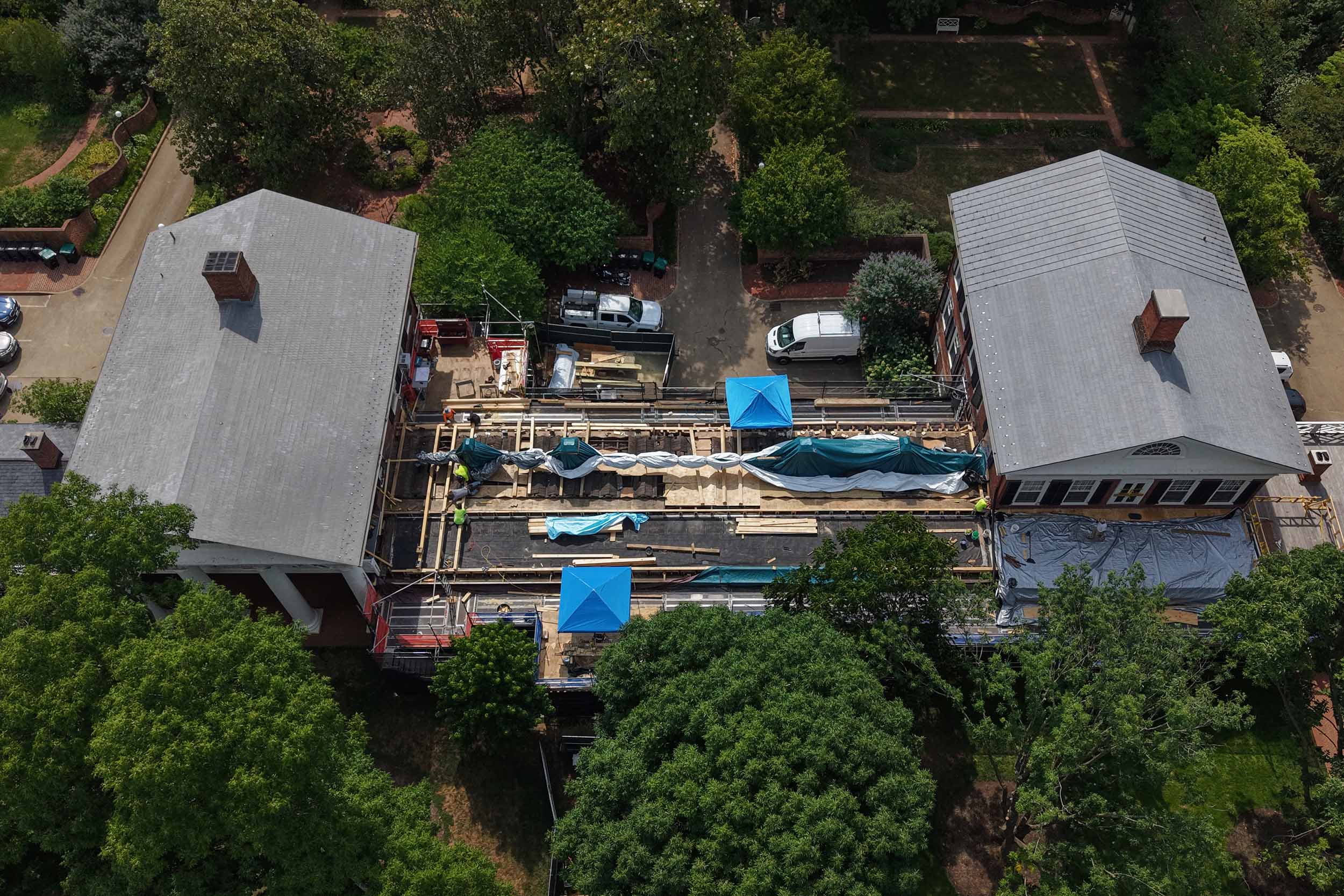
In a project that marries historical accuracy with modern technology, the University of Virginia is restoring the iconic skyline of its Academical Village, originally designed by Thomas Jefferson. This effort seeks to bring back the historical flat-roof design that Jefferson initially envisioned.
Jefferson’s original design featured uniquely structured roofs: flat decks atop serrated, angled bases. These roofs allowed water to pass through deck boards, channeling through tin-lined valleys before reaching the ground. However, by the 1830s, issues with leaks led to the installation of pitched slate roofs, which covered and preserved Jefferson’s initial structures.
According to project manager Amy Moses, “These are the Jefferson serrated roofs – the ‘ridge and furrow,’ as it was called in the day.” Some sections of these historical roofs survived changes made in the 1830s and further renovations in the 1990s.
Since 2010, the university has been systematically restoring these roofs, starting on the west side of the Lawn and gradually moving to the east. The restoration involves removing the gable roofs and reverting to a flat roof design. Moses explained, “We are removing the gable roofs and going back to a flat roof. It is slightly higher than the Jefferson era/designed roofs, because we are preserving the remaining portions of the Jefferson era roof underneath the new, but it’s mostly in line with where Jefferson would have had his flat roof.”
While these new roofs appear Jeffersonian, they incorporate advanced materials and techniques. The updated design uses layers of rubber membrane supported by “sleepers,” providing durability and structural integrity. In addition to roof restoration, workers are replacing the Chinese rails with those that match Jefferson’s original design, correcting years of misaligned and altered rail patterns.
Read More Here


![Robert Harmon Celebrates 99th Birthday at UVA’s Homecomings Weekend[embed]https://www.youtube.com/watch?v=c_VPFnE8x-w[/embed]](https://realnewsfast.com/wp-content/uploads/2026/10/Robert-Harmon-Celebrates-99th-Birthday-at-UVAs-Homecomings-Weekendembedhttpswwwyoutubecomwatchvc_VPFnE8x-wembed-300x200.jpg "Robert Harmon Celebrates 99th Birthday at UVA’s Homecomings Weekend[embed]https://www.youtube.com/watch?v=c_VPFnE8x-w[/embed]")
![Environmental Opera “Auksalaq” Opens UVA’s Arts on the Hill Series[embed]https://www.youtube.com/watch?v=PjYuP9wh3Hw[/embed]](https://realnewsfast.com/wp-content/uploads/2026/10/Environmental-Opera-Auksalaq-Opens-UVAs-Arts-on-the-Hill-SeriesembedhttpswwwyoutubecomwatchvPjYuP9wh3Hwembed-300x200.jpg "Environmental Opera “Auksalaq” Opens UVA’s Arts on the Hill Series[embed]https://www.youtube.com/watch?v=PjYuP9wh3Hw[/embed]")
![New documentary explores Elizabeth Holmes’ final days before prison[embed]https://www.youtube.com/watch?v=GGJSRFWALTI[/embed]](https://realnewsfast.com/wp-content/uploads/2026/10/New-documentary-explores-Elizabeth-Holmes-final-days-before-prisonembedhttpswwwyoutubecomwatchvGGJSRFWALTIembed-300x200.jpg "New documentary explores Elizabeth Holmes’ final days before prison[embed]https://www.youtube.com/watch?v=GGJSRFWALTI[/embed]")