Despite facing financial challenges, Broward County schools have made notable improvements in recent state assessments, outpacing the statewide averages in both math and English. This progress comes amid concerns over declining enrollment and budget issues within the district.
Since the introduction of the Florida Assessment of Student Thinking (FAST) in 2024, Broward County has seen a steady rise in passing rates. The FAST exam, conducted three times annually from voluntary prekindergarten to 10th grade, aims to track and enhance student progress throughout the academic year.
“Progress Monitoring 2,” the second of the three tests, serves as a mid-year assessment. Fabian Cone, the chief academic officer, remarked on the district’s positive trajectory, stating the approach is proving effective.
Enhancements in English and Math Results
Significant improvements were observed in English Language Arts at the elementary level, with fourth and fifth graders showing an 8% increase in passing rates compared to 2024. Fifth graders also demonstrated the largest gains in math, achieving higher scores of Level 3 and above.
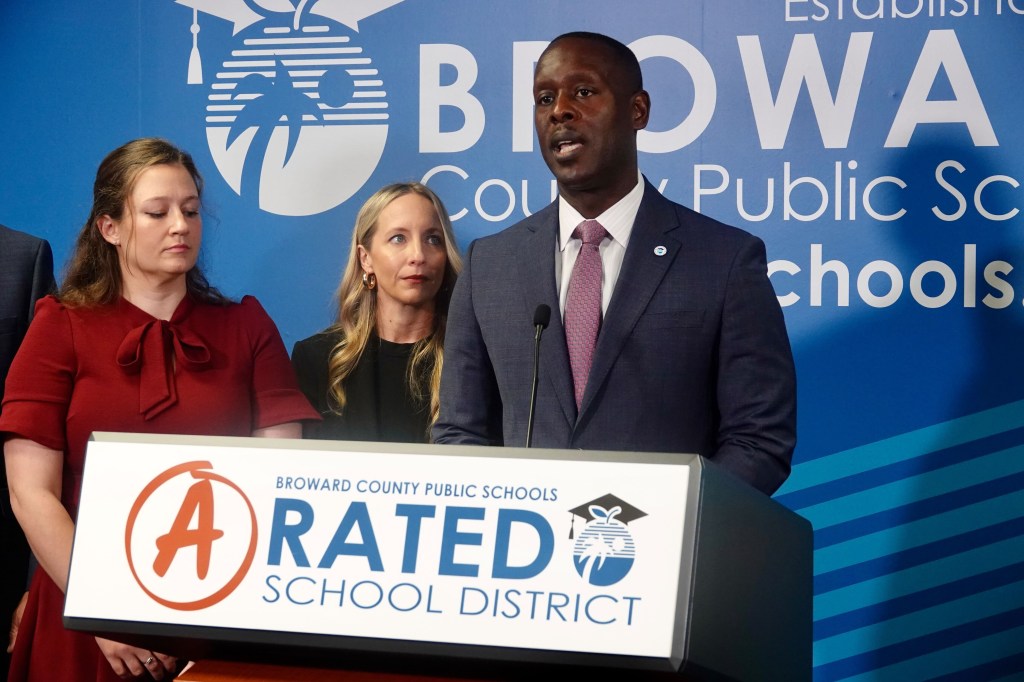
During a recent school board workshop, member Allen Zeman highlighted the advancement of 25,000 students who moved from at or below grade level to above grade level, emphasizing the magnitude given the district’s 187,000-strong student body.
The results were welcomed by board members, especially during financially troubled times for the sixth-largest district in the nation. With 50,000 empty seats, the district faces a $94 million budget deficit due to a decrease of 10,000 students from the previous year, leading to impending job cuts, excluding teachers.
Financial Struggles Amid Academic Progress
Broward County Public Schools are also dealing with various financial controversies, including a sudden withdrawal from a $3 million office-space lease, misallocated teacher referendum funds, and a failed procurement process for construction oversight.
Zeman pointed out, “Three to 5% growth (in passing levels) every year during a time where we are dramatically underfunded as an education system and now in which we’re in fiscal urgency, crisis — whatever you wanna describe it as — that to me is a big deal.”
Board member Nora Rupert reassured parents of the district’s commitment to progress, even amidst financial difficulties, asserting that the work needed in classrooms across the district is being accomplished.
English Language Arts Performance
Every grade level exceeded the state average in the mid-year FAST exam. Fourth and fifth graders increased their scores of Level 3 and above by 9 percentage points since 2024. For instance, 52% of Broward’s fifth graders achieved these scores, surpassing the state’s 48%.
The most substantial gain in ELA passing rates was among seventh graders, jumping from 42% in 2025 to 55% in 2026, a 13-point rise. This was attributed to the “Science of Reading,” a literacy approach grounded in evidence-based methods for enhancing reading comprehension.
While Black, Hispanic, and white students have improved, disparities persist. White students had the highest scores at 66%, followed by Hispanic students at 50%, and Black students at 42%. Rupert emphasized the need for substantial progress in closing these gaps.
Richard Baum, director of Educational Assessment, Analysis and Research, expressed optimism about the district’s overall and demographic-specific improvements.
Mathematics Outcomes
Fifth graders showed a notable 9% increase in Level 3 and above scores compared to 2024. Seventh graders also marked an 11% rise over three years, while sixth-grade passing rates remained stable at 44%.
Despite progress across different racial and ethnic groups, performance gaps remain. The gap between white and Black students was 27 points, and the white-Hispanic gap was 16 points, both slightly increasing since 2024.
Challenges with Testing Standards
Andrew Spar, president of the Florida Education Association, raised concerns about declining national test scores despite improvements in state assessments. He noted, “If we truly want to have the world-class education systems we should have here in Florida, then we’ve got to look a little broader than just the state assessments.”
Florida’s National Assessment of Educational Progress scores ranked the state in the lower half for math and reading, though it performed better in science and writing. Additionally, SAT scores have also decreased.
Spar suggested that frequent changes in state testing methods, such as the switch to FAST, might contribute to these discrepancies. Board member Jeff Holness also highlighted the challenges in comparing assessments across different years due to varying benchmarks.
Concerns about over-testing were also discussed, with board members acknowledging the pressure on teachers to prioritize state exam performance over individual student achievement. Rupert emphasized the importance of maintaining focus on everyday teaching and relationships that significantly impact students’ lives.
Reporting by WUSF 89.7 was used in this story.
Read More Here