

As climate change continues to impact ecosystems worldwide, a recent study uncovers how rising stream temperatures could be altering the intricate balance of river food webs. Researchers have discovered that increased water temperatures might significantly affect how carbon is processed within these aquatic environments.
A study conducted by Northern Arizona University and published in the journal Ecosphere reveals that with warmer water temperatures, microbes and aquatic insects accelerate the decomposition of organic matter, such as leaves and twigs. However, a smaller portion of this organic matter contributes to their growth, while a larger share is emitted into the environment as carbon dioxide.
These findings indicate a shift in energy retention within river ecosystems under warming conditions, which could have significant implications for plant and animal life in rivers across the western United States. “Warming doesn’t just speed up biological processes in streams—it changes how efficiently organisms turn carbon into biomass, with more of it being lost as CO₂,” stated Michael Zampini, a postdoctoral researcher at NAU and lead author of the study.
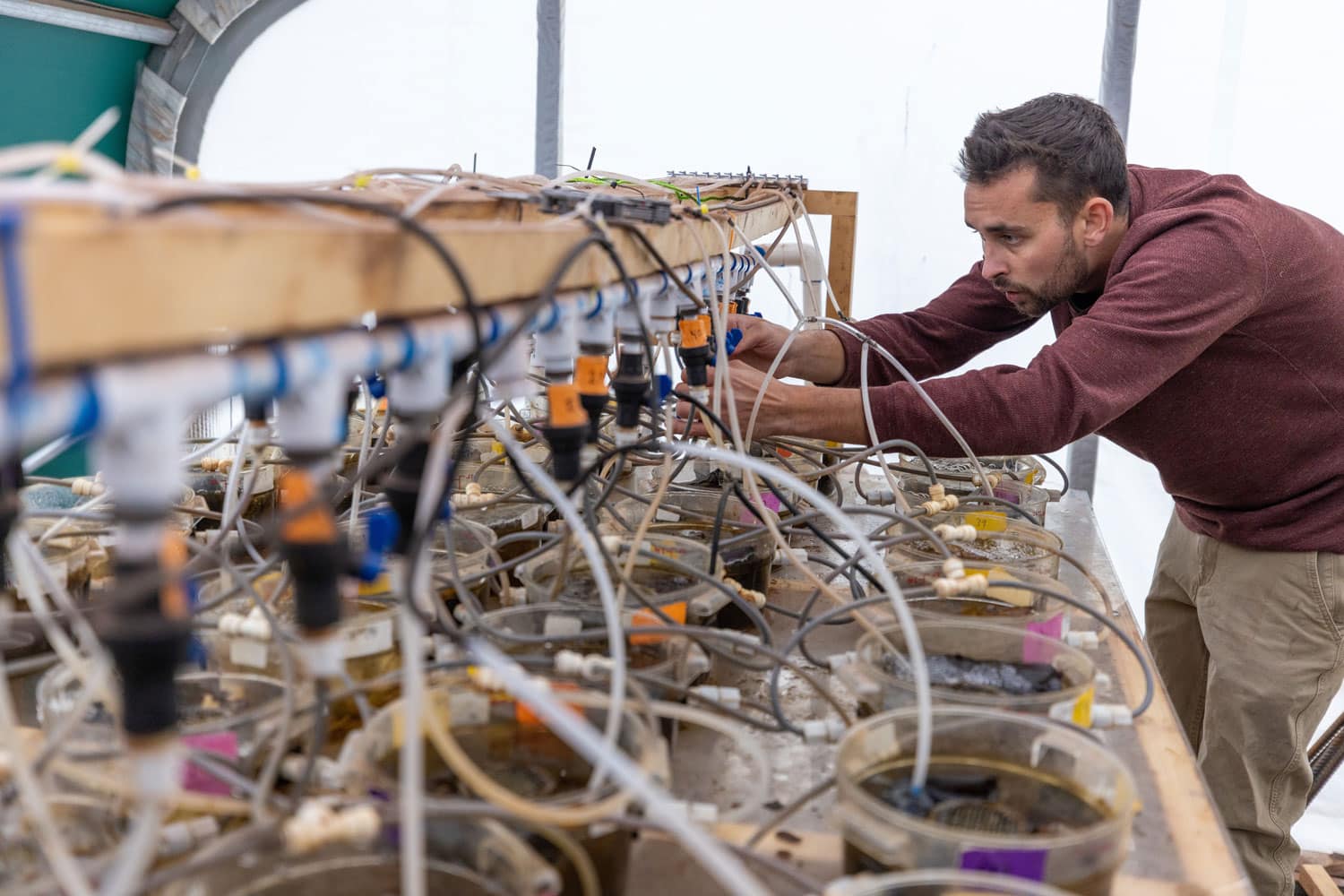
A Controlled Stream System at The Arboretum
To explore the effects of warming on river processes, researchers at NAU constructed a controlled stream system at The Arboretum at Flagstaff. This setup included 48 mini stream chambers inside a greenhouse, where pond water temperatures were manipulated while maintaining natural light and water chemistry. This innovative approach simulated various stream conditions over two years.
Zampini explained, “This system let us manipulate temperature while keeping everything else as close to a real stream as possible, which is critical for understanding how these processes actually play out in nature.”
Within this controlled environment, the team used tracers to monitor carbon flow from leaf litter into microbes and caddisflies. By labeling leaves with a rare carbon isotope, they measured carbon retention as biomass, its release as CO₂, and its transfer to microbes and insects. This allowed them to assess how effectively organisms converted food into growth.
Implications of Faster Processing and Lower Retention
The study found that as temperatures rose, decomposition rates increased, but more carbon was lost as CO₂ instead of being incorporated into biomass. Caddisflies exhibited a distinct thermal response, with low temperatures limiting their activity, intermediate temperatures maximizing their efficiency, and higher temperatures boosting consumption without corresponding biomass gains. These patterns suggest that warming results in more carbon being released into the atmosphere and less converted into biomass.
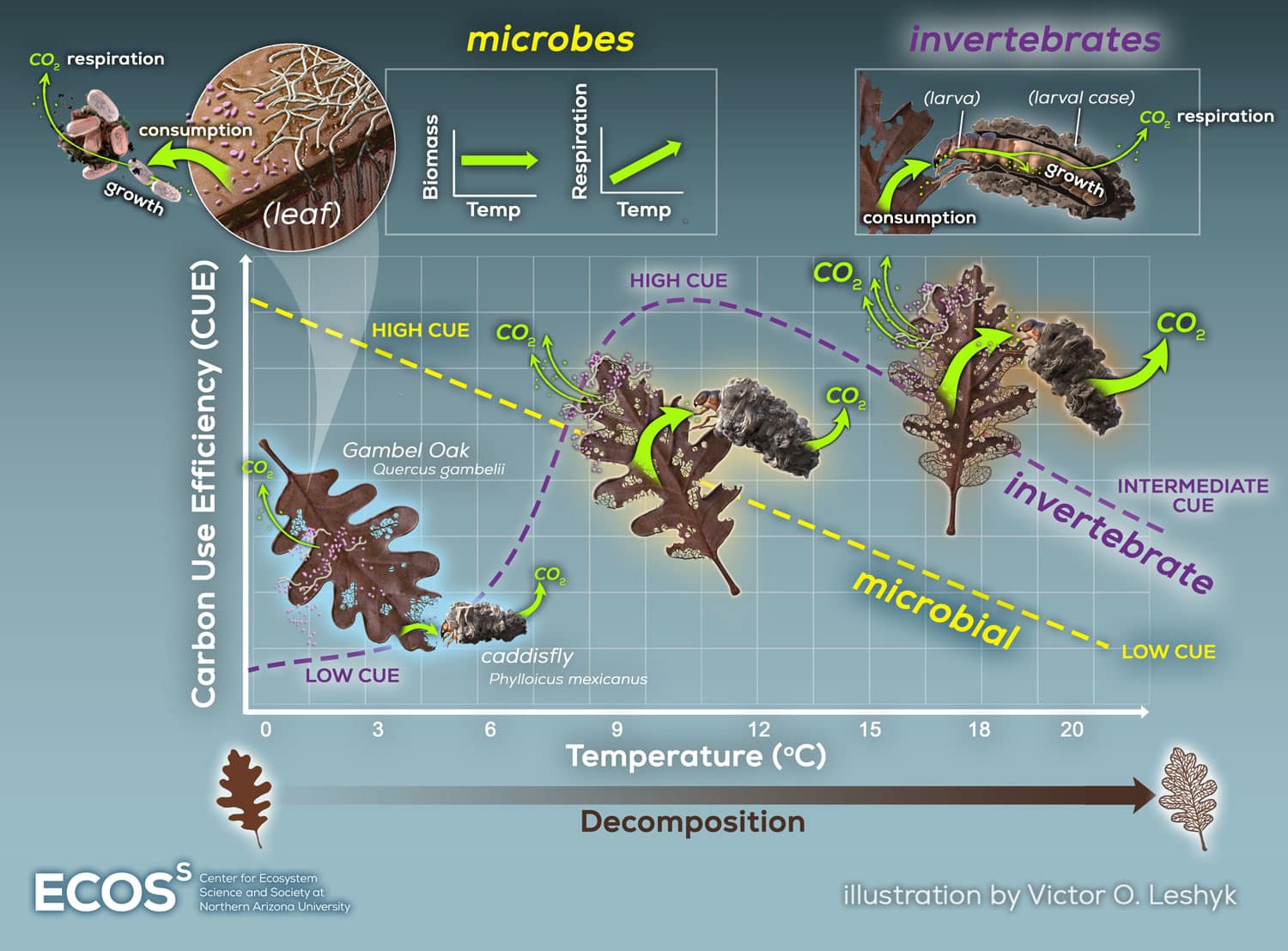
Jane Marks, a professor at NAU’s Department of Biological Sciences and the Center for Ecosystem Science and Society, noted, “Even when consumption increases, the system becomes less efficient—more carbon goes to respiration and less to building the food web.”
This shift has broader implications for rivers in the Southwest, where aquatic insects link leaf litter to animals higher on the food chain, such as fish. Declines in carbon use efficiency for microbes and insects mean more carbon entering rivers may be lost to the atmosphere, reducing energy available to aquatic food webs.
Marks emphasized the potential consequences: “When less carbon is retained in biomass, there is less energy available to support aquatic life, which can ripple through the food web and ultimately affect fisheries, water quality, and ecosystem stability that people depend on.”
The research team also included University of Alabama professor Steven Thomas and NAU researchers George Koch, Benjamin Koch, Paul Dijkstra, and Victor Leshyk at Ecoss. The study received funding from the National Science Foundation (DEB-1120343).

Jill Kimball | NAU Communications
(928) 523-2282 | jill.kimball@nau.edu
Read More Here







Comments are closed.