The Shift in STEM Education: Encouraging Girls’ Participation Amidst Post-Pandemic Challenges
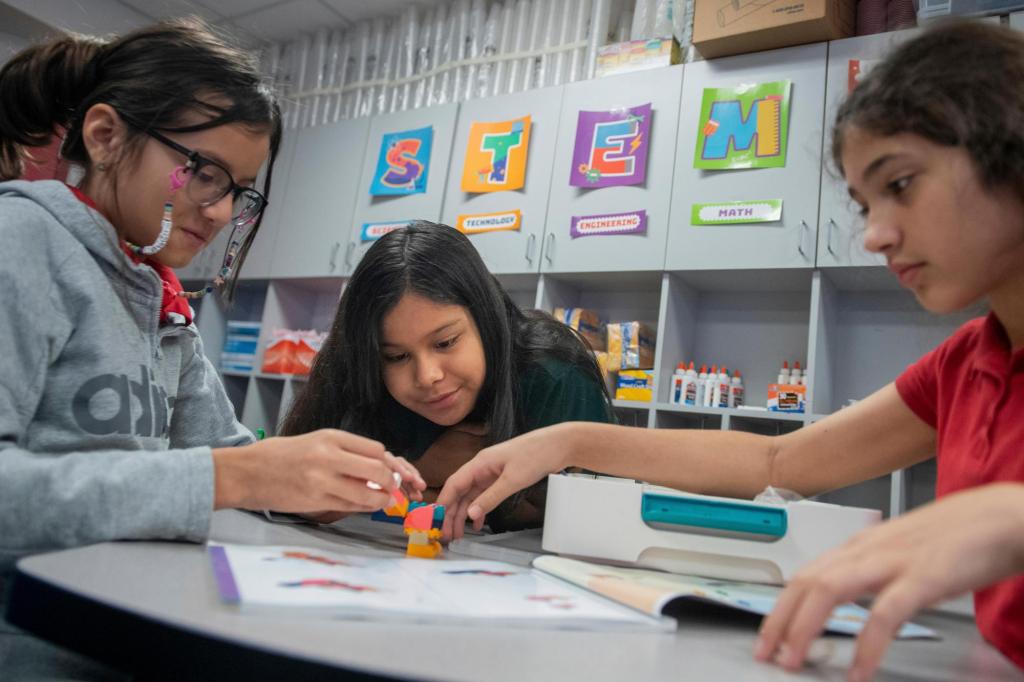
At de Zavala Middle School in Irving, Texas, a group of enthusiastic sixth-grade girls huddled around a table, diligently working on a Lego machine. As they tested their creation with a purple card and then an orange one, they discovered the machine’s sensitivity to different colors. “Oh! Oh, it reacts differently to different colors,” exclaimed Sofia Cruz, a sixth-grader, as the machine finally came to life.
This moment of discovery at de Zavala is part of a broader initiative to foster interest in science, technology, engineering, and math (STEM) among young girls. As a newly established choice school with a STEM focus, de Zavala aims to recruit and retain girls in these fields. The goal is to change the current landscape where advanced STEM classes sometimes have only one girl enrolled.
Efforts to bridge the gender gap in STEM education have gained momentum after setbacks experienced during the COVID-19 pandemic. According to an analysis by the Associated Press, the gender gap in math scores, which had nearly closed before the pandemic, has widened again. Girls, who had caught up with boys in math scores by 2018, lost ground during the pandemic, and boys’ scores have rebounded more quickly.
During the pandemic, many programs designed to engage girls in STEM were paused, and online learning often emphasized rote learning, a method some experts believe may benefit boys more. Michelle Stie from the National Math and Science Initiative noted, “When society is disrupted, you fall back into bad patterns.”
The Impact of COVID-19 on Girls in STEM
Before the pandemic, girls had made significant strides in math, surpassing boys in over half of the school districts analyzed by the Educational Opportunity Project at Stanford University. However, by the 2023-2024 school year, boys outperformed girls in math in nearly 90% of the districts.
The NWEA, an educational research organization, reported that the once-narrow gap in science and math scores between boys and girls widened by 2022, favoring boys. Despite these setbacks in STEM, girls continued to excel in reading compared to boys, both before and after the pandemic.
Reviving Initiatives to Support Girls in STEM
Pre-pandemic teaching methods had shifted to emphasize problem-solving skills and critical thinking over speed and memorization. Schools had introduced programs to build girls’ confidence in STEM through hands-on learning and real-world applications. However, these initiatives were disrupted during the pandemic, and schools are now working to reinstate them.
In Grandview C-4 District near Kansas City, Superintendent Kenny Rodrequez observed that girls lost interest when boys dominated STEM class discussions. The district responded by introducing hands-on STEM curriculum to lower grades and creating gender-balanced classes.
Rodrequez noted, “Whenever there’s crisis, we go back to what we knew.”
Addressing Persistent Bias in STEM Education
Despite efforts to encourage girls in STEM, biases persist. Raphael Bonhomme, a third-grade teacher in Washington, D.C., found that many girls do not see themselves as strong in math. He often hears them say, “I’m not a math person,” an attitude that educators are striving to change.
Research suggests that girls may prefer learning methods linked to real-life examples, whereas boys often thrive in competitive environments. During COVID, many of these sense-making processes were lost, according to Janine Remillard, a math education expert at the University of Pennsylvania.
Renewed Focus on STEM at Irving Schools
The Irving school district, home to de Zavala Middle School, is making renewed efforts to cultivate curiosity and problem-solving skills among students. Erin O’Connor, a STEM and innovation specialist, emphasized the district’s commitment to training teachers and implementing a new science curriculum from Lego Education.
For instance, fifth graders learned about genetics by constructing Lego dinosaurs, while other students explored kinetic energy through hands-on projects. “It is just rebuilding the culture of, we want to build critical thinkers and problem solvers,” O’Connor explained.
At Townley Elementary School, teacher Tenisha Willis guided second graders through a project where they built a machine to push blocks. Although some students faced challenges, Willis encouraged them to persevere and explore alternative solutions, demonstrating the value of resilience in problem-solving.
“Sometimes we can’t give up,” Willis advised. “Sometimes we already have a solution. We just have to adjust it a little bit.”
Read More Here