
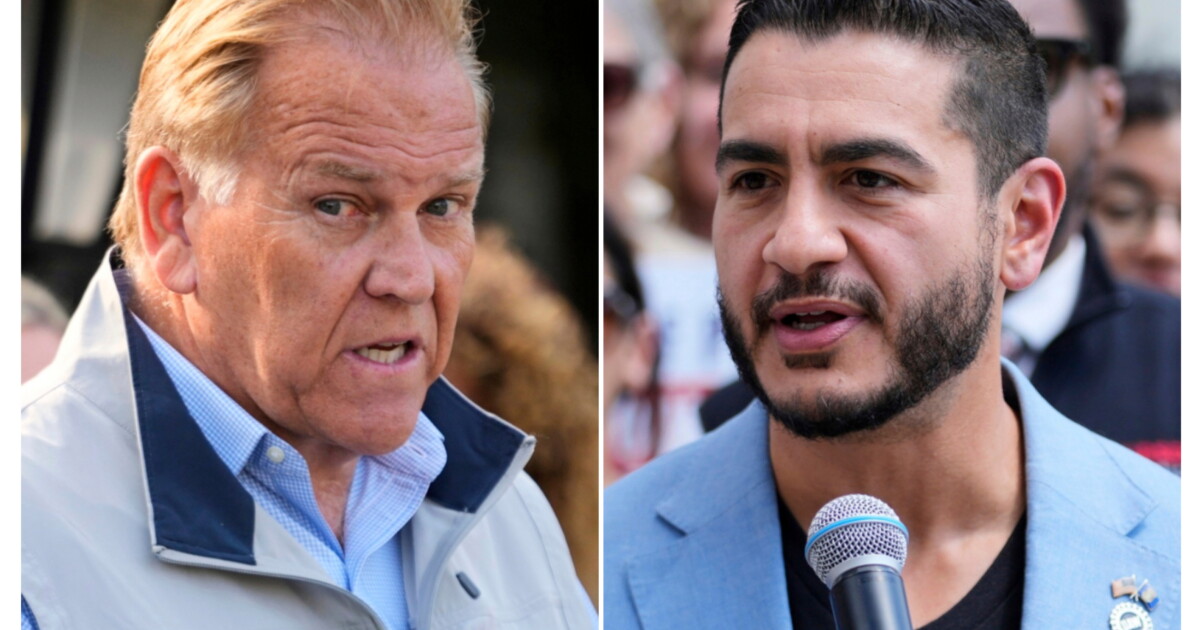
Michigan families are heading to the polls Tuesday to decide a Senate race that could reshape control of Congress — and with it, the economic policies that affect everything from gas prices to grocery bills. The contest between Democrat Abdul El-Sayed and Republican Mike Rogers has drawn more than $100 million in advertising and put Michigan at the center of the national political map.
For everyday Michiganders, the stakes are real. High gas prices, a trade war with neighboring Canada, and ongoing concerns about healthcare costs have dominated kitchen-table conversations across the state. The winner will help determine which party controls the U.S. Senate — and, by extension, which economic priorities get pushed through in Washington.
Two Very Different Visions for Michigan Families
El-Sayed, the former Wayne County health director, is running on a platform built around universal healthcare — a policy that would directly affect what families pay for doctor visits, prescriptions, and insurance premiums. He narrowly beat establishment-backed Rep. Haley Stevens in a costly August primary, positioning himself as an unapologetically progressive candidate who believes bold ideas can win in a state President Donald Trump carried two years ago.
Rogers is making his second run at this Senate seat after losing Michigan’s 2024 Senate race by fewer than 20,000 votes. This time, he’s running without Trump at the top of the ballot — a significant difference in a state where Republicans haven’t won a Senate race since 1994. The retirement of two-term Democratic Sen. Gary Peters opened the door, and Rogers is trying to walk through it even as economic headwinds trouble his party nationally.
The diverse electorate in Michigan has turned this race into a complicated balancing act. Both candidates are courting voters across the state while navigating sharp divisions within Jewish, Muslim, and Black communities — divisions that have been inflamed by the ongoing conflict in the Middle East and debates over U.S. support for Israel.
Economic Pressures Weigh on Voters
For Rogers, the political environment has created fresh obstacles. Gas prices remain stubbornly high, squeezing budgets for families who commute to work or run small businesses. A trade war with Canada — one of Michigan’s most important economic partners — has added uncertainty for workers in manufacturing and agriculture, industries that form the backbone of the state’s economy.
Rogers, a former chairman of the House Intelligence Committee who built his career around national security, has had to carefully navigate public frustration over the ongoing war with Iran while staying aligned with Trump. On that front, he has been direct:
“The war with Iran needs to end, and end quickly,”
Rogers wrote on social media in September.
Rather than pointing to Republican achievements in Congress or the White House on economic matters, Rogers has focused his campaign largely on attacking El-Sayed — including at an Oct. 25 rally in Port Huron alongside Trump. Critics note that approach leaves voters with few specifics about how Rogers would address the high cost of living.
A Primary That Left Deep Marks
El-Sayed’s path to the general election was neither easy nor cheap. Outside groups spent nearly $60 million against him during the Democratic primary — a staggering sum that included close to $30 million from AIPAC, the American Israel Public Affairs Committee, making it the organization’s largest investment in a single race.
The race was further complicated when Stevens — the Democrat El-Sayed defeated in August — crossed party lines and endorsed Rogers. The shocking endorsement of Rogers rattled Democratic circles and reflected real tensions over El-Sayed’s handling of concerns raised by Jewish voters. Stevens, who had received strong support from both Black and Jewish communities in the Detroit metro area during the primary, cited El-Sayed’s failure to adequately address those concerns as her reason for the switch.
El-Sayed faced criticism for his response to a March attack on a Michigan synagogue, when he said that
“hurt people hurt people.”
The attacker had lost family members in an Israeli strike in Lebanon. El-Sayed later said he was
“sorry”
to
“anyone who feels like my comments might have been hurtful.”
Republicans also highlighted El-Sayed’s ties to Hasan Piker, a political streamer known for inflammatory remarks about Israel, Jews, and the September 11 attacks. El-Sayed appeared with Piker multiple times during the primary but has since distanced himself from him.
The campaign has also featured some of the most inflammatory rhetoric of any Senate race this cycle. Republicans repeatedly sought to link El-Sayed — who would become the first Muslim U.S. senator — to terrorist organizations, though no evidence of such ties exists. Trump repeatedly called him a
“jihadist.”
Building a Coalition Across a Divided State
El-Sayed has worked hard to rebuild and expand his coalition since the primary. He has leaned into a populist economic message aimed at younger voters and disaffected Republicans in rural areas — communities where the cost of living and limited access to affordable healthcare are daily realities.
High-profile Democrats have rallied behind him. Former Vice President Kamala Harris campaigned with El-Sayed and told a gathering of the NAACP that he could be a
“stopgap”
on Trump. Former President Barack Obama also joined a rally for El-Sayed and other Michigan Democrats in the final days before Election Day.
Democrats need to pick up four Senate seats to reclaim the majority. Losing Michigan — a state with a competitive mix of urban workers, suburban families, and rural communities — could put that goal out of reach. With over $100 million spent on advertising since the August primary, both parties have made clear they see Michigan as ground zero for the battle over who sets the economic agenda in Washington.








Comments are closed.