
For thousands of families living on the Navajo Nation reservation, coal isn’t just a political talking point — it’s the fuel that heats their homes and the paycheck that feeds their children. But a shift is quietly happening in one of the country’s most coal-dependent communities, and it could reshape the economic future of nearly half a million people.
For the first time in recent memory, neither candidate running for Navajo Nation president in this year’s general election openly supports the coal industry. That’s a striking change for a tribe whose economy has long depended on fossil fuels — and whose sprawling 27,000-square-mile reservation stretches across Arizona, New Mexico, and Utah.
A Coal Economy Built Over Generations
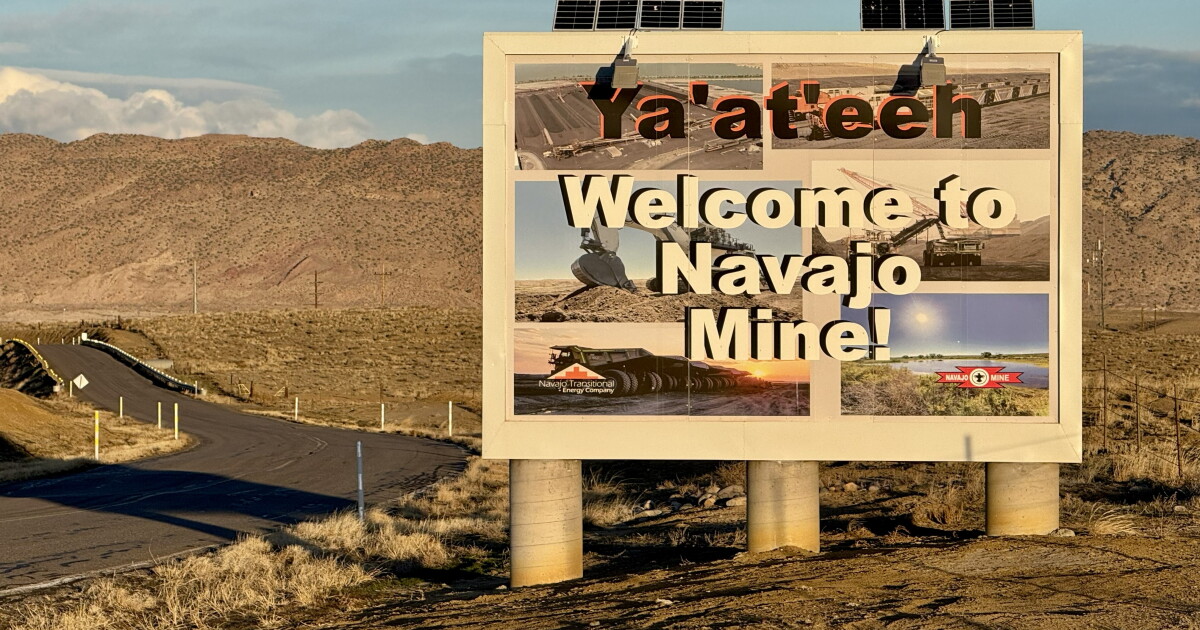
Coal has been more than an energy source for the Navajo Nation — it’s been a financial lifeline. The tribe’s Tribal Natural Resources and broader economy have been tied to extraction for decades. The Navajo Nation owns coal deposits in Wyoming, New Mexico, and Montana through NTEC — the Navajo Transitional Energy Company — which claims to be the nation’s third-largest coal producer.
The last remaining coal mine on the tribal reservation sits in the Four Corners region of New Mexico. It feeds a single coal-fired power plant owned by the private utility Arizona Public Service, which could keep running until 2038. For many Navajo families, that’s hundreds of jobs and millions of dollars in tribal revenue — not an abstraction, but a reality that puts food on the table.
Outgoing President Buu Nygren made his position clear during his annual state address in January:
“Because those are hundreds and hundreds of jobs. Those are millions and millions of dollars of revenue that the Navajo Nation receives. That’s coal that some of you haul and get for free from some of our chapters.”
Nygren, who attended the 2024 Democratic National Convention as an Arizona delegate, even took a widely-criticized selfie with President Trump at the White House after Trump signed an executive order aimed at preserving the coal industry. That photo became a liability — and according to University of Arizona assistant professor Andrew Curley, it cost Nygren politically.
“Based on my conversations with voters, people were upset,”
said Curley.
“It reflected a politics I think a lot of people on the reservation reject — and is unattuned to the real struggles, real challenges for the coal economy.”
Nygren’s slogan, “Nygren digs coal,” wasn’t enough to win over voters. He and 13 other candidates failed to advance past the July primary, leaving two candidates — neither of whom supports coal — to compete in the general election.
What the Candidates Are Saying
The two candidates now vying to lead the Navajo Nation staked out their positions during an October debate at Arizona State University in Phoenix. Their platforms represent a meaningful departure from past Navajo politics.
Attorney Justin Jones, who previously worked as a governmental affairs liaison for the New Mexico coal mine once owned by Australian mining giant BHP Billiton, was direct:
“I’m opposed to coal mining. I’m opposed to any form of mining that’s where a shovel will go, blast it and get resources out.”
Navajo Nation Council Speaker Crystalyne Curley framed the issue in economic terms that many working families might recognize:
“Coal is dying. It’s not coming back. So you do need an administration to say that this is the new plan to move forward.”
For families watching their community’s economic base shift beneath their feet, those words carry real weight. Andrew Curley, author of Carbon Sovereignty: Coal, Development, and Energy Transition in the Navajo Nation, says the shift in candidate platforms is meaningful — though he urges caution about what promises will actually deliver.
“NTEC is not in sync with the professed statements of our two presidential candidates,”
Curley noted.
“For me, kind of a rule of thumb: the bigger the promise, the more it’ll be broken.”
Real Families Caught in the Middle
The stakes aren’t abstract for people like Dailan Long, a 44-year-old lifelong resident of Burnham, New Mexico, whose backyard borders the last Navajo-owned coal mine. Long was once hopeful about Nygren’s vision — he was part of the enthusiastic wave that helped elect the youngest Navajo Nation president at age 36. Four years later, his optimism has curdled into disappointment.
“He’s within our generation,”
Long said of Nygren.
“Our hope was that he would establish a legacy that speaks to our generation and it seems that unfortunately he kind of just blended in with the status quo.”
Long’s concerns are also deeply personal. In August, the Trump administration approved a federal permit expanding the Navajo Mine’s operation by nearly 12,000 acres. That expansion opens the door for NTEC to mine more than half a billion tons of coal over the next century — through 2136. For Long and his neighbors, that means the real possibility of being displaced from their homes, with family burial grounds and community ties at risk of being uprooted.
Long’s message to whoever wins the presidency is simple. After hearing both Jones and Speaker Curley speak about coal, he said:
“I really do hope they take it to heart and really consider, we need an energy policy that works for us.”
Andrew Curley, who ran for Navajo president himself before being eliminated in the primary, sees the broader shift in the political conversation as progress — even if the road ahead is uncertain. You can explore more on the future of Navajo coal country and how these decisions ripple out for communities across the Southwest.
“I think it’s good that both sides are kind of moving in this direction — to think about the land in terms of sustainability, not just resources and extraction,”
he said.
For more coverage of related economic and policy developments, visit KJZZ Politics, including reporting on Arizona water agencies heading to court over the Colorado River by Alex Hager. Other recent stories cover a Navajo-owned arts shop expanding to Santa Fe by Gabriel Pietrorazio, a proposed Tucson Costco on a 3,000-year-old historical site via KJZZ Business, Chiricahua National Monument becoming Arizona’s fourth national park as reported by Jill Ryan, and the Heard Museum’s search for an artist to honor hoop dancing.







Comments are closed.