
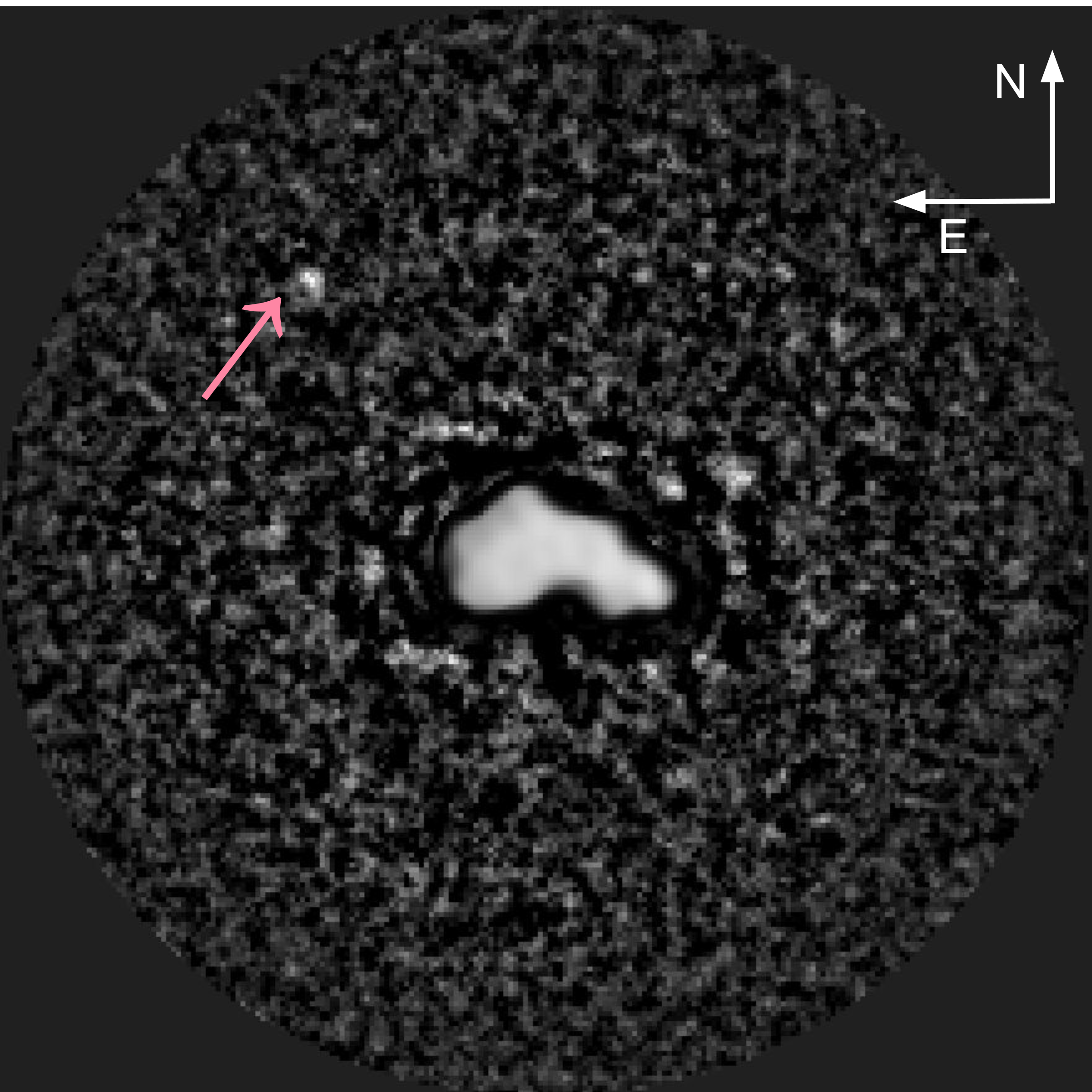
Asteroid (44) Nysa, a dazzling resident of the asteroid belt between Mars and Jupiter, has revealed a surprising three-lobed structure and a tiny moon, thanks to an international team of astronomers. This discovery offers new insights into the complex history of this enigmatic celestial body.
The investigation utilized high-resolution adaptive optics imaging from leading global telescopes, including the Large Binocular Telescope (LBT) on Mount Graham, Arizona. Managed by the University of Arizona, the LBT’s observations were enhanced by SHARK-VIS, a high-contrast optical imaging instrument, and an innovative adaptive optics system that counteracts atmospheric turbulence.
Asteroid Nysa is classified as an enstatite-like or E-type asteroid, characterized by a bright surface that mirrors the light-reflecting properties of the mineral enstatite. This composition suggests a formation close to the sun, sharing chemical similarities with Earth’s building blocks. Consequently, Nysa’s origin could provide valuable insights into the early solar system’s formation processes.
The recent study, “Unmasking (44) Nysa: Evidence for a Trilobate Structure,” reveals Nysa’s unique form. Previously speculated to have an elongated or bilobate shape, Nysa now shows multiple large surface features, including two valleys encircling its circumference. These features suggest “colli,” or neck-like connections, between separate lobes.
“The images reveal a remarkably unusual object,” stated lead author Kate Minker of Lowell Observatory. “The most likely explanation is that Nysa is either a contact trinary or an extremely irregular coherent body unlike anything we’ve previously observed.”
Using LBT with SHARK-VIS and the SPHERE/ZIMPOL instrument from the Very Large Telescope in Chile, researchers obtained the highest-resolution images of Nysa to date. By combining these with extensive photometric observations, they created a three-dimensional model supporting the presence of three distinct lobes linked by narrow neck regions.
The team’s findings suggest that Nysa’s structure may have resulted from a low-velocity re-accumulation of fragments from an ancient collision, possibly before settling in the asteroid belt. Alternatively, Nysa might be the remnants of a significant collision with a larger body.
“These new images appear consistent with several earlier clues that Nysa is not a conventional asteroid,” said Al Conrad, co-author and associate staff scientist at the Large Binocular Telescope Observatory. “For the first time, we can directly investigate whether those clues point to a deeply indented body or to a true multi-lobed structure.”
The LBT’s images, sharper than those from the Hubble Space Telescope, are possible due to its large primary mirrors and advanced adaptive optics system, which compensates for atmospheric blurring.
The study also uncovered a previously unknown moon around Nysa, temporarily named S/2026 (44) 1. Estimated to be just over a kilometer in diameter, this moon orbits at a distance of approximately 170 kilometers from Nysa, which itself spans about 75 kilometers.
Future observations of this satellite, including its orbital velocity and periodicity, could help determine Nysa’s mass and density more precisely, aiding in unraveling its complex structure. “Our technique is a bit like figuring out Christmas presents while they’re wrapped,” Conrad explained.
If these findings are confirmed, Nysa would join a growing class of solar system objects with unique shapes that preserve evidence of ancient collisions, offering a glimpse into the solar system’s early history.
Discovered in 1857, the asteroid’s name, referencing Nysa from Greek mythology, is fitting as scientists finally “unmask” its true nature, echoing the god Dionysus, associated with masks and theater. “In this paper, we’re finally unmasking the asteroid’s true nature, long after it was discovered,” Conrad concluded.
Read More Here






Comments are closed.