
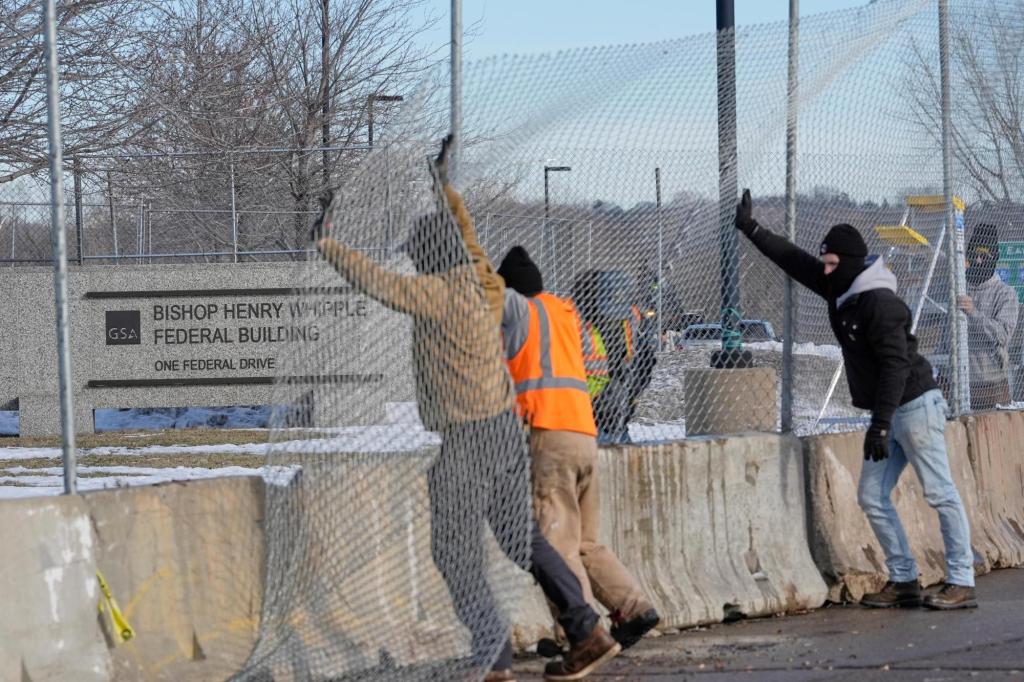
New Policy Restricts Congressional Access to ICE Facilities Amid Controversy
Amid heightened tensions following a tragic incident in Minneapolis, the Trump administration has quietly reinstated a policy that restricts congressional visits to immigration detention centers. This move comes on the heels of a federal immigration officer’s fatal shooting of a woman, escalating calls for transparency and oversight.
The incident on Saturday saw three Democratic representatives from Minnesota being denied entry into an Immigration and Customs Enforcement (ICE) facility near Minneapolis, despite their intentions to assess conditions firsthand. This occurred shortly after the shooting of U.S. citizen Renee Good by an ICE officer.
In response to these developments, lawyers representing several congressional Democrats have approached a federal judge, urging for intervention. Their request follows a recent ruling by U.S. District Judge Jia Cobb in Washington, D.C. On Dec. 17, Cobb had temporarily halted ICE from enforcing similar restrictive policies, noting that such requirements likely exceed the Department of Homeland Security’s powers.
The urgency of the situation is amplified by ongoing negotiations over DHS and ICE funding. With appropriations set to expire on Jan. 30, the timing of this policy shift is critical. “This is a critical moment for oversight, and members of Congress must be able to conduct oversight at ICE detention facilities, without notice, to obtain urgent and essential information for ongoing funding negotiations,” the plaintiffs’ attorneys emphasized in their filing.
Representatives Ilhan Omar, Kelly Morrison, and Angie Craig attempted to tour the ICE facility but were turned away shortly after their arrival. Officials cited a newly reinstated seven-day notice requirement for congressional visits, a policy Secretly signed by U.S. Department of Homeland Security Secretary Kristi Noem the day after Renee Good’s death.
Judge Cobb, appointed by President Joe Biden, had previously supported other congressional members in a lawsuit challenging these restrictive access policies. The lawsuit accused the Trump administration of obstructing oversight amid intensified immigration enforcement. Government attorneys argued that concerns over facility conditions changing within a week are speculative, a stance Cobb dismissed, stating, “The changing conditions within ICE facilities means that it is likely impossible for a Member of Congress to reconstruct the conditions at a facility on the day that they initially sought to enter.”
The legal battle continues as plaintiffs’ attorneys argue that federal law prohibits DHS from using funds to block congressional oversight. They contend that the administration has not demonstrated that none of these funds are being used for the latest policy implementation.
Read More Here



![Robert Harmon Celebrates 99th Birthday at UVA’s Homecomings Weekend[embed]https://www.youtube.com/watch?v=c_VPFnE8x-w[/embed]](https://realnewsfast.com/wp-content/uploads/2026/10/Robert-Harmon-Celebrates-99th-Birthday-at-UVAs-Homecomings-Weekendembedhttpswwwyoutubecomwatchvc_VPFnE8x-wembed-300x200.jpg "Robert Harmon Celebrates 99th Birthday at UVA’s Homecomings Weekend[embed]https://www.youtube.com/watch?v=c_VPFnE8x-w[/embed]")
![Environmental Opera “Auksalaq” Opens UVA’s Arts on the Hill Series[embed]https://www.youtube.com/watch?v=PjYuP9wh3Hw[/embed]](https://realnewsfast.com/wp-content/uploads/2026/10/Environmental-Opera-Auksalaq-Opens-UVAs-Arts-on-the-Hill-SeriesembedhttpswwwyoutubecomwatchvPjYuP9wh3Hwembed-300x200.jpg "Environmental Opera “Auksalaq” Opens UVA’s Arts on the Hill Series[embed]https://www.youtube.com/watch?v=PjYuP9wh3Hw[/embed]")
![New documentary explores Elizabeth Holmes’ final days before prison[embed]https://www.youtube.com/watch?v=GGJSRFWALTI[/embed]](https://realnewsfast.com/wp-content/uploads/2026/10/New-documentary-explores-Elizabeth-Holmes-final-days-before-prisonembedhttpswwwyoutubecomwatchvGGJSRFWALTIembed-300x200.jpg "New documentary explores Elizabeth Holmes’ final days before prison[embed]https://www.youtube.com/watch?v=GGJSRFWALTI[/embed]")