
By HANNAH SCHOENBAUM
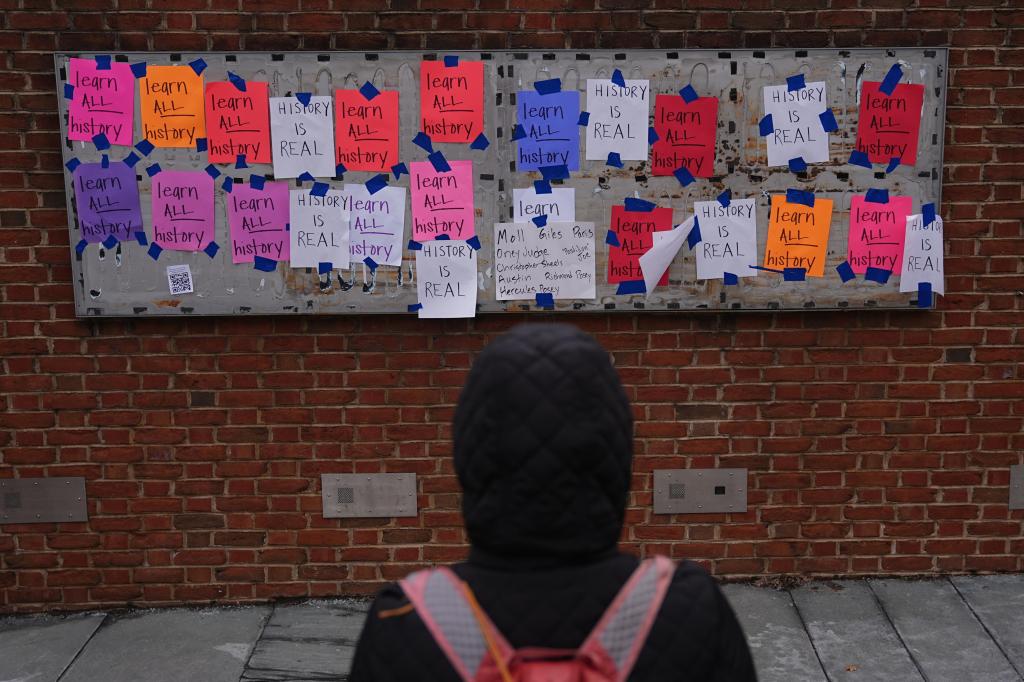
A contentious legal battle over historical representation has reached a turning point with a federal judge’s ruling to restore an exhibit on enslaved individuals at George Washington’s Philadelphia residence. The decision comes after the National Park Service’s removal of the exhibit, following an executive order from former President Donald Trump.
The city of Philadelphia initiated legal action in January, as reported in an earlier lawsuit, challenging the removal of informational panels from Independence National Historical Park. This site, historically significant as the temporary capital in the 1790s, was home to George and Martha Washington and nine enslaved individuals.
The removal aligned with Trump’s executive order aimed at “restoring truth and sanity to American history,” which instructed the Interior Department to ensure federal sites do not feature content that might “disparage” Americans.
-
FILE – People walk past an informational panel at President’s House Site Tuesday, Aug. 19, 2025, in Philadelphia. (AP Photo/Matt Rourke, File)


1 of 3
FILE – People walk past an informational panel at President’s House Site Tuesday, Aug. 19, 2025, in Philadelphia. (AP Photo/Matt Rourke, File)
U.S. District Judge Cynthia Rufe has mandated the restoration of the exhibit, emphasizing the importance of maintaining historical integrity. In her order, she referenced George Orwell’s “1984,” drawing parallels between the Trump administration’s actions and the fictional Ministry of Truth’s manipulation of historical records.
“As if the Ministry of Truth in George Orwell’s 1984 now existed, with its motto ‘Ignorance is Strength,’ this Court is now asked to determine whether the federal government has the power it claims — to dissemble and disassemble historical truths when it has some domain over historical facts,” wrote Rufe. “It does not.”
The court’s decision prevents the installation of any alternative narratives until the legality of the initial removal is resolved. During a hearing, Rufe criticized the Justice Department’s stance, describing it as “dangerous” and “horrifying.”
The Interior Department has yet to comment on the ruling, which was issued on Presidents Day, a federal holiday that led to government office closures. No deadline has been set for the exhibit’s reinstatement, and there remains the possibility of an appeal.
This Philadelphia site is among several where the Trump administration has removed historical content related to enslaved people, LGBTQ+ individuals, and Native Americans. For instance, signage at the Grand Canyon National Park concerning Native American displacement has similarly vanished.
Recently, a rainbow flag was taken down at the Stonewall National Monument, a site pivotal to the modern LGBTQ+ rights movement. References to transgender individuals have also been erased from associated web content.
The Philadelphia exhibit, developed in collaboration with city and federal representatives two decades ago, highlighted the lives of nine individuals enslaved by the Washingtons. Among them was Oney Judge, who fled to New Hampshire in 1796, and Hercules, who escaped a year later.
Judge and Hercules’s stories were integral to the site’s designation as part of the Underground Railroad network, a fact Judge Rufe noted in her ruling. The removal of materials related to Oney Judge, for instance, “conceals crucial information linking the site to the Network to Freedom.”
Despite the physical removal of plaques, the names of Judge and her fellow enslaved individuals remain etched in a cement wall at the site. The decision to restore the exhibit has been met with approval from local politicians and community leaders.
State Rep. Malcolm Kenyatta, a Philadelphia Democrat, expressed pride in the community’s efforts to resist what he described as an attempt to “whitewash our history.” “Philadelphians fought back, and I could not be more proud of how we stood together,” he stated.
Read More Here
![Robert Harmon Celebrates 99th Birthday at UVA’s Homecomings Weekend[embed]https://www.youtube.com/watch?v=c_VPFnE8x-w[/embed]](https://realnewsfast.com/wp-content/uploads/2026/10/Robert-Harmon-Celebrates-99th-Birthday-at-UVAs-Homecomings-Weekendembedhttpswwwyoutubecomwatchvc_VPFnE8x-wembed-300x200.jpg "Robert Harmon Celebrates 99th Birthday at UVA’s Homecomings Weekend[embed]https://www.youtube.com/watch?v=c_VPFnE8x-w[/embed]")
![Environmental Opera “Auksalaq” Opens UVA’s Arts on the Hill Series[embed]https://www.youtube.com/watch?v=PjYuP9wh3Hw[/embed]](https://realnewsfast.com/wp-content/uploads/2026/10/Environmental-Opera-Auksalaq-Opens-UVAs-Arts-on-the-Hill-SeriesembedhttpswwwyoutubecomwatchvPjYuP9wh3Hwembed-300x200.jpg "Environmental Opera “Auksalaq” Opens UVA’s Arts on the Hill Series[embed]https://www.youtube.com/watch?v=PjYuP9wh3Hw[/embed]")
![New documentary explores Elizabeth Holmes’ final days before prison[embed]https://www.youtube.com/watch?v=GGJSRFWALTI[/embed]](https://realnewsfast.com/wp-content/uploads/2026/10/New-documentary-explores-Elizabeth-Holmes-final-days-before-prisonembedhttpswwwyoutubecomwatchvGGJSRFWALTIembed-300x200.jpg "New documentary explores Elizabeth Holmes’ final days before prison[embed]https://www.youtube.com/watch?v=GGJSRFWALTI[/embed]")