
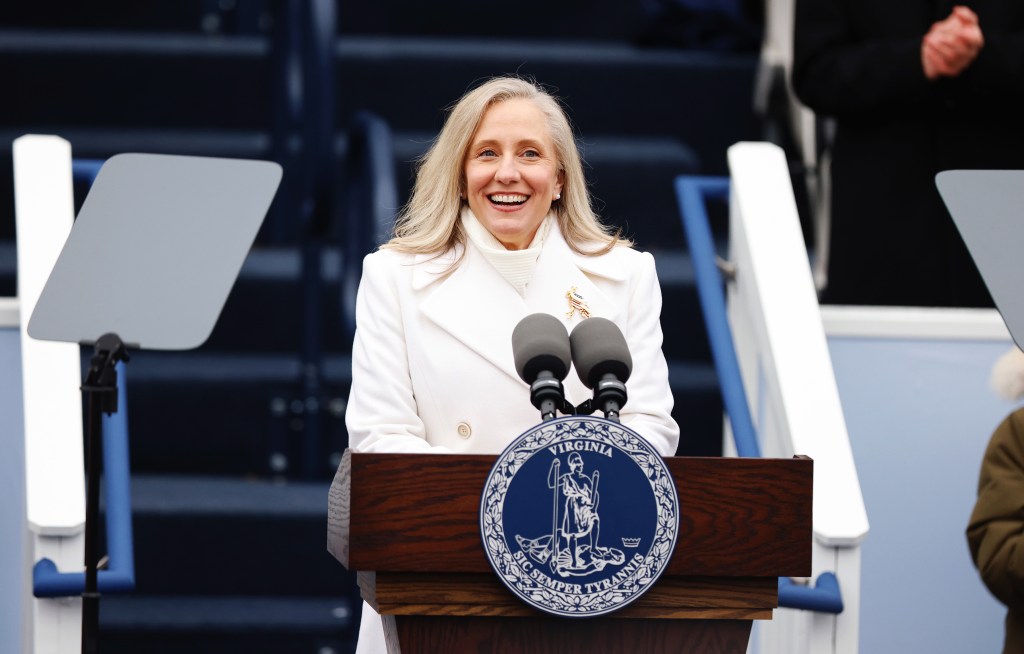
The historic inauguration of Virginia’s first female governor, Abigail Spanberger, took place on a brisk Saturday afternoon. She became the 75th individual to assume the role, standing out in her white attire against a backdrop of dark suits, symbolizing the women’s suffrage movement during her swearing-in ceremony.
Spanberger’s inauguration was not just a personal milestone but a significant moment in Virginia’s history, marking a peaceful transition of power. In her address, she acknowledged the achievements of those who paved the way for women in politics and emphasized her gratitude to those who fought for women’s voting rights. “The history and the gravity of this moment are not lost on me. I maintain an abiding sense of gratitude to those who worked generation after generation to ensure women could be among those casting ballots,” Spanberger stated.
Around 5,000 attendees were present at the Virginia State Capitol in Richmond to witness the ceremony. Spanberger’s remarks paid tribute to past suffragists who tirelessly campaigned on those very steps, despite facing repeated setbacks. “On these steps, Virginia suffragists brought their cause to the General Assembly session after session, decade after decade,” she recounted.
The ceremony also marked a political shift as Spanberger took over from Republican Glenn Youngkin, establishing a Democratic trifecta in Virginia’s government. Immediately following her inauguration, Spanberger issued 10 executive orders, signaling swift action in her new role.
Among these orders, she nullified a previous mandate that enabled Virginia State Police to act as Immigration and Customs Enforcement agents, aiming to assure immigrant communities of their security. “In Virginia, our hardworking, law-abiding immigrant neighbors will know that when we say, we’ll focus on the security and safety of all of our neighbors, we mean them too,” she asserted.
Several orders targeted Spanberger’s core policy of enhancing affordability for residents. These directives include:
- Mandating executive agencies to seek ways to reduce costs in sectors like housing, health care, and energy.
- Forming an Interagency Health Financing Task Force to bolster long-term health infrastructure and protect vulnerable services.
- Initiating a comprehensive review of housing regulations to lower development barriers.
Spanberger’s focus on education was also evident, with orders to reassess the appointment process for higher education boards and improve school performance metrics. This comes amid changes at the University of Virginia, where board members resigned following her request for a delay in appointing a new president.
Further directives included examining the state’s economic conditions in response to external factors like federal cuts and immigration policies. In a move possibly countering her predecessor’s stance, one order enforced prohibitions against discrimination across various domains, advocating for inclusive recruitment practices.
Read More Here



![Robert Harmon Celebrates 99th Birthday at UVA’s Homecomings Weekend[embed]https://www.youtube.com/watch?v=c_VPFnE8x-w[/embed]](https://realnewsfast.com/wp-content/uploads/2026/10/Robert-Harmon-Celebrates-99th-Birthday-at-UVAs-Homecomings-Weekendembedhttpswwwyoutubecomwatchvc_VPFnE8x-wembed-300x200.jpg "Robert Harmon Celebrates 99th Birthday at UVA’s Homecomings Weekend[embed]https://www.youtube.com/watch?v=c_VPFnE8x-w[/embed]")
![Environmental Opera “Auksalaq” Opens UVA’s Arts on the Hill Series[embed]https://www.youtube.com/watch?v=PjYuP9wh3Hw[/embed]](https://realnewsfast.com/wp-content/uploads/2026/10/Environmental-Opera-Auksalaq-Opens-UVAs-Arts-on-the-Hill-SeriesembedhttpswwwyoutubecomwatchvPjYuP9wh3Hwembed-300x200.jpg "Environmental Opera “Auksalaq” Opens UVA’s Arts on the Hill Series[embed]https://www.youtube.com/watch?v=PjYuP9wh3Hw[/embed]")
![New documentary explores Elizabeth Holmes’ final days before prison[embed]https://www.youtube.com/watch?v=GGJSRFWALTI[/embed]](https://realnewsfast.com/wp-content/uploads/2026/10/New-documentary-explores-Elizabeth-Holmes-final-days-before-prisonembedhttpswwwyoutubecomwatchvGGJSRFWALTIembed-300x200.jpg "New documentary explores Elizabeth Holmes’ final days before prison[embed]https://www.youtube.com/watch?v=GGJSRFWALTI[/embed]")