

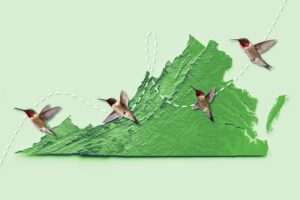
Virginia’s economy has seen a slight uptick, with a growth rate of 1.5% in 2025, signaling consistent yet modest progress. This growth, however, lags behind the national average, primarily due to the state’s significant linkage to federal economic policies and developments.
The Weldon Cooper Center, known for its unbiased research and data analysis, plays a crucial role in guiding local and state policy decisions. Their insights are instrumental for public sector leaders and policymakers.
João Ferreira, acting director of the Weldon Cooper Center’s Center for Economic and Policy Studies, highlighted, “The big take is that Virginia, for many months and contrary to what was normal, underperformed the economy of the rest of the U.S. in 2025.” He attributes this to Virginia’s vulnerability to federal workforce changes and its dependency on federal contracts, noting that for every $8 spent on these contracts, $1 is directed towards Virginia.
Looking ahead to 2026, several economic indicators suggest a downturn:
- The state’s GDP is predicted to grow by a mere 0.3%.
- Job numbers are forecasted to shrink, with a reduction of 10,300 positions.
- The unemployment rate is expected to climb from 3.5% in 2025 to 4.4% in 2026. Despite this rise, a reduction in the workforce due to retirements and out-of-state relocations may cause unemployment figures to improve in 2027.
- Inflation rates are anticipated to remain stable at 2.5%, alongside minor decreases in housing prices and an increase in rent costs.
This forecast incorporates Moody’s national projections and recent economic trends, emphasizing factors like employment, real GDP, population changes, and inflation rates. Despite the anticipated slowdown, Virginia is not expected to encounter recessionary pressures, according to Ferreira.
Observed and Forecasted Unemployment in Virginia
Read More Here






![Robert Harmon Celebrates 99th Birthday at UVA’s Homecomings Weekend[embed]https://www.youtube.com/watch?v=c_VPFnE8x-w[/embed]](https://realnewsfast.com/wp-content/uploads/2026/10/Robert-Harmon-Celebrates-99th-Birthday-at-UVAs-Homecomings-Weekendembedhttpswwwyoutubecomwatchvc_VPFnE8x-wembed-300x200.jpg "Robert Harmon Celebrates 99th Birthday at UVA’s Homecomings Weekend[embed]https://www.youtube.com/watch?v=c_VPFnE8x-w[/embed]")
![Environmental Opera “Auksalaq” Opens UVA’s Arts on the Hill Series[embed]https://www.youtube.com/watch?v=PjYuP9wh3Hw[/embed]](https://realnewsfast.com/wp-content/uploads/2026/10/Environmental-Opera-Auksalaq-Opens-UVAs-Arts-on-the-Hill-SeriesembedhttpswwwyoutubecomwatchvPjYuP9wh3Hwembed-300x200.jpg "Environmental Opera “Auksalaq” Opens UVA’s Arts on the Hill Series[embed]https://www.youtube.com/watch?v=PjYuP9wh3Hw[/embed]")
![New documentary explores Elizabeth Holmes’ final days before prison[embed]https://www.youtube.com/watch?v=GGJSRFWALTI[/embed]](https://realnewsfast.com/wp-content/uploads/2026/10/New-documentary-explores-Elizabeth-Holmes-final-days-before-prisonembedhttpswwwyoutubecomwatchvGGJSRFWALTIembed-300x200.jpg "New documentary explores Elizabeth Holmes’ final days before prison[embed]https://www.youtube.com/watch?v=GGJSRFWALTI[/embed]")