
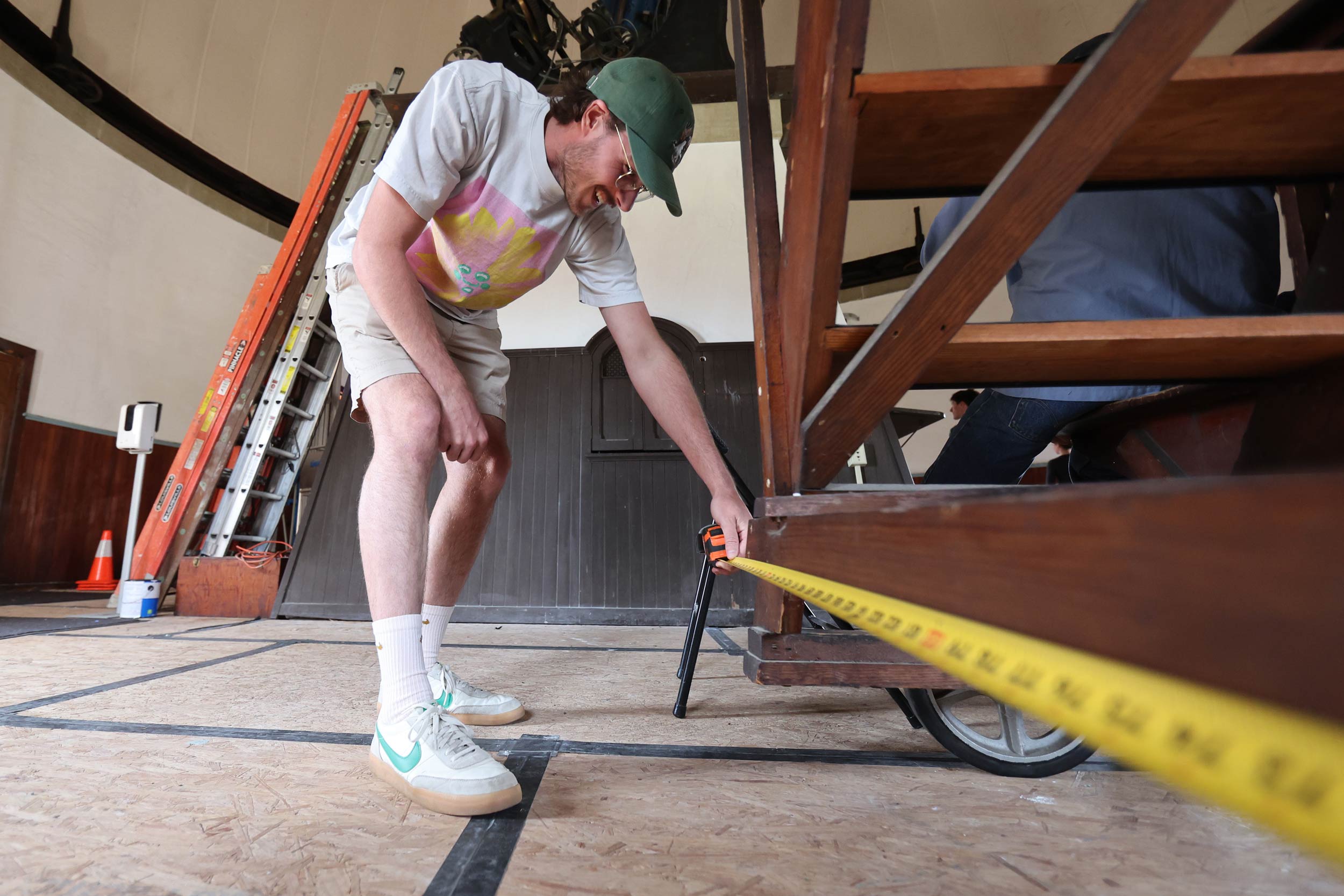
While the University of Virginia’s Leander McCormick Observatory has long been a beacon for astronomical research, it has also become an unexpected focal point for architecture students. Built in 1885, this historic structure now serves as a rich educational resource for those interested in architectural history.
Although the University utilizes a modern observatory on Fan Mountain for its research needs, the McCormick Observatory continues to engage the community by hosting public nights that offer a glimpse into the wonders of the night sky. However, students in the architectural Field Methods I course, led by associate professor Andrew Johnston, are more interested in the observatory’s historical and architectural significance.
Johnston, alongside UVA conservator Mark Kutney, brings in a variety of experts to provide insights into the observatory’s construction and legacy. These include Sarita Herman and Amy Moses from project management, Rachel Lloyd and Brian Hogg from the Office of the Architect, Will Rourk from the UVA Scholars’ Lab, and Ricky Patterson, who has firsthand experience with the observatory.
Recently, a group of around 25 students gathered at the observatory to learn from astronomy professor Ed Murphy about its historical context, the telescope’s unique features, and the mechanics of its rotating dome.
According to Johnston, “The goal of the class is to train students to think creatively about the questions they ask and the methods they use in research in architectural history.” This approach encourages students to explore and choose their methods of inquiry, rather than following a prescribed path.
Students have selected various elements of the observatory to investigate further. Alice Baughman, a graduate architecture student, is compiling a narrative history centered on those most familiar with the observatory over the years. Meanwhile, Pryce Foyt, a senior architecture student, is examining the intricacies of a locally crafted wooden observer’s chair, which boasts an adjustable seat and mobility along the observatory wall.
Genesis Rodgers, pursuing urban and environmental studies, is researching the landscape around Observatory Mountain, aiming to uncover the cultural and astronomical heritage embedded in the area. “I am so delighted to apply my interdisciplinary training in a way that is practical and useful for the University community,” Rodgers remarked.
With over three decades of experience, Kutney prefers working with tangible artifacts over archival documents. He believes, “To me, the physical object is a document.” His role in the course is more of a mentor than a teacher, providing guidance as students delve deeper into their chosen inquiries.
Kutney emphasizes student autonomy, stating, “It’s up to the students. If somebody latches on to a question they want to explore further, then I’m here to help them.” This hands-off approach allows students to explore their curiosities with the support of knowledgeable mentors.
Read More Here


![Robert Harmon Celebrates 99th Birthday at UVA’s Homecomings Weekend[embed]https://www.youtube.com/watch?v=c_VPFnE8x-w[/embed]](https://realnewsfast.com/wp-content/uploads/2026/10/Robert-Harmon-Celebrates-99th-Birthday-at-UVAs-Homecomings-Weekendembedhttpswwwyoutubecomwatchvc_VPFnE8x-wembed-300x200.jpg "Robert Harmon Celebrates 99th Birthday at UVA’s Homecomings Weekend[embed]https://www.youtube.com/watch?v=c_VPFnE8x-w[/embed]")
![Environmental Opera “Auksalaq” Opens UVA’s Arts on the Hill Series[embed]https://www.youtube.com/watch?v=PjYuP9wh3Hw[/embed]](https://realnewsfast.com/wp-content/uploads/2026/10/Environmental-Opera-Auksalaq-Opens-UVAs-Arts-on-the-Hill-SeriesembedhttpswwwyoutubecomwatchvPjYuP9wh3Hwembed-300x200.jpg "Environmental Opera “Auksalaq” Opens UVA’s Arts on the Hill Series[embed]https://www.youtube.com/watch?v=PjYuP9wh3Hw[/embed]")
![New documentary explores Elizabeth Holmes’ final days before prison[embed]https://www.youtube.com/watch?v=GGJSRFWALTI[/embed]](https://realnewsfast.com/wp-content/uploads/2026/10/New-documentary-explores-Elizabeth-Holmes-final-days-before-prisonembedhttpswwwyoutubecomwatchvGGJSRFWALTIembed-300x200.jpg "New documentary explores Elizabeth Holmes’ final days before prison[embed]https://www.youtube.com/watch?v=GGJSRFWALTI[/embed]")