
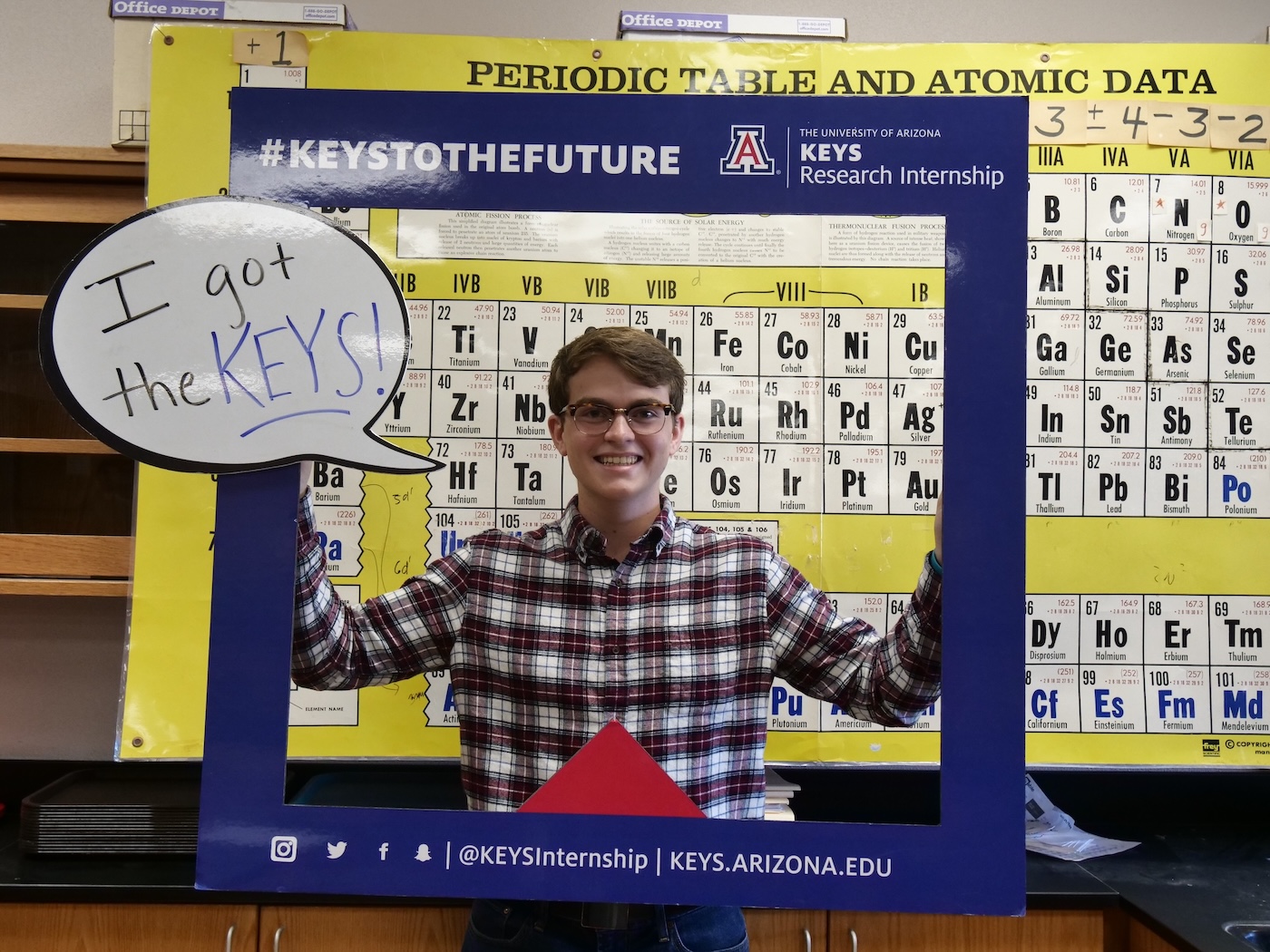
In a unique twist of fate, a simple box delivered to Ryan Mitstifer’s doorstep during the summer of 2020 marked the beginning of his research journey. As the KEYS Research Internship transitioned online due to the pandemic, the package contained a stepped motor and a motor controller from a biomedical engineering lab at the University of Arizona, setting the stage for his future in scientific research.
The lab, under the leadership of Jennifer Barton, a professor in the Department of Biomedical Engineering, focuses on developing miniature imaging devices to detect early signs of ovarian cancer. As part of his internship with KEYS, Mitstifer was tasked with constructing a motorized system for retracting an imaging probe while capturing images.
After starting as a high school junior, Mitstifer has remained a dedicated member of Barton’s lab. Now a doctoral candidate in biomedical engineering, he is involved in testing the lab’s innovative falloposcope, an ultra-thin endoscope designed to navigate the fallopian tubes.
“I have signed on with her every single month since that day,” Mitstifer said.
KEYS, which stands for Keep Engaging Youth in Science, is a seven-week summer program that places high school students in University of Arizona research labs through the BIO5 Institute.
This summer marked the 20th class of KEYS interns, with applications for the 2027 program opening on November 2.
While recent interns view the 2020 cohort with empathy, Mitstifer recalls it differently.
“It was probably one of the best summers of my life,” Mitstifer said.
Before he had a résumé
Prior to joining KEYS, Mitstifer’s summer employment included roles like cart retrieval at Walmart. Learning about KEYS through word of mouth, he applied, embarking on his first formal job interview.
With physical labs inaccessible to interns, Mitstifer’s role was primarily computational. He analyzed cross-sectional images of fallopian tubes and performed statistical analysis using image-processing software.
“I had no reason for somebody to trust me, but that’s KEYS. They gave me the opportunity and opened the door for me,” Mitstifer said.
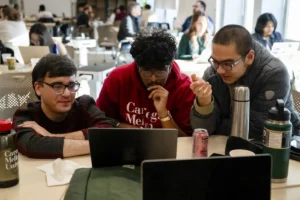
Members of Jennifer Barton’s Tissue Optics Lab at the KEYS Research Internship Showcase 2026. Ryan Mitstifer is standing third from the left.
The snowball
Mitstifer continued his association with Barton’s lab throughout high school, undergraduate, and now graduate studies.
“KEYS started the snowball and it’s been rolling and getting bigger and bigger to where I can sit here and say I am a Ph.D. student,” Mitstifer said.
Focusing on the falloposcope, a device akin to an endoscope, he aims to enhance imaging of fallopian tubes for better ovarian cancer diagnosis. During his first graduate year, Mitstifer refined this device for clinical deployment, noting that each falloposcope is custom-built for single-use in patient procedures.
Looking ahead, Mitstifer will work on developing the next-generation falloposcope, featuring a helically scanning mechanism for creating 3D images of areas within the fallopian tube.
Passing on the trust
This past summer, Mitstifer took on the role of mentor to a KEYS intern for the first time. He guided the intern in addressing a nascent lab challenge: redesigning the falloposcope’s handle for improved ergonomics and durability. The intern successfully designed and prototyped several versions, with the lab adopting the best design.
“KEYS helped me learn how to mentor. Also, it did the same thing for my student that it did for me six years ago,” Mitstifer said.
Mitstifer continues to engage with the KEYS program, attending the annual poster sessions where diverse projects are presented. He notes that there is always something new to learn from the various displays.
For those who missed participating in KEYS during high school, Mitstifer offers encouragement, emphasizing that research opportunities persist. He notes that many University of Arizona faculty members are eager to involve undergraduates in their research labs.
“Whatever you’re passionate about, there is probably a lab working on it,” Mitstifer said. “You don’t need a degree or an experience to get started.”
Read More Here






Comments are closed.