
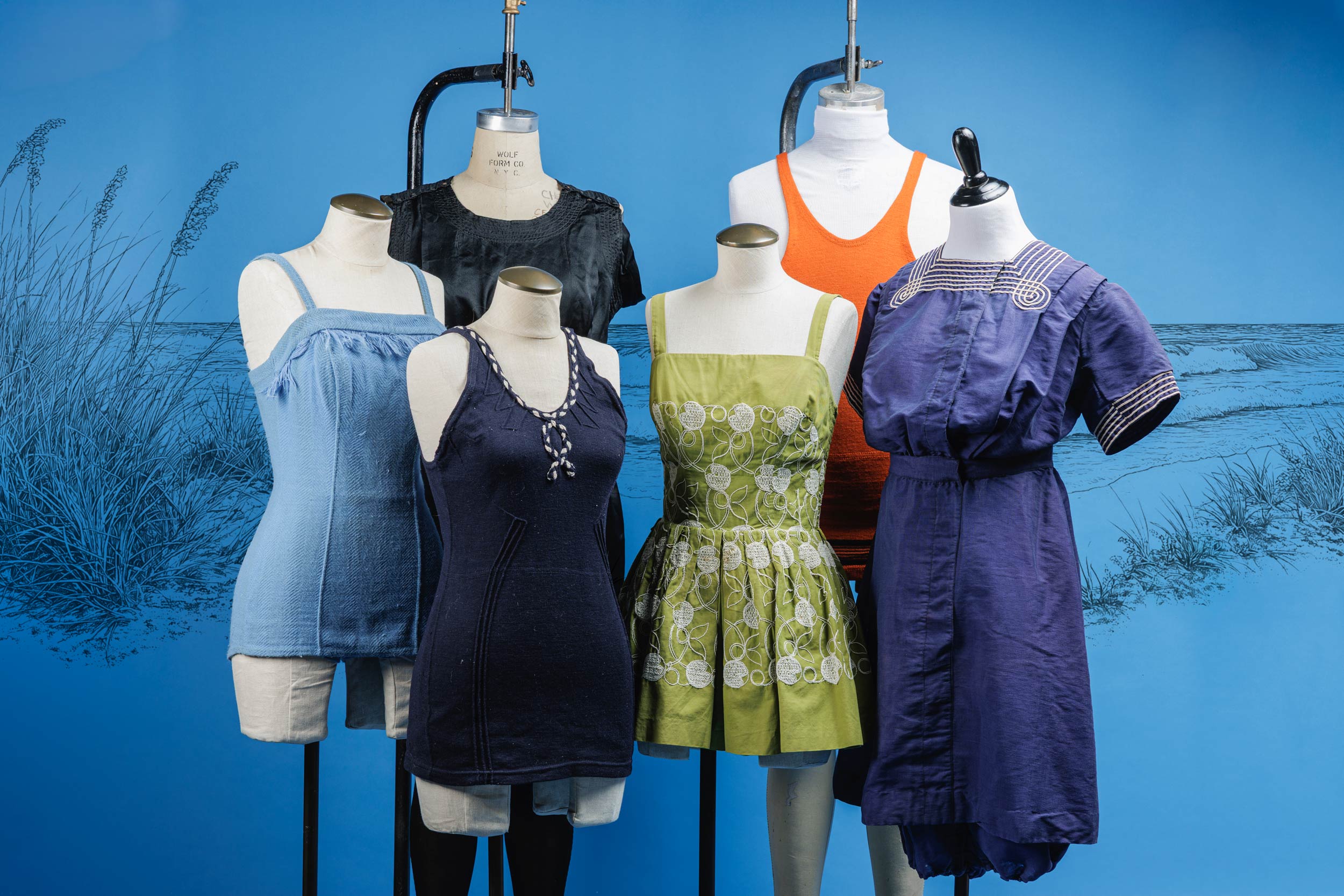
As spring break approaches, beaches across America are set to welcome throngs of college students ready to indulge in the sun-soaked tradition. Swimwear has evolved significantly over the decades, and to explore this transformation, UVA Today delved into the University of Virginia’s Historic Clothing Collection with insights from its manager, Marcy Linton.
Early 20th-Century Swimwear
An example from the early 1900s is a women’s swimsuit made entirely of wool. “You can see there are bloomers attached, and it would have been worn with black tights and little sandals so the wearer would have been as covered as possible,” explained Linton, who is also an associate professor of costume technology. She noted the impracticality of such attire when wet, given its considerable weight.
Wool was likely the fabric of choice for its insulating properties, though it tended to stretch when soaked. Despite its conservative design, Linton remarked, “Even this was a bit risqué, because you could see the shape of a woman’s calves through the tights.” Such swimwear was typically accessible to women of at least the upper middle class, as less affluent individuals often swam without swimsuits, avoiding public exposure.
1920s Swimwear Innovations
From the 1920s, a sleeveless black swimsuit in the collection features a silk overdress and a wool base. Linton described it as “lighter weight, but it’s still covering up a full set of bloomers. It’s a whole unitard with tights attached, so it would have been very difficult to get into.” With a bow at the waist and buttonholes at the back, it offered a layer of modesty, though it was considered daring for its time.
In contrast to modern practices where a cover-up suffices, swimwear of the past required a change in privacy, often in a designated bathing house.
Changing Trends in Men’s Swimwear
Men’s swim attire was less conservative than women’s. An orange-and-blue Jensen swimsuit from the late 1920s, also made of wool, revealed more skin. Linton pointed out that “this also has an overskirt to hide the shape.” Unlike today’s swim trunks, these suits often included a tank top to partially cover the chest.
Advancements in Women’s Swimwear
The 1930s and 1940s saw swimwear becoming more form-fitting. A one-piece from this period still utilized wool but embraced the female form more comfortably. Linton attributed these changes to female athletes advocating for less restrictive swimwear, thereby enhancing performance in the water.
Into the mid-20th century, wool swimsuits remained common, with new designs incorporating built-in bras and underwear, marking a shift towards practicality and comfort.
Mid-20th Century and Beyond
A final piece in the collection resembles a sundress, crafted from cotton and featuring a machine-embroidered design with pleated shorts. Linton observed, “You can see it’s becoming more decorative, so people are much happier to be seen in something like this.” This marked a departure from the need for changing facilities, as such attire was suitable for casual outings.
As spring break revelers prepare for their beach escapades, they will don swimwear that is a testament to a century of evolution. Reflecting on this journey, Linton remarked, “It’s amazing how freely we dress today. A hundred years ago, people were almost totally covered up, and now people are wearing little to nothing.”
Read More Here








![Robert Harmon Celebrates 99th Birthday at UVA’s Homecomings Weekend[embed]https://www.youtube.com/watch?v=c_VPFnE8x-w[/embed]](https://realnewsfast.com/wp-content/uploads/2026/10/Robert-Harmon-Celebrates-99th-Birthday-at-UVAs-Homecomings-Weekendembedhttpswwwyoutubecomwatchvc_VPFnE8x-wembed-300x200.jpg "Robert Harmon Celebrates 99th Birthday at UVA’s Homecomings Weekend[embed]https://www.youtube.com/watch?v=c_VPFnE8x-w[/embed]")
![Environmental Opera “Auksalaq” Opens UVA’s Arts on the Hill Series[embed]https://www.youtube.com/watch?v=PjYuP9wh3Hw[/embed]](https://realnewsfast.com/wp-content/uploads/2026/10/Environmental-Opera-Auksalaq-Opens-UVAs-Arts-on-the-Hill-SeriesembedhttpswwwyoutubecomwatchvPjYuP9wh3Hwembed-300x200.jpg "Environmental Opera “Auksalaq” Opens UVA’s Arts on the Hill Series[embed]https://www.youtube.com/watch?v=PjYuP9wh3Hw[/embed]")
![New documentary explores Elizabeth Holmes’ final days before prison[embed]https://www.youtube.com/watch?v=GGJSRFWALTI[/embed]](https://realnewsfast.com/wp-content/uploads/2026/10/New-documentary-explores-Elizabeth-Holmes-final-days-before-prisonembedhttpswwwyoutubecomwatchvGGJSRFWALTIembed-300x200.jpg "New documentary explores Elizabeth Holmes’ final days before prison[embed]https://www.youtube.com/watch?v=GGJSRFWALTI[/embed]")