The Curious Case of the Small Magellanic Cloud’s Star Motion
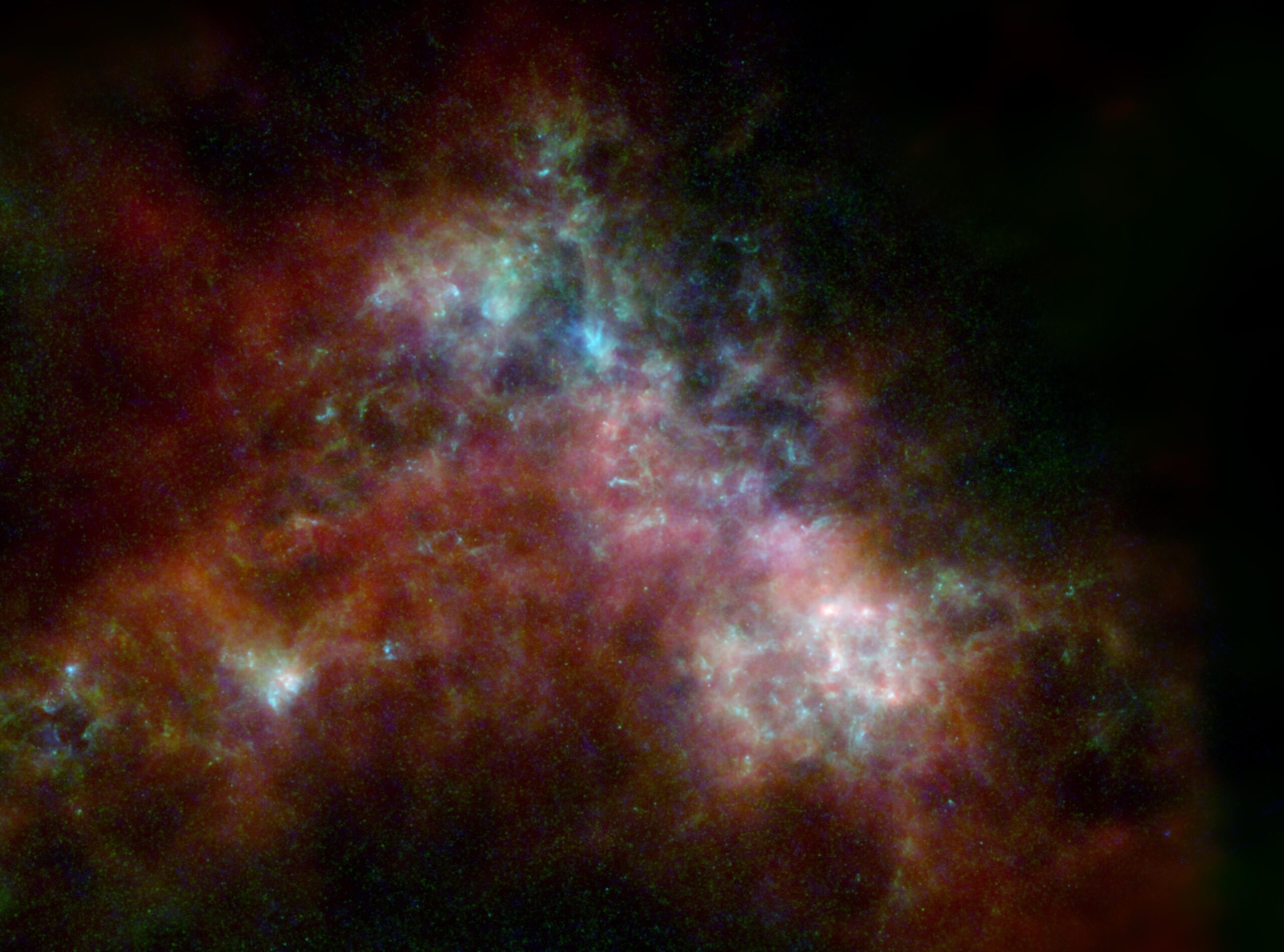
Amid the vast cosmos, the Small Magellanic Cloud (SMC) stands out as one of the Milky Way’s closest intergalactic allies. This small, gas-rich galaxy can be observed with the naked eye from the southern hemisphere. Bound by gravity, it has been in a celestial dance with the Large Magellanic Cloud (LMC) and our galaxy for eons. The intricate relationship among these galaxies has intrigued astronomers for decades.
While the SMC is among the most thoroughly studied galaxies, a key mystery about its stars’ motion persisted. Unlike most galaxies where stars orbit around a central point, those in the SMC do not follow this pattern. A recent study published in The Astrophysical Journal by University of Arizona astronomers sheds light on this enigma, attributing the peculiar motion to a direct collision with its larger companion, the LMC. This revelation also prompts a reevaluation of the SMC’s role as a reference point for understanding galaxy evolution.
“We are seeing a galaxy transforming in live action,” stated Himansh Rathore, a graduate student at Steward Observatory and the study’s lead author. “The SMC gives us a unique, front-row view of something very transformative of a process that is critical to how galaxies evolve.”
Unlike most galaxies, the SMC contains more mass in gas than stars. Typically, gas within galaxies cools, contracts, and forms a rotating disk, much like the spinning plane of our solar system. However, previous observations using the Hubble Space Telescope and the European Space Agency’s Gaia satellite revealed that the SMC’s stars defy this convention. According to Rathore, the collision with the LMC disrupted the SMC’s internal structure and sent its stars into a chaotic motion.
This collision, occurring a few hundred million years ago, caused the LMC’s gravity to scatter the SMC’s stars and exert pressure on its gas, dismantling its rotation. Rathore likens this to “sprinkling water droplets on your hand and moving it through the air – as the air rushes past, the droplets get blown off because of the pressure it exerts.”
The findings also address a long-standing puzzle regarding the SMC’s gas. Despite earlier telescope observations suggesting the gas was rotating, this study reveals that the apparent rotation was merely an illusion. As the collision stretches the SMC, gas moving toward and away from the Earth creates a false perception of rotation from certain viewpoints.
Gurtina Besla, an astronomy professor at Steward Observatory and the senior author of the study, emphasized the impact of the findings: “The SMC went through a catastrophic crash that injected a lot of energy into the system. It is not a ‘normal’ galaxy by any means.”
To reach these conclusions, the team employed computer simulations that incorporated the known properties of the SMC and LMC, such as gas content and positions relative to the Milky Way. They also developed new methods to interpret the jumbled star motions in the aftermath of the collision, which could refine observations from telescopes.
The collision’s effect on the LMC also holds keys to probing dark matter. Another study by the team, led by Rathore and published in 2025, found that the collision impacted the LMC’s central bar structure. This physical mark provides insights into the dark matter content of the SMC, offering a novel method to measure a substance known only through its gravitational influence.
Rathore remarked, “We are used to thinking of astronomy as a snapshot in time. But these two galaxies have come very close together, gone right through one another, and transformed into something different.”
Read More Here