
Historic Sketch of North Carolina Brigade Makes Rare Appearance
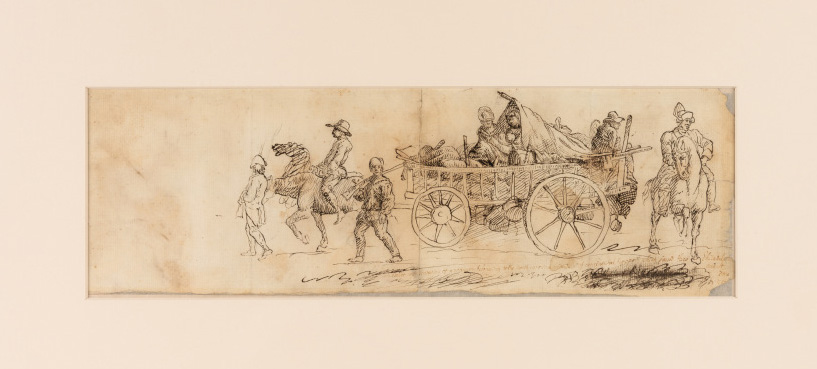
A remarkable pen-and-ink sketch of the Continental Army’s North Carolina Brigade, recently unearthed, is set to be displayed in North Carolina for the first time. This significant piece of history captures the troops marching through Philadelphia on August 25, 1777, and will be on loan from the Museum of the American Revolution to the N.C. Department of Natural and Cultural Resources (DNCR) as part of the America 250 NC commemoration.
This artifact stands as the earliest known wartime depiction of North Carolina soldiers and includes one of only two known eyewitness illustrations of female camp followers of the Continental Army. DNCR Secretary Pamela B. Cashwell remarked, “Without the benefit of photography during the Revolutionary Era, it can be hard for us to picture the people and events of 250 years ago. This extraordinary sketch – an eyewitness account of the war – is an amazing opportunity to envision the reality of America’s fight for liberty from Great Britain.”
The original sketch is scheduled for display at the North Carolina State Capitol in Raleigh for a single day on Wednesday, May 13, from 9 a.m. to 5 p.m. Following this, the sketch will be exhibited in the East Building of the N.C. Museum of Art from May 20 through August 1. It will then move to the N.C. History Center at Tryon Palace in New Bern until early October, and finally, it will be showcased at the Visitor Center at Historic Halifax State Historic Site until November 6. The display at both the State Capitol and Tryon Palace will include Revolutionary Era artifacts from the N.C. Museum of History.
Discovered by Matthew Skic, director of Collections and Exhibitions at the Museum of the American Revolution, at Judith Hernstadt’s New York home, this sketch is among only 12 known illustrations of the Continental Line. Skic confirmed the work’s authenticity and identified the artist as Pierre Eugène du Simitière, a Swiss-born illustrator who settled in Philadelphia around 1774 and documented the American Revolution as it unfolded. The drawing was donated to the Museum of the American Revolution by Hernstadt in 2024.
The conservation of the sketch was supported by contributions from the North Carolina Society of the Cincinnati, an organization composed of descendants of officers from the North Carolina Continental Line. The display in North Carolina has been made possible with the support of the Richard Hampton Jenrette Foundation, the State Capitol Foundation, and the North Carolina Society of the Cincinnati.
About Museum of the American Revolution
The Museum of the American Revolution uncovers and shares compelling stories about the diverse people and complex events that sparked America’s ongoing experiment in liberty, equality, and self-government. Through the Museum’s unmatched collection, immersive galleries, powerful theater experiences, and interactive elements, visitors gain a deeper appreciation for how this nation came to be and feel inspired to consider their role in ensuring that the promise of the American Revolution endures. Located just steps away from Independence Hall, the Museum serves as a portal to the region’s many Revolutionary sites, sparking interest, providing context, and encouraging exploration. The Museum, which opened on April 19, 2017, is a private, non-profit, and non-partisan organization. For more information, visit www.AmRevMuseum.org or call (877) 740-1776.
About the North Carolina Department of Natural and Cultural Resources
The N.C. Department of Natural and Cultural Resources (DNCR) manages, promotes, and enhances the things that people love about North Carolina – its diverse arts and culture, rich history, and spectacular natural areas. At more than 100 sites across the state, the department enhances education, stimulates economic development, improves public health, expands accessibility, and strengthens community resiliency. For more information, please visit www.dncr.nc.gov.
Read More Here
![NCDOT Weekly Highlights: Bridge Grant, Rail Records, Safety Campaigns[embed]https://www.youtube.com/watch?v=srOxkRc9E7A[/embed]](https://realnewsfast.com/wp-content/uploads/2026/04/Beware-of-Smishing-Scam-Targeting-NC-Quick-Pass-Toll-Customers-300x157.jpg "NCDOT Weekly Highlights: Bridge Grant, Rail Records, Safety Campaigns[embed]https://www.youtube.com/watch?v=srOxkRc9E7A[/embed]")



Be First to Comment