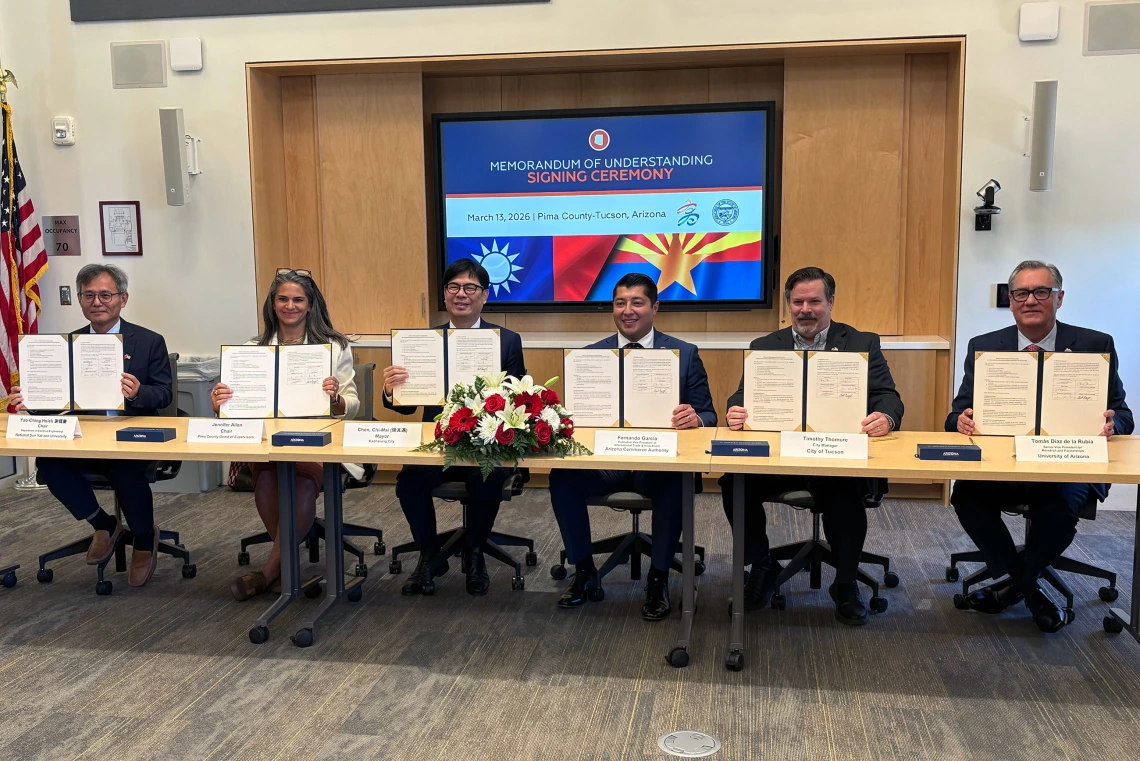
In a significant move to bolster global technological collaboration, an international agreement was signed in Tucson on March 13, positioning the University of Arizona at the forefront of semiconductor, optics, and photonics innovation.
A delegation from Taiwan visited the University of Arizona campus March 13 for presentations, tours, and networking.
Kris Hanning/Office of Research and Partnerships
Key figures from the University of Arizona, Pima County, the city of Tucson, the Arizona Commerce Authority, the city of Kaohsiung, and National Sun Yat-sen University in Taiwan have formalized a memorandum of understanding. This pact is aimed at enhancing cooperation in research, workforce development, and advanced manufacturing.
The agreement is a coalition of governmental, industrial, and academic forces aligning on economic and technological imperatives. “As I look across this partnership, I don’t just see institutions,” said Tomás Díaz de la Rubia, senior vice president for research and partnerships at the University of Arizona. “I see the architects of the global digital future.”
Kaohsiung Mayor Chen Chi-mai, who was present at the signing, emphasized the importance of fortifying ties between regions with complementary capabilities. He shared his vision for Kaohsiung’s technological future, noting the city’s positioning at the “forefront of future technology” and the synergy between Tucson’s optics expertise and Kaohsiung’s advanced semiconductor production.
Kaohsiung is a burgeoning hub for industry and technology, excelling in manufacturing, shipping, semiconductors, artificial intelligence, and green energy. Meanwhile, Southern Arizona, with the University of Arizona as a key player, is enhancing its role in research-driven innovation and advanced manufacturing. The collaboration aims to bolster semiconductor technologies, optics and photonics research, workforce development, and academic exchange.
“This is a recognition of convergent strengths,” Díaz de la Rubia stated. “We are joining the industrial might of Kaohsiung with the research excellence of our institutions to build something neither region could achieve alone.”
The tour included the Applied Research Building’s anechoic chamber, where radio-wave-absorbing material allows researchers to test satellite antennae for their command, control, and data relay performance.
Kris Hanning/Office of Research and Partnerships
The University of Arizona, recognized for its research prowess and billion-dollar research enterprise, is a pivotal element of Southern Arizona’s semiconductor landscape, driving discovery and cultivating future talent. The Wyant College of Optical Sciences plays a critical role in supporting technologies crucial for next-generation semiconductor production.
Across the university, researchers are making strides in various fields shaping the future of technology, including space sciences, astronomy, biotechnology, artificial intelligence, and clean energy. This research is paired with a focus on practical impacts, with the university’s Tech Launch Arizona aiding in launching over 150 startups, resulting in significant economic activity and job creation in high-tech sectors.
“Our goal is to translate discovery into action that drives progress for the public good,” Díaz de la Rubia stated.
The partnership prioritizes workforce development, equipping students to meet the demands of the fast-changing semiconductor industry. University of Arizona graduates already contribute significantly to regional advanced manufacturing, and this agreement is set to enhance opportunities for experiential learning, industry collaboration, and international exchange.
Moreover, the agreement supports Taiwanese companies as they establish and expand operations in Southern Arizona, with the university acting as a conduit for talent and innovation.
University leaders stress that the future of semiconductor manufacturing and the broader innovation economy relies on international collaboration. “No single institution or country can do this alone,” Díaz de la Rubia remarked. “Partnerships like this are essential to building resilient supply chains and accelerating discovery.”
For both Tucson and Kaohsiung, this memorandum of understanding signifies a long-term commitment to shared growth and innovation. As this collaboration progresses, the two regions will work jointly to drive the next wave of technological advancements.
“This is more than an agreement – it is a promise for partnership, progress, and the future we are building together,” Díaz de la Rubia said. “Together, we are building a bridge across the Pacific that will support the next era of global innovation.”
This agreement follows a recent collaboration between the University of Arizona and National Yang Ming Chiao Tung University in Hsinchu, Taiwan, which established the Talent and Innovation Hub, an educational hub with industry-focused curricula for the semiconductor sector.
A version of this story originally appeared on the Office of Research and Partnerships website.
Read More Here