
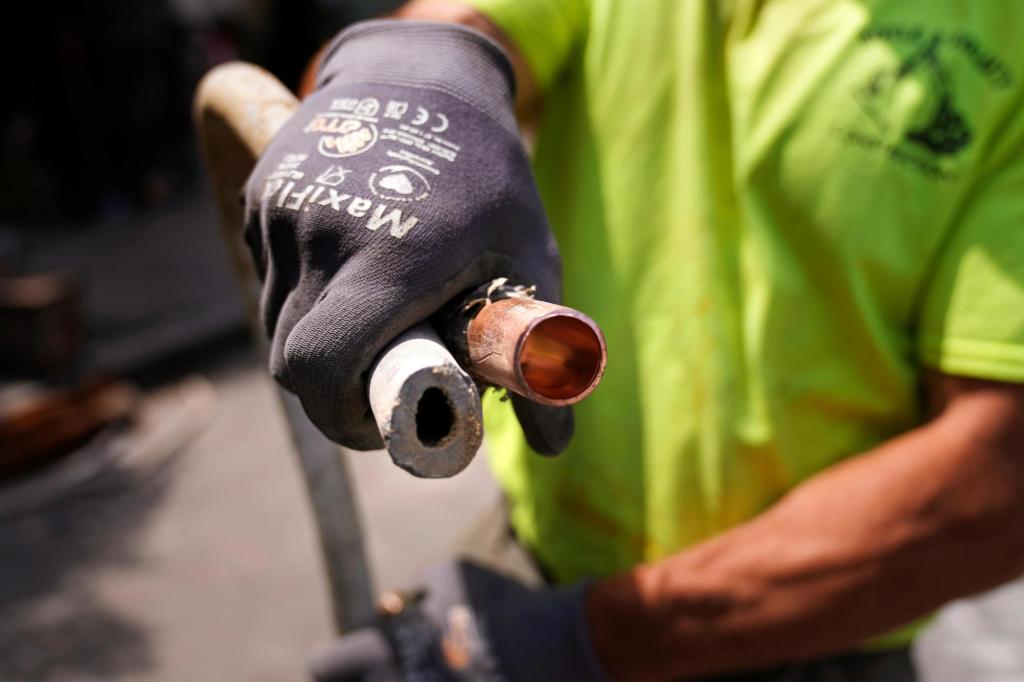
EPA Reaffirms 10-Year Lead Pipe Replacement Plan Amid Industry Opposition
In an ongoing effort to address public health concerns, the Environmental Protection Agency (EPA) has committed to a decade-long initiative aimed at replacing lead pipes in cities and towns across the United States. This stance, originally adopted during the Trump administration, was reinforced by the Biden administration and is now being defended by the EPA in court against a challenge from a utility industry association.
The EPA’s recent court filing in Washington emphasizes the agency’s determination to uphold what is considered the most significant update to lead-in-water standards in 30 years. This comes in contrast to the Trump administration’s broader trend of regulatory rollbacks, including the repeal of strict mercury emissions limits on the same day.
The EPA asserts that replacing lead service lines within a 10-year timeline is not only feasible but necessary to meet the Safe Drinking Water Act’s requirement to prevent adverse health effects. This approach marks a shift from previous strategies that relied on chemical treatments, which were found inadequate in preventing widespread lead contamination.
Protecting Public Health
Lead exposure poses serious health risks, especially to children, as it can impair development and lower IQ scores. In adults, it is linked to increased blood pressure. The Biden administration’s overhaul of lead standards, finalized in 2024, reduced the action level for lead in water from 15 to 10 parts per billion. Utilities are required to notify consumers and act to reduce lead levels if they exceed this threshold. The administration estimated these measures could protect up to 900,000 infants from low birth weight and prevent up to 1,500 premature deaths annually.
Despite these health benefits, the American Water Works Association (AWWA) has contested the rule, arguing that the EPA lacks the authority to mandate the replacement of lead pipes located on private property. The EPA, however, maintains that utilities have sufficient control over the entire lead pipe network to enforce such replacements.
The AWWA also expressed concern over the 10-year deadline, citing labor shortages and other infrastructure challenges. The EPA has responded by stating that most water utilities can meet the timeline, based on their analysis of various utility data.
Revisiting Historical Standards
Lead pipes are predominantly found in older industrial regions, including major cities like Chicago and Detroit. The updated rule alters how lead levels are assessed, potentially increasing the number of communities identified as non-compliant. While the original lead and copper rule has decreased lead levels over the past three decades, it has been criticized for allowing slow responses to high concentrations.
The Trump administration’s broader environmental strategy included efforts to deregulate, yet their approach to drinking water demonstrated some complexities. For instance, the EPA under Trump proposed changes to PFAS chemical regulations in drinking water, balancing strict limits with consideration of implementation timelines.
Estimates of lead pipe prevalence in the U.S. have varied, with the Biden administration citing approximately 9 million pipes, while Trump-era revisions decreased this figure to around 4 million. These changes reflect adjustments in data assumptions, such as excluding communities without submitted data.
As the legal battle continues, the EPA remains steadfast in its commitment to enforcing the 10-year replacement plan, while public health advocates emphasize the critical need to eliminate toxic lead from drinking water systems nationwide.
The Associated Press receives support from the Walton Family Foundation for coverage of water and environmental policy. The AP is solely responsible for all content. For all of AP’s environmental coverage, visit https://apnews.com/hub/climate-and-environment.
Read More Here



![Robert Harmon Celebrates 99th Birthday at UVA’s Homecomings Weekend[embed]https://www.youtube.com/watch?v=c_VPFnE8x-w[/embed]](https://realnewsfast.com/wp-content/uploads/2026/10/Robert-Harmon-Celebrates-99th-Birthday-at-UVAs-Homecomings-Weekendembedhttpswwwyoutubecomwatchvc_VPFnE8x-wembed-300x200.jpg "Robert Harmon Celebrates 99th Birthday at UVA’s Homecomings Weekend[embed]https://www.youtube.com/watch?v=c_VPFnE8x-w[/embed]")
![Environmental Opera “Auksalaq” Opens UVA’s Arts on the Hill Series[embed]https://www.youtube.com/watch?v=PjYuP9wh3Hw[/embed]](https://realnewsfast.com/wp-content/uploads/2026/10/Environmental-Opera-Auksalaq-Opens-UVAs-Arts-on-the-Hill-SeriesembedhttpswwwyoutubecomwatchvPjYuP9wh3Hwembed-300x200.jpg "Environmental Opera “Auksalaq” Opens UVA’s Arts on the Hill Series[embed]https://www.youtube.com/watch?v=PjYuP9wh3Hw[/embed]")
![New documentary explores Elizabeth Holmes’ final days before prison[embed]https://www.youtube.com/watch?v=GGJSRFWALTI[/embed]](https://realnewsfast.com/wp-content/uploads/2026/10/New-documentary-explores-Elizabeth-Holmes-final-days-before-prisonembedhttpswwwyoutubecomwatchvGGJSRFWALTIembed-300x200.jpg "New documentary explores Elizabeth Holmes’ final days before prison[embed]https://www.youtube.com/watch?v=GGJSRFWALTI[/embed]")