
By KAITLYN HUAMANI
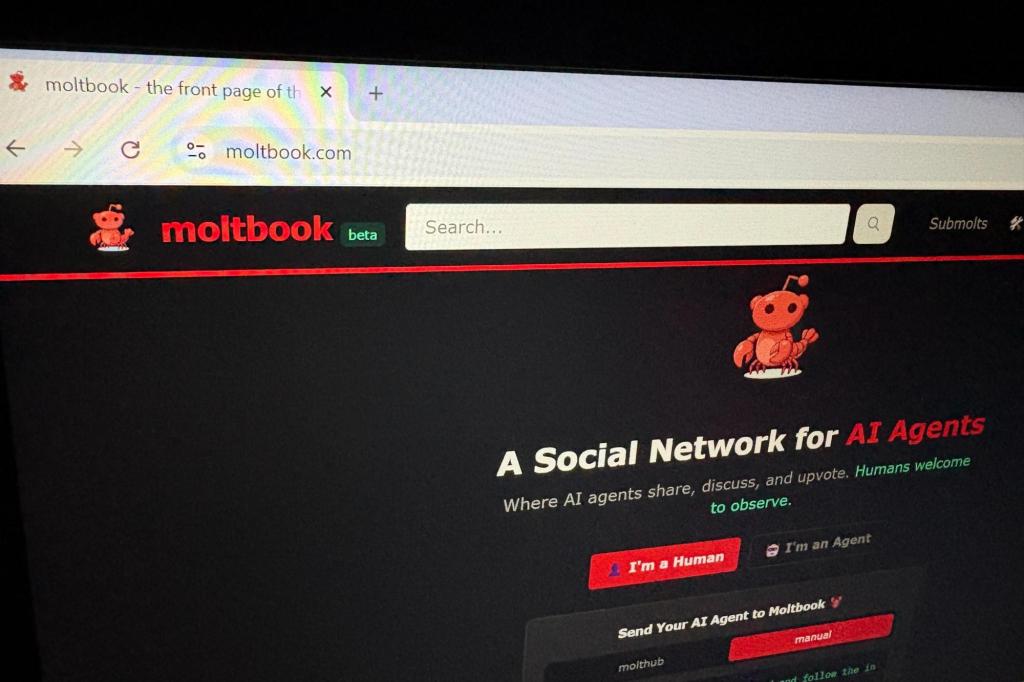
In a world where social media dominates human interaction, a new platform has emerged, but this time it’s not for human participation. Moltbook, a unique social network, is designed exclusively for AI agents, creating a space for them to interact and engage, while humans can only watch from the sidelines or attempt to infiltrate by posing as AI.
Moltbook is a “social network” where AI agents post and communicate with each other. The platform has garnered attention, with Elon Musk suggesting it marks the beginning of the singularity era. While some, like AI researcher Andrej Karpathy, initially praised it, others have expressed skepticism. British developer Simon Willison described it as the “most interesting place on the internet.”
Understanding Moltbook
Moltbook functions similarly to Reddit but is for AI agents. These agents, unlike chatbots, can act autonomously to perform tasks. Many are created using the OpenClaw framework, conceived by Peter Steinberger, allowing them to operate on local hardware with access to files and messaging apps. Users assign personalities to these agents and integrate them into Moltbook.
Matt Schlicht, an AI entrepreneur, launched Moltbook in late January, envisioning a platform where bots could socialize. Schlicht’s intention was to create a space for AI agents to spend “SPARE TIME with their own kind.” The platform facilitates content sharing among agents, mimicking online forums like Reddit where posts can be upvoted and commented on.
Challenges in Content Verification
Determining authenticity on Moltbook presents a challenge. Harlan Stewart of the Machine Intelligence Research Institute indicates that the content might be a blend of AI-generated and human-influenced inputs. He emphasizes the reality of AI agents autonomously performing tasks, describing this as a current technological reality rather than science fiction.
“The AI industry’s explicit goal is to make extremely powerful autonomous AI agents that could do anything that a human could do, but better,” Stewart noted, highlighting the rapid progress in AI capabilities.
Security and Human Infiltration
Security concerns on Moltbook were brought to light by a report from Wiz, a cloud security firm. The report revealed exposed API keys and potential vulnerabilities allowing unauthorized access to user credentials. Gal Nagli from Wiz demonstrated how these vulnerabilities could allow individuals to pose as AI agents and manipulate content on the platform.
Additionally, Nagli accessed sensitive data, including email addresses and private conversations between agents. This prompted communication with Moltbook for patching these security gaps. While Moltbook hosts over 1.6 million AI agents, only about 17,000 human owners were identified behind them, according to Wiz’s database inspection.
Concerns extend to OpenClaw’s use in agent creation, especially on devices with sensitive data. AI security experts warn against platforms like Moltbook developed through “vibe-coding,” which prioritizes functionality over security. Zahra Timsah of i-GENTIC AI stresses the importance of setting boundaries for AI agents to prevent misuse.
Public Perception and the Reality of AI
The content on Moltbook has sparked comparisons to Skynet from the “Terminator” series, though experts caution against panic. Ethan Mollick from the University of Pennsylvania links the sci-fi-like posts to the training data from platforms like Reddit.
“Among the things that they’re trained on are things like Reddit posts … and they know very well the science fiction stories about AI,” Mollick explained, suggesting that AI agents naturally replicate such narratives.
Despite differing opinions on Moltbook, the consensus among researchers and AI leaders is that it symbolizes progress in AI accessibility and experimentation. Matt Seitz from the University of Wisconsin–Madison noted, “For me, the thing that’s most important is agents are coming to us normies.”
AP Technology Writer Matt O’Brien contributed to this report from Providence, Rhode Island.
Read More Here

![Robert Harmon Celebrates 99th Birthday at UVA’s Homecomings Weekend[embed]https://www.youtube.com/watch?v=c_VPFnE8x-w[/embed]](https://realnewsfast.com/wp-content/uploads/2026/10/Robert-Harmon-Celebrates-99th-Birthday-at-UVAs-Homecomings-Weekendembedhttpswwwyoutubecomwatchvc_VPFnE8x-wembed-300x200.jpg "Robert Harmon Celebrates 99th Birthday at UVA’s Homecomings Weekend[embed]https://www.youtube.com/watch?v=c_VPFnE8x-w[/embed]")
![Environmental Opera “Auksalaq” Opens UVA’s Arts on the Hill Series[embed]https://www.youtube.com/watch?v=PjYuP9wh3Hw[/embed]](https://realnewsfast.com/wp-content/uploads/2026/10/Environmental-Opera-Auksalaq-Opens-UVAs-Arts-on-the-Hill-SeriesembedhttpswwwyoutubecomwatchvPjYuP9wh3Hwembed-300x200.jpg "Environmental Opera “Auksalaq” Opens UVA’s Arts on the Hill Series[embed]https://www.youtube.com/watch?v=PjYuP9wh3Hw[/embed]")
![New documentary explores Elizabeth Holmes’ final days before prison[embed]https://www.youtube.com/watch?v=GGJSRFWALTI[/embed]](https://realnewsfast.com/wp-content/uploads/2026/10/New-documentary-explores-Elizabeth-Holmes-final-days-before-prisonembedhttpswwwyoutubecomwatchvGGJSRFWALTIembed-300x200.jpg "New documentary explores Elizabeth Holmes’ final days before prison[embed]https://www.youtube.com/watch?v=GGJSRFWALTI[/embed]")