
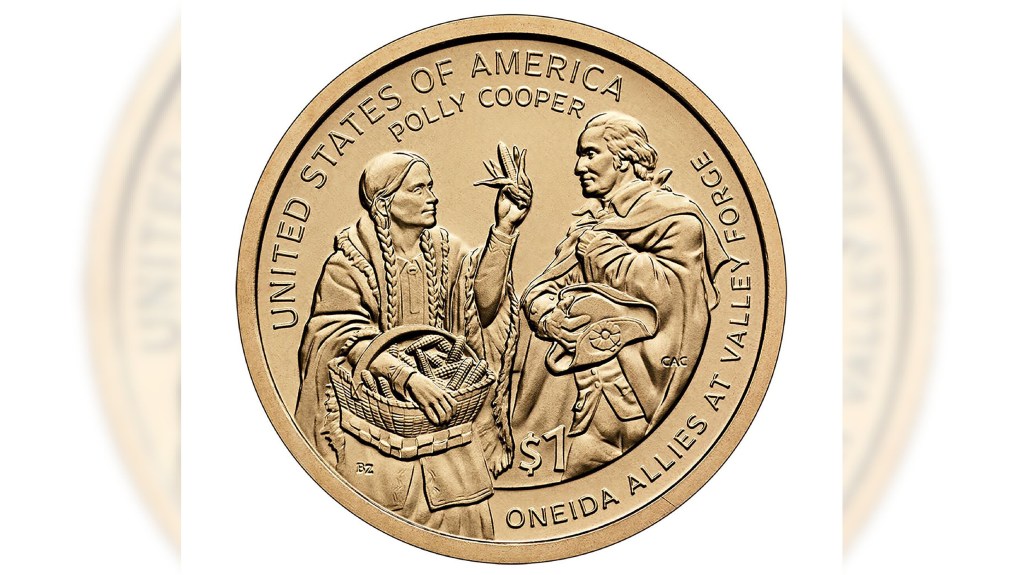
A Tribute to Courage: Polly Cooper Honored on New U.S. $1 Coin
Polly Cooper, an Oneida woman whose bravery and compassion aided George Washington’s Continental Army, is now immortalized on the reverse side of the 2026 Sacagawea $1 coin. This release by the U.S. Mint coincides with the 250th anniversary of the Declaration of Independence, spotlighting Cooper’s significant contributions during the Revolutionary War.
In a 1778 relief expedition, Cooper, alongside 47 Oneida warriors, journeyed from what is now central New York to Valley Forge, Pennsylvania. The Continental Army was in dire need of food and supplies during the harsh winter, and Cooper’s intervention proved invaluable. According to Oneida oral history, she stopped the starving soldiers from consuming raw white corn, which could have made them ill, and taught them to prepare it as hulled corn soup.
Ray Halbritter, a representative from the Oneida Indian Nation of New York, emphasizes that “Polly Cooper symbolizes courage that is not just found on the battlefield but in compassion and willingness to help others, which is just a part of Oneida culture and hospitality.” The coin shows Cooper offering George Washington a basket of corn, a design developed closely with the U.S. Mint.
Established by a 2007 act of Congress, the Native American $1 Coin Program has previously honored figures like Osage ballerina Maria Tallchief and athlete Jim Thorpe, as well as key historical events, such as the 1778 treaty with the Delaware. This program highlights the role of Native Americans in shaping the nation’s history.
Senator Markwayne Mullin, a Cherokee Nation citizen, affirmed that such commemorations highlight contributions to a nation built on freedom and self-determination. However, some planned designs for the anniversary, featuring suffragettes and civil rights icon Ruby Bridges, were discontinued during President Donald Trump’s administration.
The U.S. Department of the Treasury, responsible for the U.S. Mint, did not comment on these changes.
The Oneida Indian Nation of New York, self-described as “America’s first ally,” played a crucial role by siding with the Continental Army, despite the risks. This alliance subjected them to British retaliation, leading to significant losses for the tribe. Dartmouth College professor Colin Calloway notes that the Oneida faced severe consequences post-war, with many being displaced to reservations in Wisconsin and Ontario due to land seizures.
While some narratives might oversimplify relationships between Native Americans and settlers, Cooper’s story, as represented by the coin, underlines the crucial role the Oneida played in the fight for independence. As Halbritter states, “The whole country reaps the benefit of Polly Cooper’s conduct because we won the conflict and the United States was born.”
Read More Here


![Robert Harmon Celebrates 99th Birthday at UVA’s Homecomings Weekend[embed]https://www.youtube.com/watch?v=c_VPFnE8x-w[/embed]](https://realnewsfast.com/wp-content/uploads/2026/10/Robert-Harmon-Celebrates-99th-Birthday-at-UVAs-Homecomings-Weekendembedhttpswwwyoutubecomwatchvc_VPFnE8x-wembed-300x200.jpg "Robert Harmon Celebrates 99th Birthday at UVA’s Homecomings Weekend[embed]https://www.youtube.com/watch?v=c_VPFnE8x-w[/embed]")
![Environmental Opera “Auksalaq” Opens UVA’s Arts on the Hill Series[embed]https://www.youtube.com/watch?v=PjYuP9wh3Hw[/embed]](https://realnewsfast.com/wp-content/uploads/2026/10/Environmental-Opera-Auksalaq-Opens-UVAs-Arts-on-the-Hill-SeriesembedhttpswwwyoutubecomwatchvPjYuP9wh3Hwembed-300x200.jpg "Environmental Opera “Auksalaq” Opens UVA’s Arts on the Hill Series[embed]https://www.youtube.com/watch?v=PjYuP9wh3Hw[/embed]")
![New documentary explores Elizabeth Holmes’ final days before prison[embed]https://www.youtube.com/watch?v=GGJSRFWALTI[/embed]](https://realnewsfast.com/wp-content/uploads/2026/10/New-documentary-explores-Elizabeth-Holmes-final-days-before-prisonembedhttpswwwyoutubecomwatchvGGJSRFWALTIembed-300x200.jpg "New documentary explores Elizabeth Holmes’ final days before prison[embed]https://www.youtube.com/watch?v=GGJSRFWALTI[/embed]")