New College of Florida Undergoes Transformative Changes with a Conservative Shift
By Anemona Hartocollis | New York Times
SARASOTA — Stepping into a New College of Florida classroom, April Flakne embarks on teaching a course centered around “The Odyssey,” now a requisite for all students. While her teaching history spans 25 years at the institution, focusing on topics like totalitarianism and feminism, this new direction marks a significant shift.
The introduction of this course is emblematic of a broader transformation at New College, initiated by Gov. Ron DeSantis’ efforts to steer the college in a conservative direction. The college, once a haven for nonconformist students with fewer than 1,000 enrollees, has been reshaped with a curriculum prioritizing the Western canon.
Richard Corcoran, the college’s new president, described the previous environment as a homogenous community, likening it to “a little Club Med” for ideologically similar individuals.
Under the new leadership, the college has diversified its offerings, adding sports teams and recruiting athletes. Notably, it has attracted faculty known for conservative viewpoints, such as Spencer Klavan, who previously lectured at the college.
In a symbolic gesture, a statue of Charlie Kirk, a noted conservative activist, will soon be unveiled on campus. Moreover, the college has aligned with the Trump administration’s Compact for Academic Excellence in Higher Education, emphasizing adherence to federal policies in exchange for funding benefits.
The changes have prompted a departure of approximately 20 faculty members and 200 students. The evolving campus culture now blends conservative voices with the traditional liberal arts focus, a rarity in higher education.
Corcoran asserts that the objective is not to impose a singular viewpoint but to cultivate a space rich in debate. However, some faculty members, including Flakne, remain cautious about the college’s political trajectory, expressing concerns about their roles in this new landscape.
Tradition Meets Transformation
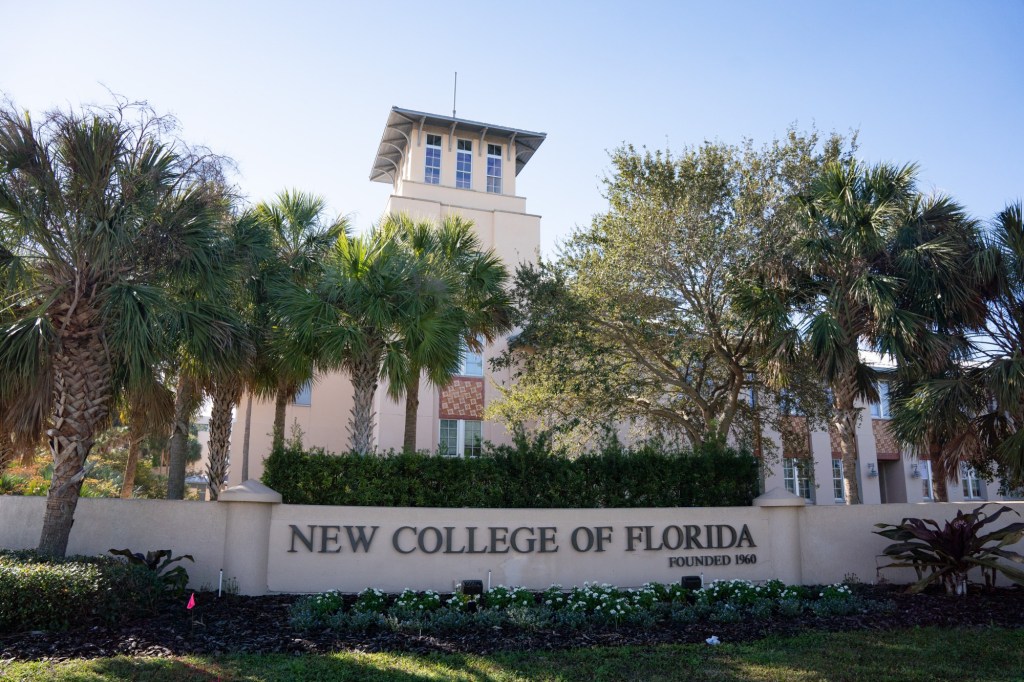
Founded in 1960, New College was envisioned as an innovative institution, free from rigid curricula and traditional metrics. Its picturesque campus, sprawling across a highway with views of Sarasota Bay, has seen better days, with some facilities in need of refurbishment.
Corcoran acknowledges the college’s past struggles with declining enrollment and maintenance issues but argues that the revitalization efforts are essential for its survival. These efforts include recruiting athletes and upgrading infrastructure.
Yet, the college has also made decisions that challenge liberal norms, such as removing all-gender bathrooms and allowing collaboration with U.S. Immigration and Customs Enforcement.
The shift is evident in the college’s commencement ceremonies, which have become more conservative, featuring speakers like Scott Atlas and Alan Dershowitz, known for their controversial stances.
David Mikics, a newly appointed professor, downplays the notion of a deep ideological divide, describing the campus as a mix of varying perspectives.
Despite some faculty reservations about teaching ancient texts like “The Odyssey,” the college maintains that such works offer valuable insights for students.
Flakne, who continues to teach her preferred subjects, embraces the challenge, noting her ability to justify her courses on intellectual grounds.
Enrollment has grown, with more than 900 students currently enrolled. The college aims to maintain an intimate student-to-faculty ratio, a key selling point, alongside competitive tuition rates.
The student body now includes diverse groups, from traditionalists to athletes, reflecting the college’s evolving identity. Despite initial hesitations, some students, like Callie Flemming, have chosen to stay, finding safety and community.
State investments have bolstered the college, although critics point to high per-student spending. Officials argue this investment is necessary for long-term growth and infrastructure improvements.
As the college continues to evolve, its distinctive character is transforming, yet the demand for its unique offerings remains in question.
Some prospective students may be drawn to the college for its athletic opportunities rather than its academic offerings, highlighting a shift in the institution’s appeal.
Liv Fenstermaker, a student-athlete, observes a campus where students focus on their own paths, devoid of clear ideological divisions.
This article originally appeared in The New York Times.
Read More Here