
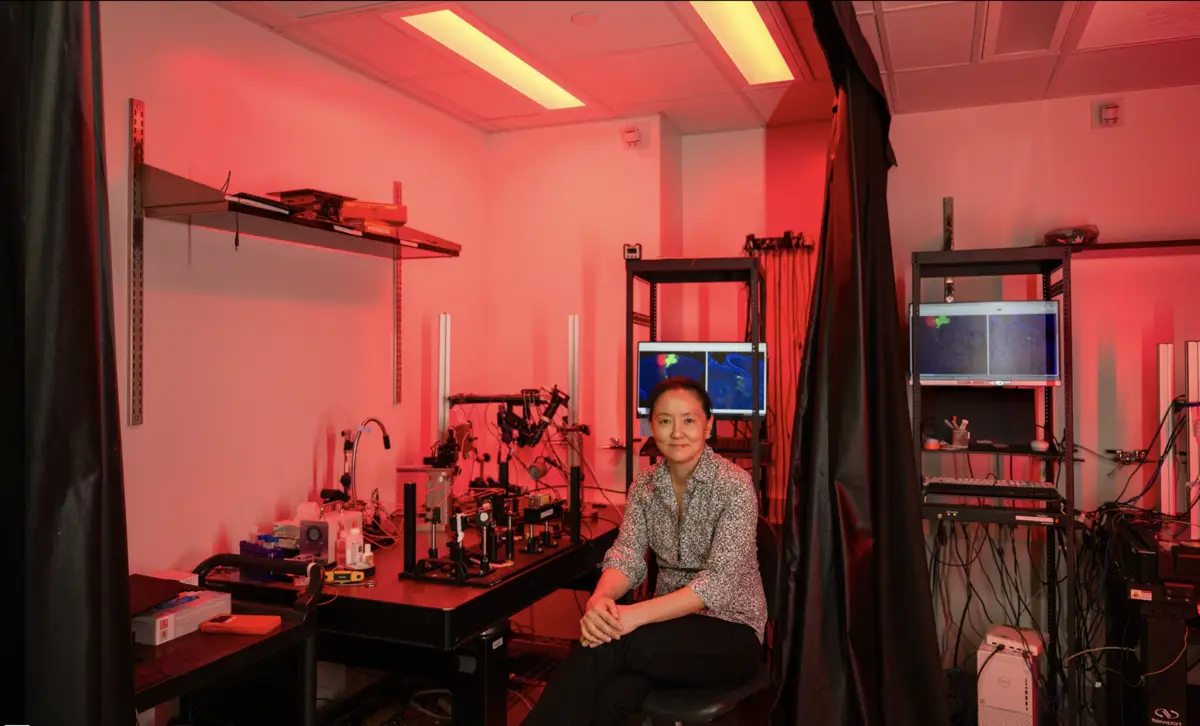
As Halloween approaches, the mind becomes acutely alert to every eerie sound and touch, transforming ordinary creaks and whispers into signs of the supernatural. Safe at home, however, those same sensations often go unnoticed. Recent research sheds light on how our brains interpret these sensory experiences, particularly in spooky contexts.
Research led by Kate Hong from Carnegie Mellon University, detailed in Nature Communications, explores the brain’s role not just in receiving but in interpreting sensory information. This research highlights how our perception of the world, especially during the Halloween season, can be heightened by seemingly insignificant stimuli.
The Importance of Sensory Perception
Understanding the brain’s decision-making process regarding sensory importance is a major focus in neuroscience. “We don’t always see the world as it really is. Our brains are constantly interpreting signals to help us make sense of what’s going on in the environment,” notes Hong, an assistant professor at Carnegie Mellon’s Mellon College of Science.
Hong’s work emphasizes that perception is an active process, with the somatosensory cortex and the superior colliculus playing key roles in determining whether a sensation is perceived. Alice Nam, a former graduate student in Hong’s lab, underscores the importance of viewing the brain as an interconnected system rather than isolated parts.
Decoding “I Felt That” Moments
The research team focused on two aspects of perception: sensitivity to stimuli and decision bias in reporting sensations. Mice were trained to detect whisker movements and indicate whether they felt a stimulus by choosing between two water ports.
Context influenced the mice’s perception threshold. For example, in an eerie setting like a cemetery, the brain might be more alert to faint touches. “Even if the sensation is the same, you might have a higher or lower threshold for saying yes or consciously noting it,” Hong explains.
Exploring Ancient Brain Systems
Using optogenetics, the researchers examined how the somatosensory cortex affects perception. Contrary to expectations, suppressing this region didn’t reduce sensitivity but altered the likelihood of the mice reporting sensations, depending on which side of the brain was affected.
This discovery led to a closer examination of the superior colliculus, a primitive brain structure crucial for rapid responses to sensory changes. “The superior colliculus helps us react quickly to sensory changes happening around us,” Hong states, highlighting its role in coordinating instinctive reactions.
Hong emphasizes the collaboration between the primary sensory cortex and this ancient system in deciding the presence of stimuli.
Future Directions in Perception Research
The study suggests that perception is the result of brain region interactions, with the brain continuously evaluating sensory signals against expectations and context. The next step for Hong’s team is to explore how the brain distinguishes between basic detection and more complex perceptual judgments.
“What can a frog do versus what can a human do?” Hong ponders, noting the evolutionary progression of the neocortex. Understanding these processes may eventually illuminate changes in sensory processing due to brain injuries or conditions like autism.
Read More Here







Comments are closed.