
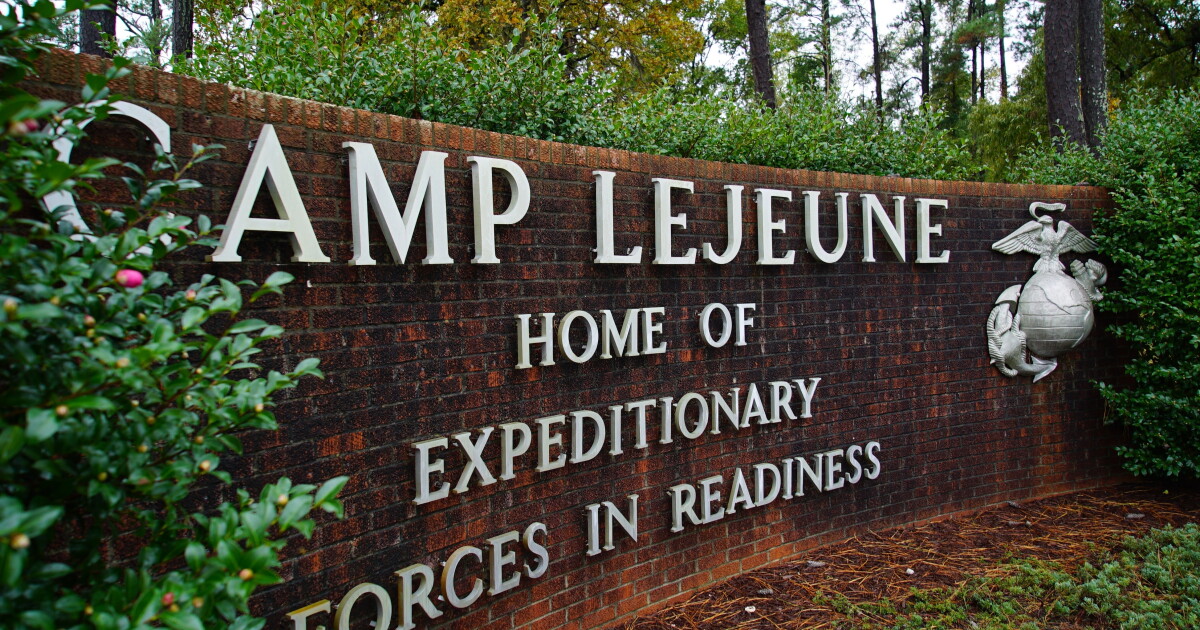
For decades, Marines and their families stationed at Camp Lejeune drank water laced with toxic chemicals — and for decades, they’ve fought the federal government for accountability. Now, a statement by President Donald Trump has raised a troubling new question: should the compensation those veterans are owed depend on how Americans vote in next month’s midterm elections?
At a rally in Greenville, North Carolina this week, Trump suggested exactly that. He told the crowd that if Republicans keep control of Congress, he would direct the Department of Justice to settle remaining “legitimate” Camp Lejeune claims as quickly as possible. But he issued a pointed warning to the other side of that equation.
“If we don’t win, there’s no money. If we do win, you’re getting it. It’s going to be finally over with, that nightmare that’s been going on for so many years,” Trump said.
For veterans advocates and those who have spent years fighting for justice for poisoned military families, those words crossed a line — not just as a matter of policy, but as a matter of democratic principle. Tying federal obligations to election results, critics say, is a form of political coercion that undermines the basic trust Americans place in their government and their democratic institutions.
A Promise Made to Servicemembers — Not to a Party
Jerry Ensminger knows the stakes of this fight better than most. A retired U.S. Marine Corps master sergeant, his daughter Janey died of childhood leukemia after being conceived and born on Camp Lejeune. He has since become one of the most prominent voices advocating for those harmed by the base’s contaminated water.
Ensminger pushed back hard on Trump’s framing, arguing that the military’s relationship with the nation transcends any party’s electoral fortunes. When service members enlist or re-enlist, he noted, they swear an oath to the U.S. Constitution — not to a political party. Conditioning their compensation on midterm results, in his view, fundamentally betrays that covenant.
“Our military members who were poisoned and our families, this has no place for partisan politics. The military has no place for partisan politics,” Ensminger said.
The legislation that opened the door to compensation — the Honoring our Promise to Address Comprehensive Toxics (PACT) Act of 2022 — did not pass on party-line votes. It earned bipartisan support in both chambers of Congress, reflecting a broad national consensus that these families deserved relief regardless of political affiliation.
Embedded within the PACT Act was the Camp Lejeune Justice Act, which for the first time allowed individuals to bring legal claims against the federal government for illnesses linked to the contamination. The U.S. Department of Navy is now offering settlements ranging from $100,000 to $550,000, depending on the claimant’s diagnosis, how long they lived or served on the base, and whether they are still alive.
There have been approximately 408,500 claims filed under the Justice Act. Trump announced this week that more than $1 billion in settlements have been paid — but according to Mike Partain, a fellow victims advocate who co-founded the group The Few, The Proud, The Forgotten with Ensminger, less than 1% of all filed claims have actually been paid out.
Critically, the money to pay these settlements does not require a new congressional vote or a fresh appropriation. Payments come from the U.S. Treasury’s Judgment Fund, a permanent, indefinite fund created by Congress in 1956 specifically to cover settlements and judgments when no other appropriation exists. In other words, a Congress that acted 70 years ago already ensured the money would be available — making Trump’s suggestion that electoral outcomes control the flow of funds difficult to square with how the law actually works.
How This Affects Public Trust in Democracy
Statements like Trump’s can have a real effect on how citizens understand and engage with democratic institutions. When a sitting president implies that federal benefits owed to military families hinge on how elections turn out, it blurs the line between governance and political leverage — and that erosion of trust has consequences that extend well beyond Camp Lejeune.
Voters who believe government institutions operate as political rewards systems — rather than as impartial, law-bound bodies — may become more cynical about whether their participation in elections actually changes anything. For communities of veterans and their families, who have historically held deep faith in public institutions, that cynicism can be especially corrosive.
This was not an isolated incident. During a rally in Gastonia last month, Trump made similar comments about Hurricane Helene recovery funding for North Carolina, suggesting money could be withheld if Republican Senate candidate Michael Whatley lost his race — before pulling back with
“Now, if Michael loses, I’m not sending it, OK. No, I’m only kidding.”
Whether meant seriously or not, the repeated pattern of linking federal resources to electoral outcomes is drawing scrutiny from elected officials and candidates on both sides of the aisle — with notably uneven engagement from Republicans.
Political Reaction — and Silence
Both Greenville and Camp Lejeune fall within North Carolina’s 3rd Congressional District, represented by Republican Congressman Greg Murphy. Murphy did not respond to a request for comment on Trump’s remarks. Murphy has previously introduced legislation aimed at addressing Camp Lejeune cases, including provisions to cap attorney fees, expand which federal courts can hear cases, and allow jury trials rather than bench trials only.
Murphy faces Democratic challenger Raymond Smith — a former state legislator and combat veteran — in next month’s election. Smith offered a stark response to the president’s comments.
“I think it is abhorrent for anyone, much less the president of the United States, to use military families and their suffering as political pawns. This is the lowest that I’ve seen in this administration,” Smith said.
Republican U.S. Senate candidate Michael Whatley, who was present at Tuesday’s Greenville rally, declined to directly address Trump’s remarks. Whatley told CBS 17: “Look, I’m not going to speak for the president. What I will say is that we need to get that settlement done, and we need to support the military families that were affected by the water situation at Camp Lejeune.”
Former Governor Roy Cooper, the Democratic candidate in the U.S. Senate race, was more direct. Cooper told MSNOW:
“They didn’t sign up to serve based on partisanship or the outcome of an election. They signed up to defend our country, and it is shameful to extort votes, especially from service members.”
Spokespeople for Rep. Don Davis and Republican candidate Laurie Buckhout — who was in attendance at the Greenville rally — did not respond to requests for comment.
Decades of Contamination, Thousands Still Waiting
The scale of what happened at Camp Lejeune is difficult to overstate. Contamination of the groundwater that supplied the base’s Hadnot Point drinking water system likely began as early as August 1953 and continued until 1985, according to the U.S. Agency for Toxic Substances and Disease Registry. Samples from Hadnot Point showed levels of trichloroethylene (TCE) hundreds of times above current safety standards. Other toxic chemicals found in the water included benzene, vinyl chloride, and other volatile organic compounds. That contamination has been traced to leaking underground storage tanks and waste disposal areas on the base.
The base’s Tarawa Terrace drinking water system was separately contaminated — primarily with tetrachloroethylene (PCE), a chemical linked to a nearby dry cleaning facility. That system, which supplied on-base family housing, contained levels of the contaminant above current EPA limits for nearly 30 years, beginning in November 1957.
Research has linked these chemicals to multiple serious illnesses, including bladder cancer, kidney cancer, leukemia, Parkinson’s disease, and kidney disease. Government researchers have also found an association between Camp Lejeune exposure and male breast cancer — a condition that affects Mike Partain himself.
Partain was a child living on the base when his family was exposed. He moved to Florida with his parents at age four and has lived there since. In 2007, he was diagnosed with male breast cancer. Despite the documented research connection, male breast cancer is not among the nine conditions the Veterans Administration currently recognizes as service-connected for Lejeune personnel.
Partain emphasizes that while Camp Lejeune is a North Carolina base, the victims of its contamination are spread across the entire country.
“In the past, the issue has been seen and perceived as a North Carolina issue. It’s not. It’s a national issue,” Partain said.
Arguments in the first Camp Lejeune trial cases are scheduled to begin Monday in the U.S. District Court for the Eastern District of North Carolina in Elizabeth City. But for Ensminger, even the settlements currently on the table fall far short of what he believes victims deserve.
“It’s peanuts. They’re pennies on the dollar of what those cases would be worth in court,” Ensminger said.
For the hundreds of thousands of claimants still waiting — many of them ill, many of them grieving — the question is not about partisan politics. It’s about whether the American government will honor the promises it made to the people who served it.








Comments are closed.