
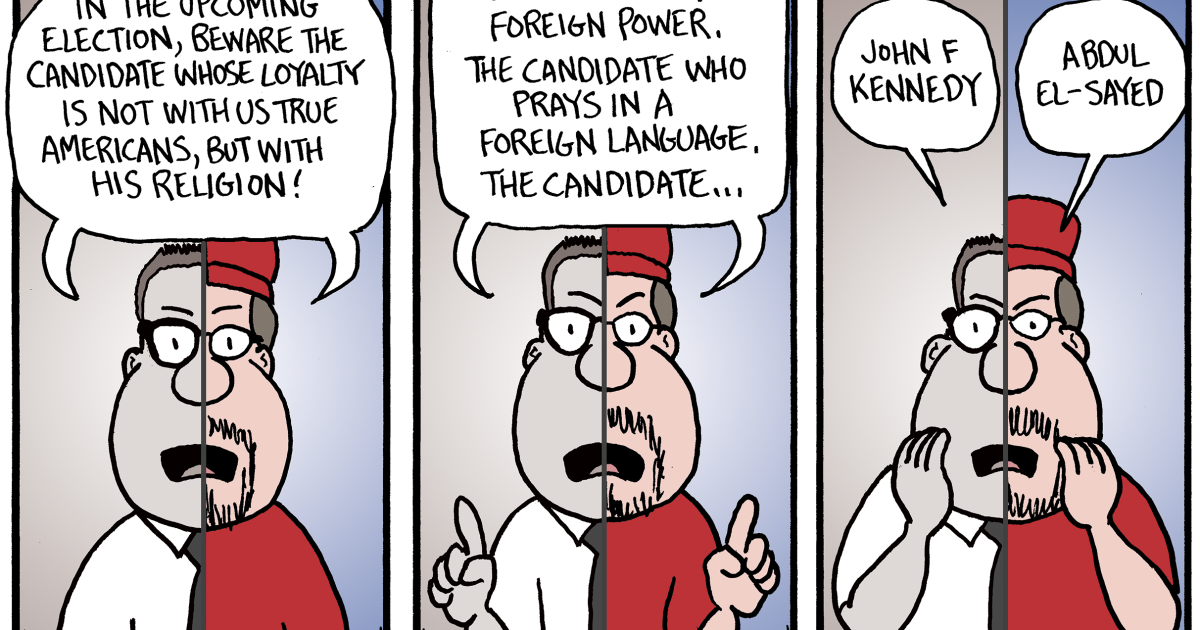
Religious intolerance is not a new problem in America — but what a Michigan political cartoonist is raising right now cuts to the heart of what this country was built to stand against. John Auchter, whose editorial cartoons appear regularly on Michigan Public, is drawing attention to a pattern he says conflicts directly with one of America’s most fundamental founding principles.
Auchter’s latest cartoon addresses religious discrimination in the United States — and he notes the timing aligned unexpectedly with a moment already unfolding online. Before the viral “Tommy” video began circulating on social media, Auchter had already developed the concept for this piece. When he finally watched the video — featuring Abdul El-Sayed, a prominent Michigan Muslim public figure — he felt it confirmed exactly what he had been thinking. As Auchter put it, El-Sayed had “kind of already made my point.”
Still, Auchter decided to move forward with the cartoon for two reasons: the point is an important one that deserves wider reach, and he couldn’t find a stronger idea to replace it.
A Founding Principle Under Pressure
At the center of Auchter’s commentary is a historical reality about American identity. Religious intolerance is not an exclusively American problem — it exists across cultures and throughout history. But the United States was shaped, in part, by people who fled religious persecution elsewhere. That heritage, Auchter argues, is not incidental. It is structural — woven into the intentions behind how this country was designed to function. He describes being a refuge for the religiously persecuted as “literally foundational to how we intended our country operate.”
That context gives the El-Sayed situation added weight. The discrimination he has encountered as a Muslim American is not an isolated incident in American history — it fits a long and painful pattern that has affected many religious communities over the centuries. What Auchter wants readers to take away is not just awareness of that pattern, but a sense of responsibility about whether such behavior gets rewarded or rejected in today’s public and political life.
Why the Cartoon Still Matters
Auchter’s work in this space spans decades of opinion and commentary on Michigan and national issues. His recent cartoons have tackled subjects ranging from outside political spending — including a piece on Elon Musk’s financial involvement in Michigan races — to the dynamics of Senate campaigns under the shadow of President Trump, and even the relentless flood of political text messages that prompted his cartoon “Lose My Number.”
This latest piece steps outside electoral politics and into territory that Auchter sees as more timeless — and more urgent. Describing religious intolerance as a “universal human fault,” he nonetheless draws a sharp distinction: while other nations may not have built their identity around rejecting it, the United States explicitly did. That gap between stated ideals and present-day behavior is where his cartoon lives.
On the question of what comes next, Auchter is direct:
“What is critical now is that we don’t reward it.”
For more Michigan news, see recent coverage including the James campaign’s environmental policy focus in Macomb County, Benson’s statewide bus tour, warnings from the ACLU and AG Nessel on election interference, a new study on oil spills in the Great Lakes, updates on fuel loading at Palisades Nuclear Plant, and a roundup of 28 things to do in Michigan this weekend.






Comments are closed.