
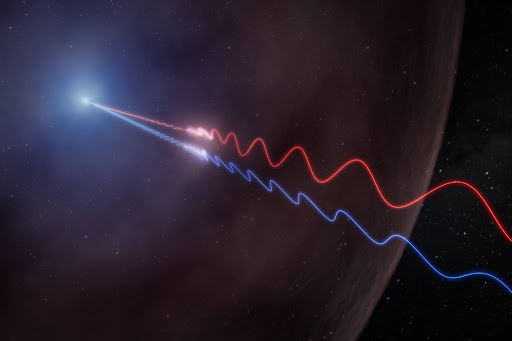
In an exciting advancement for astrophysics, researchers from the University of Arizona and the University of Utah have unveiled groundbreaking insights into the universe’s most explosive phenomena. Their work, utilizing the U.S. National Science Foundation’s Very Large Array radio telescope, marks a significant step forward in understanding gamma-ray bursts, the universe’s most powerful explosions.
The research team achieved a world first by detecting polarized light from a gamma-ray burst afterglow at radio wavelengths. This was coupled with the initial observation of Faraday rotation within a gamma-ray burst, a process where magnetic fields twist the polarization of light as it travels through space. These findings, detailed in a paper submitted to The Astrophysical Journal and accessible on arXiv, offer new perspectives on the extreme physics governing gamma-ray bursts and the life cycles of massive stars.
Understanding Gamma-Ray Bursts
Gamma-ray bursts are colossal cosmic explosions that release energy equivalent to what the sun will emit throughout its entire lifetime, all within mere seconds. These long-duration bursts are believed to occur when massive stars collapse into black holes, emitting narrow jets of particles at near-light speeds. These jets produce a radio “afterglow” that can persist for months, although the exact mechanism behind their launch remains a mystery.
“Exactly how you go from a dying star to launching a beam of plasma traveling at nearly the speed of light is still not a solved problem,” noted Collin Christy, the lead author of the study and a graduate student at the University of Arizona.
Revealing Polarized Radio Waves
The research focused on GRB 260310A, a gamma-ray burst located approximately 2 billion light-years away, a relatively short distance in cosmic terms. Its radio afterglow was one of the brightest observed in a decade, providing a rare opportunity for in-depth analysis.
For the first time, the team detected polarized radio emission from a gamma-ray burst. Polarized light waves oscillate in a consistent direction, unlike the random vibration in non-polarized light, similar to how polarized sunglasses reduce glare by filtering specific light waves.
Decoding Faraday Rotation
Beyond detecting polarized waves, the team made a groundbreaking discovery of Faraday rotation in the gamma-ray burst. This phenomenon acts as a magnetic fingerprint, revealing the strength and structure of the magnetic fields encountered by the radio waves en route to Earth.
Observations indicated a magnetic field along the light’s path that was far stronger than what the Milky Way or intergalactic space could explain, suggesting the presence of a dense, magnetized cloud surrounding the star before it exploded to form GRB 260310A.
Insights into Gamma-Ray Burst Origins
The findings propose that GRB 260310A occurred within an H II region, a dense bubble of ionized hydrogen gas formed by a young massive star’s ultraviolet radiation and stellar winds. This supports the theory that long-duration gamma-ray bursts originate from the deaths of massive stars and sheds light on the environments that give rise to these extreme events.
“Each new observation reveals another layer of the magnetic story these explosions are telling us,” Christy remarked.
Utilizing long, centimeter wavelengths with the NSF telescope enabled the team to achieve this first detection of Faraday rotation in a gamma-ray burst, a feat resulting from years of preparation and technological advancements.
Implications for Future Research
This discovery opens the door for astronomers to monitor the evolution of magnetic fields following gamma-ray bursts. “Future monitoring of GRB afterglows with the NSF VLA and other radio telescopes will allow scientists to watch magnetic field structures evolve in real time,” said Kate Alexander, co-author of the study and assistant professor of astronomy at the University of Arizona’s Steward Observatory. This capability could revolutionize our understanding of how these powerful jets form and the dynamics of magnetic energy in extreme cosmic environments.
Read More Here








Comments are closed.