
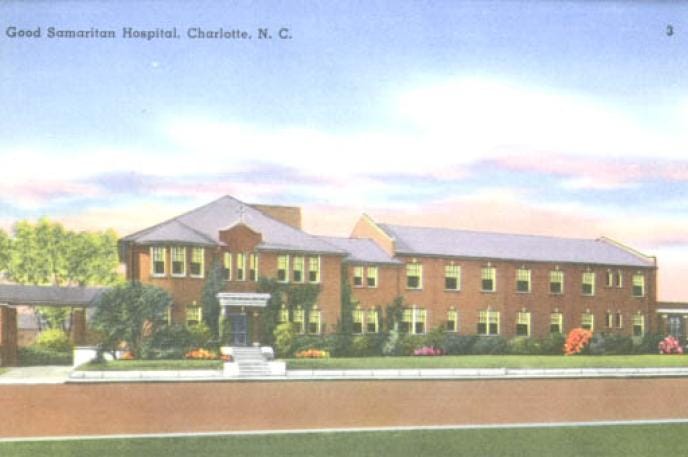
The Good Samaritan Hospital, a pioneering institution in the treatment of African American patients, is set to be honored with a historical marker in North Carolina. This recognition is facilitated by the N.C. Historical Marker Program, which is a part of the state’s Department of Natural and Cultural Resources.
The dedication ceremony for the marker will take place on Thursday, May 28, at 11 a.m., at Ebenezer Baptist Church (2020 W. Sugar Creek Rd., Charlotte, NC 28262). Although the ceremony will be held at the church, the marker itself will be installed later that day. The hospital once stood at the intersection of Mint and Graham streets from 1891 to 1996.
Established in 1891 by Jane Renwick Smedberg Wilkes and her collaborators, Good Samaritan Hospital was the first public hospital dedicated to serving Black patients in North Carolina. Despite its humble beginnings with just 20 beds, it inspired other communities to build similar facilities, including St Agnes Hospital in Raleigh and Lincoln Hospital in Durham, which opened in 1896 and 1901, respectively.
In 1903, the hospital made strides in medical education by opening a nursing school for Black individuals. Over the years, the facility expanded, doubling its capacity in 1925 and later increasing to accommodate 100 patients with a new wing added in 1936.
By 1959, the hospital’s medical school was closed, and in 1961, the facility was sold to the city of Charlotte. Renamed Charlotte Community Hospital, it began serving both Black and white patients, albeit in segregated wards. The landmark 1963 U.S. Supreme Court Case, Simkins Vs. Moses Cone Memorial Hospital, initiated desegregation in some states, followed by the comprehensive Civil Rights Act of 1964 which outlawed segregation in public buildings.
The hospital transitioned into the Magnolia Rest Home in 1982, before the site was eventually chosen for constructing a 75,000-seat stadium for the Carolina Panthers, an NFL team.
For further details on the historical marker, visit the Good Samaritan Hospital blog entry, or contact (919) 814-6625.
The N.C. Highway Historical Marker Program is a joint initiative between the state’s departments of Natural and Cultural Resources and Transportation.
About the North Carolina Department of Natural and Cultural Resources
The N.C. Department of Natural and Cultural Resources (DNCR) is dedicated to managing, promoting, and enhancing North Carolina’s cultural and natural assets. With over 100 sites, the department contributes to education, economic development, public health, accessibility, and community resilience. For more information, visit www.dncr.nc.gov.
Read More Here



Comments are closed.