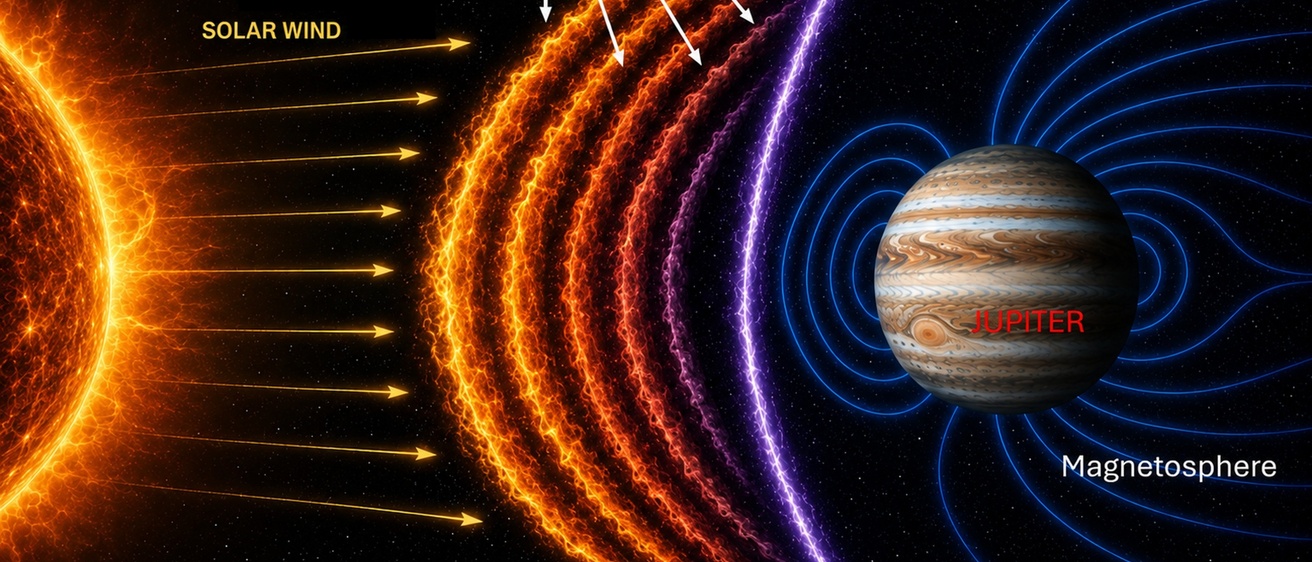
In a groundbreaking study led by a research team from the University of Iowa, the bow shock at Jupiter has been observed in greater detail than ever before. Utilizing data from NASA’s Juno mission, scientists have uncovered significant differences between Jupiter’s bow shock and Earth’s, providing insights that could enhance our understanding of shock physics in more extreme cosmic events such as supernovas.
Why It Matters
Bow shocks are essential phenomena in physics, occurring when supersonic solar winds encounter planetary magnetic fields. While Earth’s bow shock serves as a protective barrier against solar winds, Jupiter’s more intense bow shock reveals how these processes adapt under harsher conditions, akin to the shocks produced by supernovas that impact space and potential life on other planets.
The bow shock is an invisible boundary that stands between the sun and a planet’s magnetic field, acting as the first line of defense against the solar wind—a powerful stream of charged particles from the sun. On Earth, this boundary slows down, heats, and deflects the solar wind, preventing harmful particles from reaching the planet’s atmosphere.
The gaseous nature of Jupiter has intrigued scientists eager to learn how its bow shock operates differently than Earth’s, with implications for other celestial bodies. The study revealed that Jupiter utilizes multiple plasma wave frequencies, described as “harmonics,” to counteract the solar wind’s force. “Jupiter has found its own way to deal with the solar wind, through plasma waves that are stronger and exhibit richer harmonic structures,” explains Jayasri Joseph, a postdoctoral researcher at Iowa and the study’s corresponding author. These harmonics enable the absorption of the solar wind’s impact more effectively than Earth’s use of a single frequency.
Another critical finding of the study is Jupiter’s employment of “shocklets,” a series of regions that engage the solar wind before it encounters the planet’s main bow shock. This contrasts with Earth, which relies solely on its bow shock as the main barrier. “Earth does not need to take these extra steps to handle the solar wind because the impact isn’t as powerful,” says Bill Kurth, a research scientist at Iowa and co-author of the study.
The study’s insights into Jupiter’s bow shock could shed light on how supernova remnants and other astrophysical objects manage the vast energy releases during cataclysmic events. “Because even more powerful shocks occur around astrophysical objects such as supernova remnants, Jupiter’s bow shock offers a nearby natural laboratory for exploring and for understanding how nature converts enormous amounts of flow energy into heat and energetic particles,” Joseph adds.
The findings are based on data collected by the Juno spacecraft, which has been orbiting Jupiter since July 2016. The Juno Waves instrument, designed by Iowa physicists, played a crucial role in capturing the data. Prior to Juno, spacecraft could only detect the presence of the bow shock without measuring the complexity of plasma waves at an outer planet.
The study, titled “Plasma wave observations from Juno spacecraft at the Jovian bow shock,” was published online on July 31 in the journal Nature Communications. Contributing authors from the University of Iowa include Allison Jaynes, Jeremy Faden, and Chris Piker, with additional contributions from researchers at NASA Goddard Space Flight Center, the Southwest Research Institute, the University of Colorado-Boulder, the University of Minnesota, and Johns Hopkins University Applied Physics Laboratory.
The research was funded by NASA.
Read More Here