
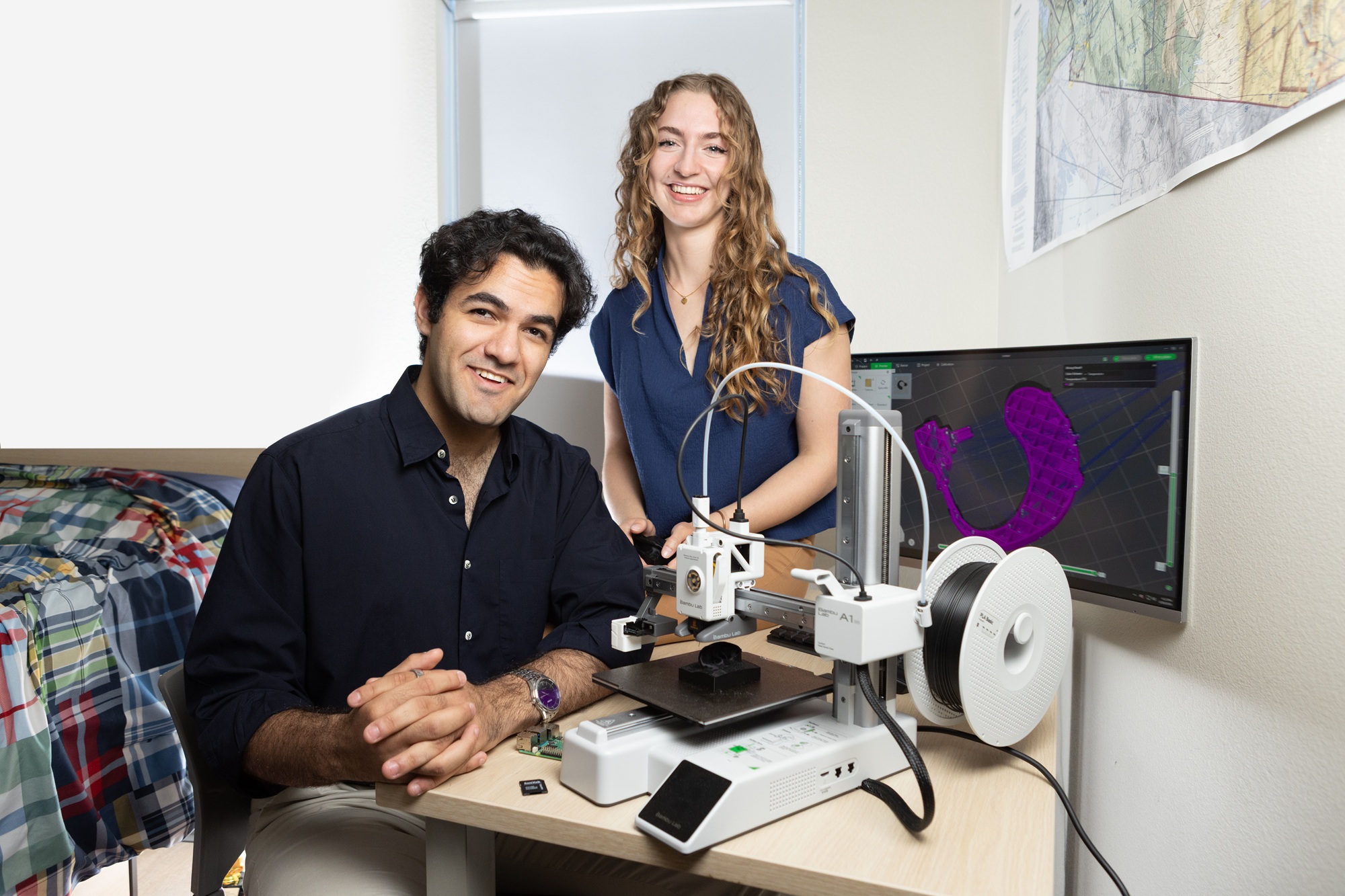
In an unexpected encounter at the University of Arizona, Kian Sadat’s flyer exchange with fellow student Safiya Tarazi marked the inception of Ampira, a promising technology startup. This venture aims to revolutionize access to hearing aids in underserved communities globally, combining cutting-edge technology with a strong commitment to health care.
Safiya Tarazi and Kian Sadat
Chris Richards/University Communications
Both Sadat and Tarazi are students at the W.A. Franke Honors College, bringing together their expertise in electrical and computer engineering and neuroscience and cognitive science, respectively. Their shared interest in health care is at the heart of their innovative approach to creating a hearing aid that facilitates remote calibration via hearing-test data.
“We’re not interested in reusing old hearing aids from the ’80s and ’90s,” Sadat remarked. “Our goal is to create a new, basic product that incorporates aspects of modern technology like automatic calibration and remote fitting.”
Ampira’s journey began in February when the team won the campus qualifier for the prestigious Hult Prize. This competition, backed by EF Education First, encourages students to devise solutions for global challenges aligned with the United Nation’s Sustainable Development Goals. Victors at the global final stand to win $1 million to launch their startup.
Competing against a host of innovative minds from the university, Sadat and Tarazi secured their place in the national competition, set to occur locally at the University of Arizona during the inaugural western regional finals on April 17 and 18.
The Venture Studio at the Franke Honors College is instrumental in nurturing such entrepreneurial endeavors, guided by Scott Hessell, who emphasizes the practical applicability of the Hult Prize. “The 17 sustainability goals provide real, tangible problems that need to be solved,” Hessell noted.
Preparing for Nationals
With the campus qualifier behind them, Ampira’s team is now focused on refining their business model and solidifying a proof of concept. Sadat dedicates his time to designing and 3D printing prototype components in his dorm, a crucial step towards demonstrating the viability of their hearing aid.
Kian Sadat spends much of his free time 3D printing ears and prototypes parts for Ampira’s low-cost hearing aid.
Chris Richards/University Communications
The design process is not without its hurdles, particularly the challenges of connectivity and calibration in technologically limited regions. The team is actively seeking guidance from existing health care programs and professionals, as well as exploring the potential development of a teleaudiology platform.
Looking ahead, Ampira is exploring partnerships with NGOs and nonprofits to distribute their hearing aids in bulk to underserved areas, ensuring ongoing support and accessibility. “Ampira is not just about addressing one individual person’s hearing abilities,” Tarazi emphasized. “It’s about providing access to education and participation in the workforce, improvements in mental health and the sense of community that comes from that.”
Read More Here










Be First to Comment