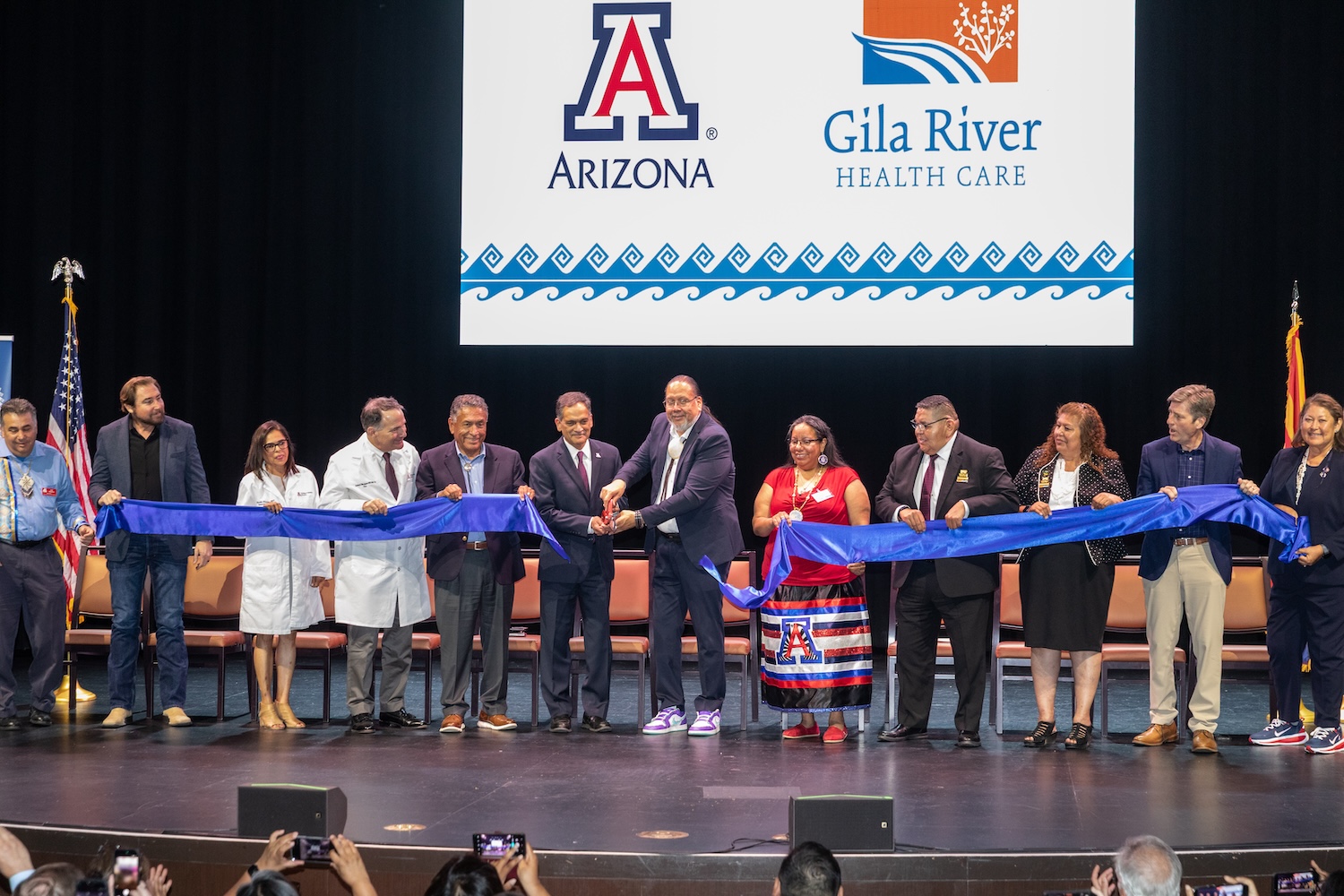
The University of Arizona, in collaboration with Gila River Health Care (GRHC), is embarking on a groundbreaking initiative to enhance medical education and healthcare delivery. Together, they announced the creation of the first-ever MD-granting medical school branch on sovereign Tribal Nation land, a move poised to transform healthcare access in underrepresented regions.
The new branch, located in Sacaton, Arizona, will operate under the University of Arizona College of Medicine – Phoenix. It aims to train future physicians within a Tribal healthcare setting, focusing on improving healthcare accessibility in Tribal, rural, and underserved communities. Starting in July 2027, ten students per year will enroll in a three-year MD program, with their tuition fully funded by GRHC. The program structure includes 18 months of foundational studies in Phoenix, followed by 18 months of clinical education in Sacaton.
University of Arizona President Suresh Garimella delivers remarks to celebrate the announcement of the nation’s first MD-granting medical school branch located on the lands of a sovereign Tribal Nation with the Gila River Indian Community.
Chris Richards/University Communications
“Tribal and rural communities have some of the nation’s greatest unmet primary care needs,” stated University of Arizona President Suresh Garimella. “This partnership to establish the country’s first medical school branch within a Tribal Nation will train physicians through an accelerated three-year MD program, support them with full scholarships to free them of debt burden and provide residency opportunities that anchor them to the places and patients they know. That is how you build a physician workforce that remains in the communities that need them most.”
The U.S. is grappling with a persistent shortage of physicians, particularly in rural and Tribal areas. Arizona ranks 42nd in the nation for primary care access, a situation exacerbated by its rapidly growing population. Data indicates that physicians often practice in locations where they train, making localized medical education crucial for bolstering Arizona’s future healthcare workforce.
Moving away from traditional large academic centers, this Regional Medical Branch immerses students in a community-based healthcare system. Here, they will gain practical experience by treating patients and collaborating with physicians dedicated to serving Native communities. Discussions are underway to develop primary care residency programs at GRHC, furthering the objective of retaining physicians in these communities.
“This is a tremendous opportunity for our community and for the next generation of physicians,” remarked Stephen Roe Lewis, Governor of the Gila River Indian Community. “For too long, many of our young people who dreamed of becoming doctors had to leave home to pursue that goal. This partnership with the University of Arizona changes that. It gives them the opportunity to learn, train and build their careers right here in the Community, where they can make a real difference for the people they serve.”
Gila River Indian Community Gov. Stephen Roe Lewis delivers remarks to celebrate the announcement of the nation’s first MD-granting medical school branch located on the lands of a sovereign Tribal Nation with the Gila River Indian Community.
Chris Richards/University Communications
GRHC has pledged over $25 million until 2034 to establish and maintain the Regional Medical Branch, covering aspects such as faculty positions, student scholarships, and educational resources. Unlike conventional clinical rotations, students will integrate into the healthcare system, working under faculty guidance and gaining insight into the cultural, historical, and social determinants of health. The partnership aims to inspire more Native American students to consider careers in medicine, thereby strengthening Arizona’s physician workforce over time.
“This partnership challenges us to think differently about where and how physicians are educated,” said Dr. Fredric Wondisford, dean of the University of Arizona College of Medicine – Phoenix. “Clinical excellence is shaped not only by scientific knowledge, but by understanding the communities physicians serve. By educating future physicians within a tribally operated healthcare system serving Native communities, we are creating a learning experience that cannot be replicated in a traditional academic medical center.”
Developed through a close collaboration between the University of Arizona and GRHC, this partnership exemplifies shared leadership and a commitment to enhancing health outcomes through innovative medical training. It showcases how public research universities, sovereign Tribal Nations, and community healthcare systems can unite to strengthen the physician workforce while enhancing healthcare access. The initiative also highlights the University of Arizona’s dedication to preparing physicians for service in diverse communities across the state.
“There’s a real challenge for rural health hospitals to recruit trained professionals to come and work in their communities,” said Robert Pablo, chairman of the Gila River Health Care Board of Directors. “We are very fortunate to launch this first-of-its-kind partnership between Gila River Health Care and the University of Arizona, which will establish a starting ground for these young doctors to jumpstart their careers.”
Inspired by a similar partnership announced last year with Onvida Health in Yuma, the Regional Medical Branch further advances the University of Arizona’s commitment to expanding community-based medical education across Arizona. The Association of American Medical Colleges projects the United States could face a shortage of up to 86,000 physicians by 2036, with Tribal and rural communities expected to be among those most affected.
Leaders from the University of Arizona, Gila River Indian Community, and GRHC believe that the evolution of medical education will increasingly depend on partnerships that integrate land-grant universities more deeply with the communities they serve. They are optimistic that this pioneering collaboration will demonstrate how public research universities, sovereign Tribal Nations, and community healthcare systems can synergize to fortify the physician workforce, improve healthcare access, and expand educational opportunities for future generations.
Read More Here